How Digital Data Can Support Dairy Farms in Their Day-to-Day Barn Operations
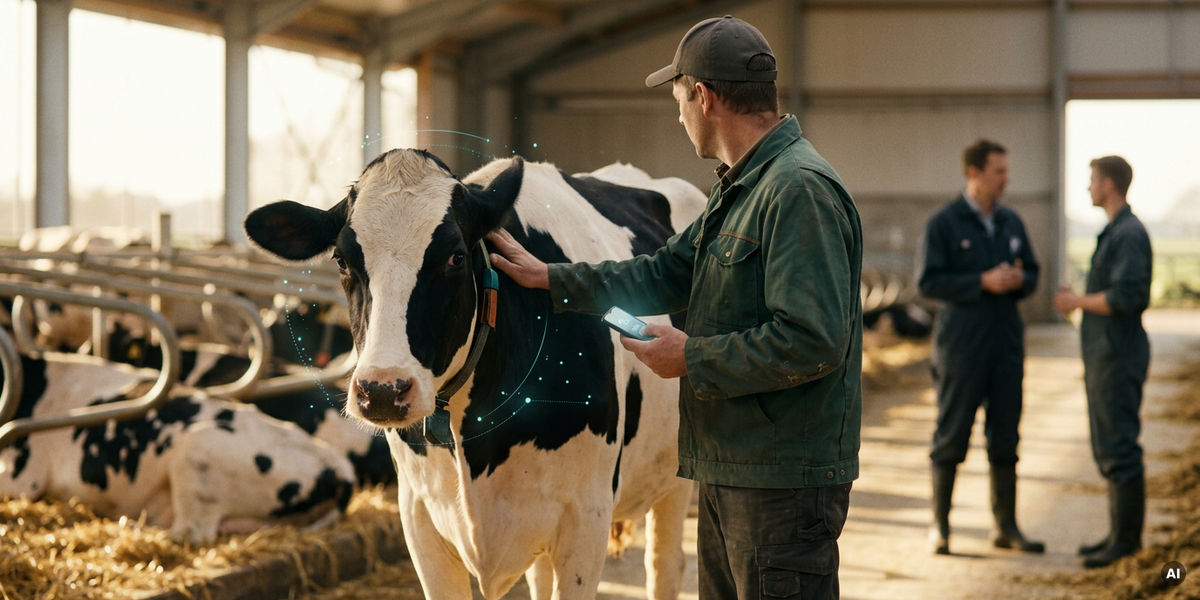
How can dairy farms use digital data in a way that truly helps with day-to-day operations in the barn? The KUHNECT research project is investigating how existing technology can better support animal health, workflows, and decision-making on dairy farms.
Sensors, herd management programs, and digital milking systems provide dairy farms with a wealth of information about their animals every day. They track activity and rumination patterns, for example, and can flag changes. But a notification alone does not answer the most important question: Does immediate action need to be taken, is a check during the next barn round sufficient, or should veterinary advice be sought?
This is precisely where the research project “KUHNECT: Connected Dairy Farms: Establishing Long-Term Digital Management of Animal Health” comes in. The project leader on behalf of Vetmeduni Austria is Melanie Schären-Bannert, professor of herd management with a focus on digital health monitoring in livestock. KUHNECT has been running since the summer of 2026 and is funded by the Federal Ministry of Agriculture and Forestry, Climate and Environmental Protection, Regions, and Water Management.
When Data Makes Decision-Making Easier
Many dairy farms are already using digital applications. Activity sensors, rumination monitors, automatic milking systems, and herd management programs are part of everyday life on many farms. These systems provide valuable insights but can also create additional work. Different programs, numerous notifications, and unclear responsibilities don’t always make it easy to interpret data quickly and effectively. “We want to help farmers use existing technology more efficiently and realize its full potential. To do this, we rely on close collaboration with veterinarians who care for the herds as well as manufacturers, in order to make optimal use of working time and sustainably improve workflows,” says Schären-Bannert.
KUHNECT is therefore investigating the challenges that arise when using digital technology and how these can be practically resolved. One focus is on animal health management. For example, if a cow is ruminating less or moving significantly less than usual, this may indicate a change. However, making the right decision requires more than just a digital alert: What other information is available? Who is checking on the animal? And when is a veterinary assessment necessary?
The project aims to develop clear and practical procedures for this purpose. Digital information should complement daily animal observation and facilitate decision-making—not replace it. “An anomaly on the screen is only helpful if it’s clear to everyone what to do next,” explains the livestock veterinarian. “Our goal is to create processes that fit the farm’s operations and make people’s jobs easier.”
Working with farms to develop practical solutions
To ensure that the developed solutions work in everyday barn operations, the project brings together research, consulting, veterinary medicine, and agricultural practice in close collaboration. Vetmeduni Austria supports the participating farms in assessing the initial situation, conducting farm visits, and evaluating the results. This is supplemented by interviews and an online questionnaire designed to show how digital systems are currently used on the farms and where challenges still exist.
The focus is on the farmers’ experiences. Jointly developed strategies are being tested on a total of nine to 15 participating farms. The farms contribute their day-to-day experiences, test new approaches, and participate in workshops. The HBLFA Raumberg-Gumpenstein is investigating in which situations digital technology can be particularly helpful and where typical problems arise. This will result in concrete use cases and solutions, such as for handling alerts, sharing observations, or organizing tasks on the farm.
The University of Natural Resources and Life Sciences, Vienna (BOKU) is responsible for the social science and structural analysis of technology use. It also contributes to the scientific processing of the project results and disseminates them in various formats, including technical articles, presentations, webinars, and podcasts. The Lower Austrian Chamber of Agriculture is responsible for the practical application and dissemination of the results. This includes, in particular, technical articles, presentations, webinars, the practical handbook, and e-learning courses.
Testing What Works in Everyday Life
In addition to animal health, KUHNECT also focuses on work organization. The project team is investigating who reviews reports, how observations are shared within the team, and which tasks can be better organized with digital support. After all, whether technology reduces the workload depends not only on its function but also on how it is integrated into day-to-day farm operations.
The economic impacts are also a key focus. These include working hours, investment costs, animal health costs, income, and profit. STUDIA coordinates the project and evaluates the developed solutions from a business management perspective. This involves examining the costs incurred and the potential benefits the measures can provide for typical dairy farms.
The findings from KUHNECT will then be presented in practical examples, educational programs, and a guide for dairy farms. The goal: Digital technology should provide support in the barn where it is needed—in monitoring the animals, organizing work, and making informed decisions.
Note: This article has been translated using a computer system without human intervention. LUMITOS offers these automatic translations to present a wider range of current news. Since this article has been translated with automatic translation, it is possible that it contains errors in vocabulary, syntax or grammar. The original article in German can be found here.
Other news from the department science