Roland Berger: Demand for poultry to grow by up to 3.4 percent annually through 2040
Chicken is the only major meat category showing significant growth. Domestic production is not keeping pace with consumption.
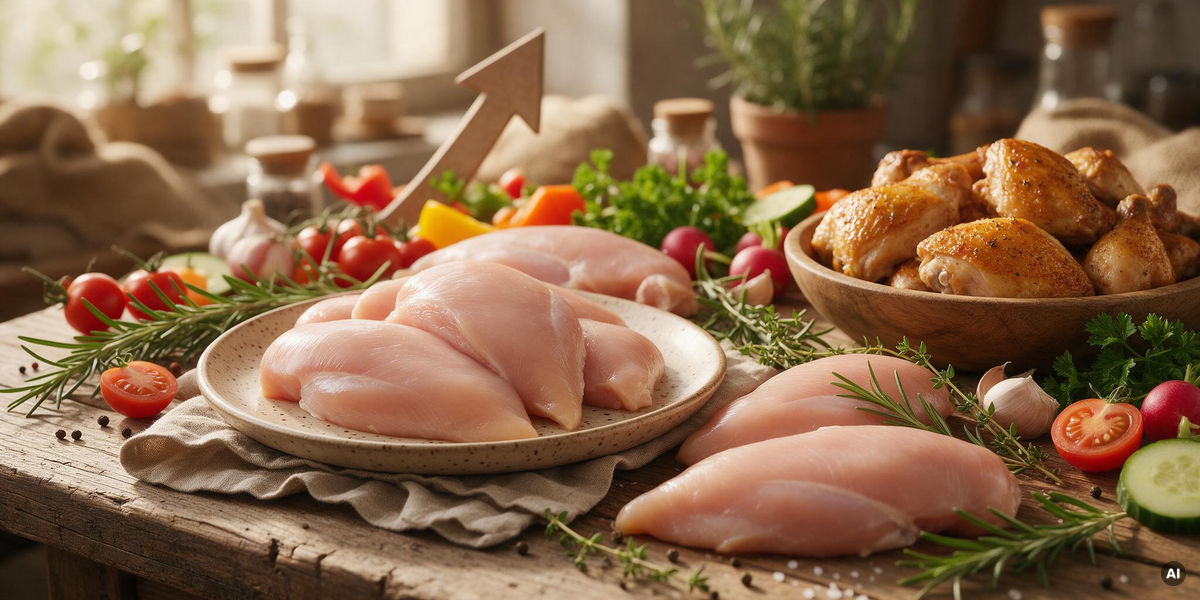
- Roland Berger’s 2026 Poultry Study Shows Continued Growth in Demand, Benefits for Nutrition and the Climate, and an Urgent Need for More Domestic Production
- Roland Berger: Demand for poultry meat in Germany remains strong. Annual growth of up to 3.4 percent is projected through 2040 for chicken meat alone. This represents an increase of over 50 percent in market volume by 2040.
- The trend toward increased poultry consumption will reduce CO2 emissions by approximately 25 percent between 2010 and 2040. Poultry consumption in Germany is growing twice as fast as domestic production. Dependence on imports continues to rise.
- Without targeted countermeasures, the self-sufficiency rate will drop from 91 percent today to between 73 and 77 percent by 2040.
- ZDG Managing Director Schleicher: “The best countermeasure against rising dependence on imports is more domestic production. The industry is prepared to invest at least one billion euros.”
- The study recommends faster approvals, digital streamlining of bureaucracy, visible domestic quality, and fair EU framework conditions
The poultry boom in Germany will continue until at least 2040. That is the key finding of the Roland Berger 2026 Poultry Study. The modeling shows annual demand growth for poultry meat of 2.1 to 2.5 percent through 2040, and for chicken, as much as 3.4 percent. According to Roland Berger, the reasons are as follows: Poultry meat provides plenty of natural and affordable protein. It is easy to prepare in a variety of ways and provides important micronutrients. At the same time, it has a particularly low carbon footprint compared to other types of meat. The boom is therefore not bad news for nutrition and the climate. However, the regulatory environment in Germany is holding back domestic production. The Roland Berger Poultry Study 2026, commissioned by the Central Association of the German Poultry Industry (ZDG), shows: Without additional production capacity, Germany’s self-sufficiency rate for poultry meat could drop from 91 percent today to between 73 and 77 percent by 2040. Meanwhile, the import surplus has already increased eightfold between 2014 and 2025.
The German poultry industry is prepared to take countermeasures and invest one billion euros in modern poultry houses as well as additional slaughtering and processing capacities. Key prerequisites for the industry include reliable regulatory conditions, faster approvals, and fair competitive conditions in Europe.
The study, jointly presented by the ZDG and Roland Berger, analyzes trends in consumption, production, and foreign trade, models supply through 2040, and identifies four specific areas for policy action based on current geopolitical factors and market developments.

Our society’s dietary profile is shifting toward poultry meat: the poultry boom will continue.
Eating habits in Germany are changing: Total meat consumption fell by about 12 percent between 2010 and 2025, to 76 kilograms per capita. Poultry consumption, however, is growing significantly against this trend. Per-capita consumption rose by 28 percent to around 22 kilograms during the same period. For chicken meat, the increase is as high as 62 percent. This makes poultry the only major meat category showing significant growth.
Younger people in particular are driving this trend. According to a recent Civey survey commissioned by the ZDG among young adults, one in two 16- to 29-year-olds eats poultry most frequently. Eighty percent eat poultry at least once a week. Taste, high protein content, and good nutritional value are the main reasons. The Roland Berger poultry study places this finding within a broader dietary trend: 55 percent of Gen Z and Millennials actively ensure they get enough protein.
Poultry meets several requirements of modern nutrition. Chicken and turkey breasts provide about 23 and 24 grams of protein per 100 grams, respectively, with only about one to two grams of fat. According to estimates analyzed in the study, poultry meat already accounts for 13 to 14 percent of Germany’s protein intake. At the same time, poultry has a low carbon footprint and high feed efficiency compared to other meat categories. It is therefore high in protein, versatile, and affordable for broad segments of the population.
“The poultry boom will continue. That’s not bad news for people or for the climate. German poultry ranks among the world’s best in terms of quality. It is high in protein, healthy, easily digestible, tasty, and affordable,” says Wolfgang Schleicher, managing director of the ZDG. “We are ready to invest one billion euros or more in additional capacity and modern poultry houses. This will strengthen jobs and economic activity in rural areas and improve the supply of high-quality, protein-rich food to the public.”
Import volumes are growing significantly faster than domestic production
Between 2010 and 2025, poultry meat consumption in Germany rose by 28 percent, while gross domestic production increased by only 9 percent. Germany consumes more poultry meat than is produced domestically. The traditionally high self-sufficiency rate is declining, while imports are increasing. For chicken meat, the self-sufficiency rate has fallen since 2010 to 93 percent today. Across all poultry types, it stands at 91 percent. The trend continues to decline.
So far, the gap has been closed by growing imports. The import surplus rose from 55,000 metric tons in 2014 to 462,000 metric tons in 2025, more than eightfold. Chicken accounts for 82 percent of poultry meat imports. Imports of high-quality cuts are growing particularly rapidly: About 60 percent of chicken imports are now premium cuts such as breast meat.
International trade remains an indispensable part of the food supply. However, the study warns against becoming overly dependent on just a few supply regions for a strategically important food product. Animal diseases, geopolitical conflicts, export restrictions, and fluctuating feed, energy, and transportation costs can strain supply chains at short notice. Efficient domestic production therefore complements open markets by providing a resilient safety net.
Dr. Nicolas Wüthrich, a partner at Roland Berger, describes the strategic importance of domestic poultry meat production as follows: “Germany should prepare itself strategically. We are observing that supply chains are becoming more vulnerable and that geopolitical upheavals are having a faster impact on agricultural markets and food prices. At the same time, Germany has favorable natural resources and conditions, expertise, and an efficient infrastructure. It therefore makes strategic sense to expand domestic poultry production as a strong pillar of food security and supply. This requires faster approvals for new facilities, digitally streamlined administrative processes, greater visibility of domestic standards, and a level playing field across Europe.”
More Domestic Production
To meet the additional demand more effectively through domestic production, 130 to 180 new broiler houses per year would be required by 2040—across Germany. In addition, extra capacity is needed in slaughtering and processing.
The conditions in Germany are generally favorable: Thanks to its temperate climate, available water and land resources, skilled workforce, short transport distances, and tightly integrated value chains, Germany is an ideal region for poultry meat production. More than half of poultry farmers have already invested in energy efficiency, such as solar power. Another 30 percent or so are planning similar measures.
The Solution: Four Steps Toward Greater Supply Security
The study outlines a pragmatic course of action that can translate the industry’s willingness to invest into actual capacity. The goal is not to isolate the market, but to achieve a balanced combination of international trade and strong, nationwide domestic production.
1. Streamline Permits and Facilitate Renovations
Planning, construction, environmental, and air pollution control procedures should become simpler, more digital, and more reliable. The repurposing of vacant barns should also be possible more quickly. Clear political guidelines can provide municipalities and authorities with additional certainty in decision-making.
2. Reduce bureaucracy through digitalization
A central one-stop agency should implement the principle of “enter once, use multiple times.” This would allow existing data from quality assurance, animal welfare programs, and regulatory reporting systems to be securely linked, thereby avoiding duplicate reporting.
3. Highlighting domestic quality and origin
High German standards for sustainability, animal welfare, biosecurity, and environmental and consumer protection should be recognizable in the marketplace. Transparent origin labeling—including in the restaurant industry and institutional food service—enables informed purchasing decisions and rewards domestic quality.
4. Creating Fair European Competitive Conditions
Animal welfare, environmental, labor, and inspection standards should be interpreted and enforced in a comparable manner across the EU single market. Imports from third countries also require equivalent requirements or effective compensatory mechanisms. This allows for the integration of high standards, security of supply, and economic viability.
“The federal government can kill two birds with one stone: it can improve Germany’s resilience and food security while simultaneously promoting a healthy, protein-rich, and comparatively climate-efficient diet,” states Wolfgang Schleicher. “The industry is ready. Now it’s a matter of setting the right course together.”
About the Study
The Roland Berger Poultry Study 2026 was commissioned by the Central Association of the German Poultry Industry (ZDG). Among other sources, it analyzes data from the Federal Ministry of Agriculture, Food, and Home Affairs, the Federal Statistical Office, and other scientific and market-related sources. The scenarios through 2040 are based on projections of trends from the past 15 and 30 years, respectively. They are not precise predictions but rather illustrate the range of possible developments under current conditions. Please send us an email at presse@zdg-online.de if you would like to receive the full study.
About the ZDG
As an umbrella and leading organization, the Central Association of the German Poultry Industry (ZDG) represents the interests of the German poultry industry at the federal and EU levels. Its members span the value chain from production through slaughter and processing to the egg industry.
About Roland Berger
Roland Berger is the only leading strategy consulting firm with European roots. The company combines deep industry and sector expertise with extensive experience in key management roles and transformation projects. Founded in 1967 and headquartered in Munich, Roland Berger supports companies worldwide in designing and implementing complex transformations—from strategic realignment and performance improvement to the development and application of data-driven, AI-powered solutions. Roland Berger has set company-wide net-zero emissions targets for 2040, which have been validated by the Science Based Targets Initiative. The company reports on its progress annually in its ESG report. In 2025, the company generated revenue of over one billion euros.
Note: This article has been translated using a computer system without human intervention. LUMITOS offers these automatic translations to present a wider range of current news. Since this article has been translated with automatic translation, it is possible that it contains errors in vocabulary, syntax or grammar. The original article in German can be found here.
Other news from the department business & finance