Powered by food (waste): Virginia Tech researchers discover potential method to convert food waste into batteries
“This research could be a piece of the puzzle in solving the sustainable energy problems for rechargeable batteries,” said Haibo Huang, an associate professor in the Department of food science and Technology.
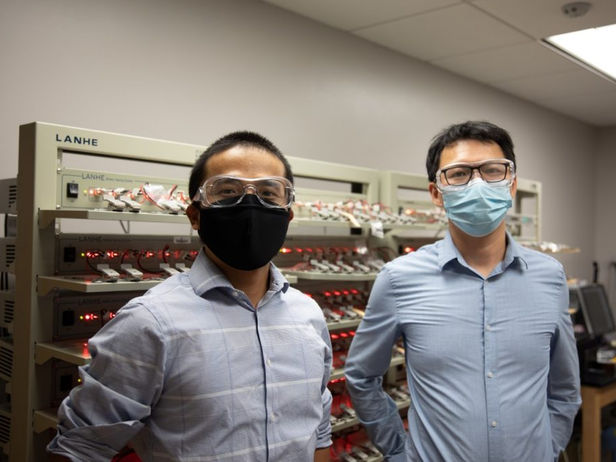
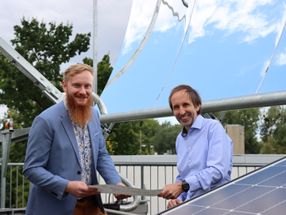
Feng Lin and Haibo Huang
Max Esterhuizen for Virginia Tech
What do apple cores, spent grain, and walnut shells have in common? They could one day be used to power a data center.
As the world works toward economically and environmentally friendly ways to power these devices, two Virginia Tech researchers investigate how food waste and its associated biomass can be converted into rechargeable batteries.
“This research could be a piece of the puzzle in solving the sustainable energy problems for rechargeable batteries,” said project co-lead Haibo Huang, an associate professor in the Department of Food Science and Technology in the College of Agriculture and Life Sciences. “Demand for these reusable batteries has skyrocketed and we need to find a way to reduce the environmental impacts of batteries.”
The research is funded through a three-year, $450,000 grant from the United States Department of Agriculture Foundational and Applied Science Program with the priority area of bioprocessing and bioengineering. The grant runs through April 2023.
Based on the preliminary results, the researchers found that the fiber component in food waste was the key to develop an advanced carbon materials that could be used as a battery anode, the negative terminal on a battery.
“Our unique approach of using agricultural waste-derived carbon materials to host alkali metal, such as lithium and sodium, will bring major advances to agricultural waste processing and battery technology,” said Feng Lin, an associate professor in the Department of Chemistry and the project’s principal investigator.
This research will advance the utilization of agricultural wastes generated in agricultural systems for value-added carbon production and ultimately energy storage devices.
The team uses highly tunable, abundant, and cost-effective raw materials to address the need in the energy storage field. Using waste-derived carbon materials as the host for metal anodes could significantly reduce alkali metal usage per battery.
Powering up
Not long ago, Huang and Lin played a game of pickup basketball when the idea struck them.
“We thought why not convert food waste into battery materials because of how much food waste there is across the globe,” Huang said. “Most of these wastes are put into garbage and then sent to landfills. We just need to solve the battery side.”
There’s a heavy reliance on graphite – a limited resource – to make battery anodes. The researchers first tested different types of food waste material to see if any could be used to make batteries.
“As a food processing engineer, I can modify the composition of the food,” Huang said. “I could take the proteins and lipids out, along with some of the minerals, to see how it impacts battery performance.”
The researchers found that when certain compounds were removed from the equation, the essential compounds of cellulose, hemicelluloses, and lignin after thermal treatment could sufficiently work for a battery.
An apple a day keeps the charger away
In the upcoming final two years of the project, the researchers will further test the food-waste-turned-carbon, with feedback from the lab to optimize the battery science. The final step will be an economic analysis on the feasibility of implementing this technology to ensure usage when pushed to the market.
The anticipated initial uses of the technology are for affordable energy storage solutions for data centers or other large energy storage facilities where the size of the battery is not a factor. As they progress, the researchers hope to be able to turn food waste into a carbon that lacks the impurities experienced today.
“We have the opportunity to solve two urgent issues in two different industries,” Huang said. “A lot of energy is already put into the production and transportation of food in the food supply chain. We must recover the value from food waste. This is the perfect opportunity, as battery production looks for different materials than the traditional carbon.”
While they may not solve the problem of having to replace batteries in the TV remote just yet, the team is helping the technology get closer to having food waste power the devices people use daily.
Just don't underestimate the power of apple waste, spent grain, and walnut shells.
Other news from the department science