Pesticides in Food: Beyond the Surface
Advertisement


pesticides and herbicides are critical to ensuring food security worldwide, but these substances can present a safety risk to people who unwittingly ingest them. Protecting human health, therefore, demands sensitive analytical methods to identify even trace levels of potentially harmful substances. Now, researchers reporting in ACS’ Nano Letters have developed a high-tech imaging method to detect pesticide contamination at low levels, and its application on fruits reveals that current food safety practices may be insufficient.
The analytical method called surface-enhanced Raman spectroscopy (SERS) is gaining popularity as a nondestructive method for detecting chemicals from modern farming on produce. With SERS, metal nanoparticles or nanosheets are used to amplify the signals created by molecules when they are exposed to a Raman laser beam. The patterns created by the metal-enhanced scattered light serve as molecular signatures and can be used to identify small amounts of specific compounds. Looking to improve SERS sensitivity for pesticide detection, Dongdong Ye, Ke Zheng, Shaobo Han and colleagues designed a metal-coated membrane they could lay atop farm-grown produce. They also wanted to develop the material to be versatile enough to accommodate an array of other applications.
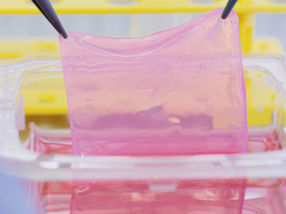
The researchers started with a cellulose hydrogel film, which they stretched to form aligned nanoscale wrinkles along its surface. They then immersed the film in a solution of silver nitrate to coat the grooves with SERS-enhancing silver nanoparticles. The resulting membrane was highly flexible and practically transparent in visible light, essential features for SERS signal detection.
In tests of the silver-embedded membrane for food safety applications, the researchers sprayed the pesticides thiram and carbendazim, alone or together, onto apples, air-dried the fruits and then washed them to mimic everyday practices. When they laid their membrane over the apples, SERS detected pesticides on the apples, even though the chemicals were present at low concentrations. The team was also able to clearly resolve scattered-light signatures for each pesticide on apples sprayed with both thiram and carbendazim, as well as detect pesticide contamination through the fruit’s peel and into the outermost layer of pulp.
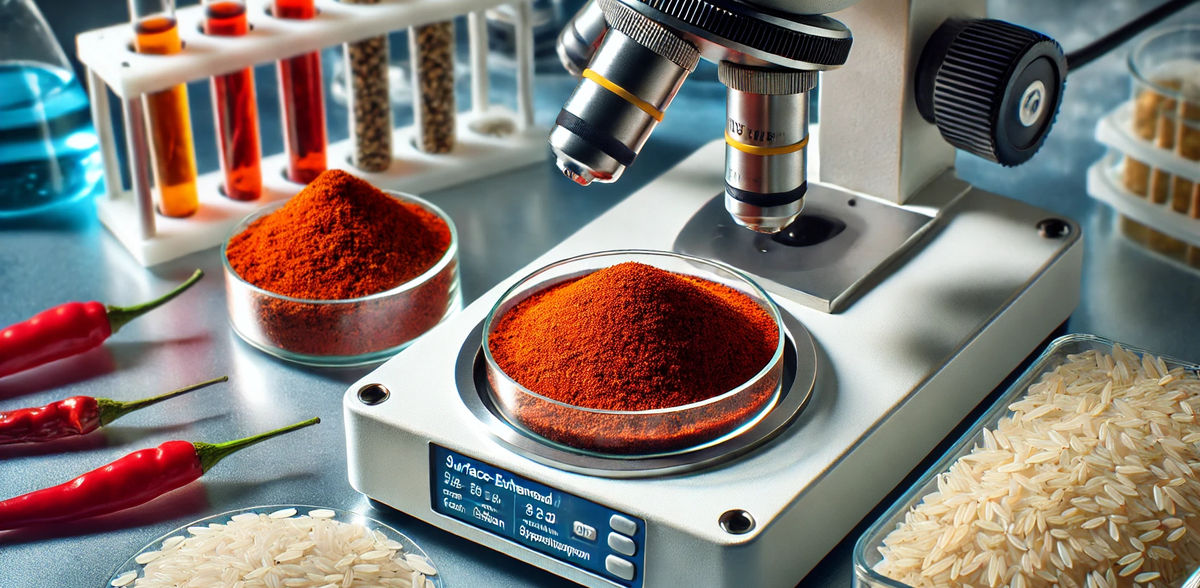
These results suggest that washing alone could be insufficient to prevent pesticide ingestion and that peeling would be required to remove potential contamination in the skin and outer pulp, the researchers say. Beyond apples, they also used the SERS membrane system to detect pesticides on cucumbers, shrimp, chili powder and rice.
Other news from the department science



















Most read news






More news from our other portals





















See the theme worlds for related content
Topic world Food safety
Food safety is at the heart of the food and beverage industry. It ensures that the food we eat every day is not only nutritious, but also free of harmful contaminants. From field to plate, the industry monitors and regulates every step of the process with strict quality controls, advanced testing methods and continuous research.

Topic world Food safety
Food safety is at the heart of the food and beverage industry. It ensures that the food we eat every day is not only nutritious, but also free of harmful contaminants. From field to plate, the industry monitors and regulates every step of the process with strict quality controls, advanced testing methods and continuous research.
Topic World Spectroscopy
Investigation with spectroscopy gives us unique insights into the composition and structure of materials. From UV-Vis spectroscopy to infrared and Raman spectroscopy to fluorescence and atomic absorption spectroscopy, spectroscopy offers us a wide range of analytical techniques to precisely characterize substances. Immerse yourself in the fascinating world of spectroscopy!

Topic World Spectroscopy
Investigation with spectroscopy gives us unique insights into the composition and structure of materials. From UV-Vis spectroscopy to infrared and Raman spectroscopy to fluorescence and atomic absorption spectroscopy, spectroscopy offers us a wide range of analytical techniques to precisely characterize substances. Immerse yourself in the fascinating world of spectroscopy!