Secrets of slicing: What happens when a sausage is cut?
Researchers investigate the processes involved in cutting soft tissue
Advertisement


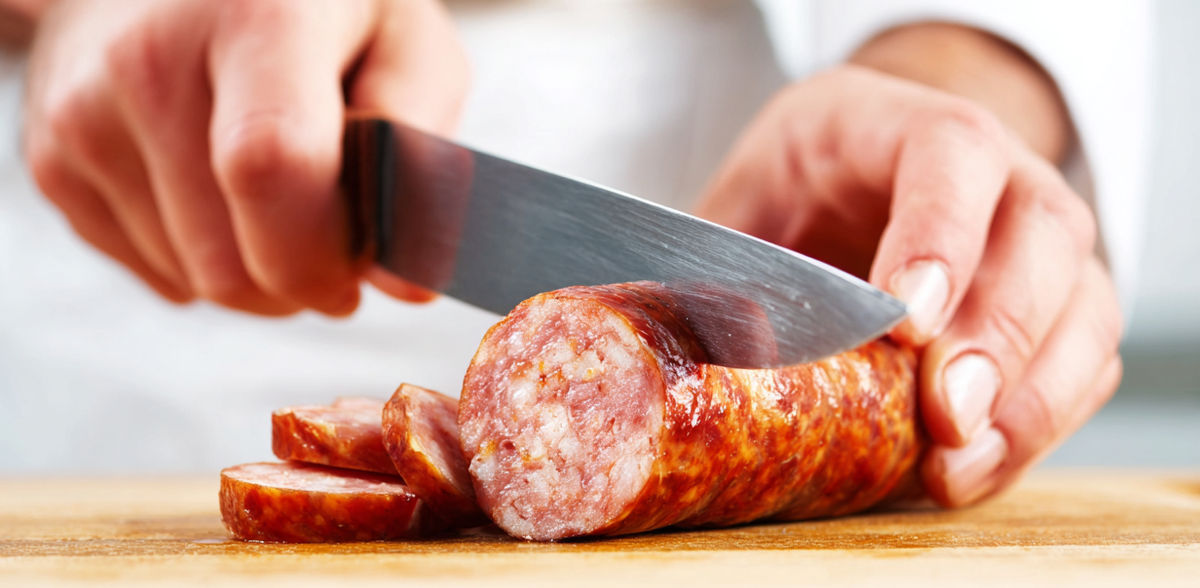
Anyone who bites into a bratwurst or cuts off a piece at a Christmas market or fair has usually practiced this technique since childhood. Hardly anyone thinks about this everyday process, the main thing is that it tastes good. Yet the cutting of such soft materials still holds a few secrets, and modern science knows little about the details of cutting sausages, gelatine or synthetically produced elastomers that resemble rubber. Miguel Angel Moreno-Mateos from the Chair of Engineering Mechanics at Friedrich-Alexander-Universität Erlangen-Nürnberg (FAU) is currently changing this for good reason: food manufacturers and surgeons would like to know more in order to improve their technology for the benefit of consumers and patients. The results have now been published in Nature Computational Materials.
Bread knife or roasting knife, or would you prefer the cake knife?
After all, it's not just amateur confectioners who are wondering whether they should cut their homemade cream cake with a bread knife or perhaps a roasting knife. As both options work rather poorly, experience shows that the cake knife offered specifically for this purpose is probably the best choice. Miguel Ángel Moreno-Mateos investigates why this is the case. Not on a cake, however, but on gelatine, which contains plenty of water. This makes the material, which is made from animal skins and bones, very soft on the one hand, but also very resistant on the other. Another object of investigation is synthetically produced elastomers, which can be easily deformed like rubber. And Nuremberg sausages, which in simple terms consist of tiny pieces of meat and fat.
"All three materials are soft, but behave differently when cut," explains the FAU engineer. The same applies to various substances in nature. This is why ants that cut up leaves have completely different chewing tools than a human's teeth that cut up potatoes or strawberries. Miguel Ángel Moreno-Mateos and chair holder Paul Steinmann first observed what happens when soft materials are cut in experiments and then simulated this using computer models.
When the blade presses on the gelatine, it first deforms the structure very strongly before finally cutting through the material abruptly because the internal resistance forces suddenly collapse. A knife that presses on an elastomer and continues to cut it very evenly behaves quite differently. With the Nuremberg sausage, on the other hand, the soft fat lubricates the contact between the blade and the pieces of meat, allowing it to cut evenly without breaking or changing quickly. It is probably for this very reason that sausages feel much softer than meat when chewed: The teeth or the blade do not open a relatively resistant surface, but rather glide as if through a viscous substance that offers little resistance.
Simulations can make operations safer
The computer models then show what happens in detail: How do frictional forces influence the cutting of such soft materials? How long does the blade deform the material and when exactly does it start to cut it open? These simulations then not only show food manufacturers how they can improve their processes and which blades they should use and how precisely to achieve the best result.
They can also make surgeons' work easier and operations considerably safer. After all, doctors use their scalpels to cut through very different layers, from the skin to connective tissue, until they reach their target. The incision should be as gentle as possible and cause few injuries that heal relatively quickly. Nevertheless, it easily damages veins and the blood that escapes interrupts the contact between the scalpel and the tissue. This is why surgeons warm their blades a little, which stops the bleeding more quickly and allows them to continue operating faster. In addition, a scalpel has tiny holes that reduce the surface area and reduce the risk of the blade getting stuck.
As sophisticated as these techniques are, they can be further improved with experiments on soft materials and computer simulations. This reduces the risks of surgery and improves healing. So it is not only the surgeons, but above all the patients who benefit from these and future experiments by Miguel Ángel Moreno-Mateos. And who, when they visit Christmas markets and folk festivals, understand much better what exactly happens when they bite into a bratwurst.
Note: This article has been translated using a computer system without human intervention. LUMITOS offers these automatic translations to present a wider range of current news. Since this article has been translated with automatic translation, it is possible that it contains errors in vocabulary, syntax or grammar. The original article in German can be found here.
Original publication


Other news from the department science