Plastic in chewing gum? Forest Gum has its microplastic-free status independently certified
TÜV SÜD and an accredited laboratory tested the chewing compound in accordance with the flustix PLASTIKFREI program
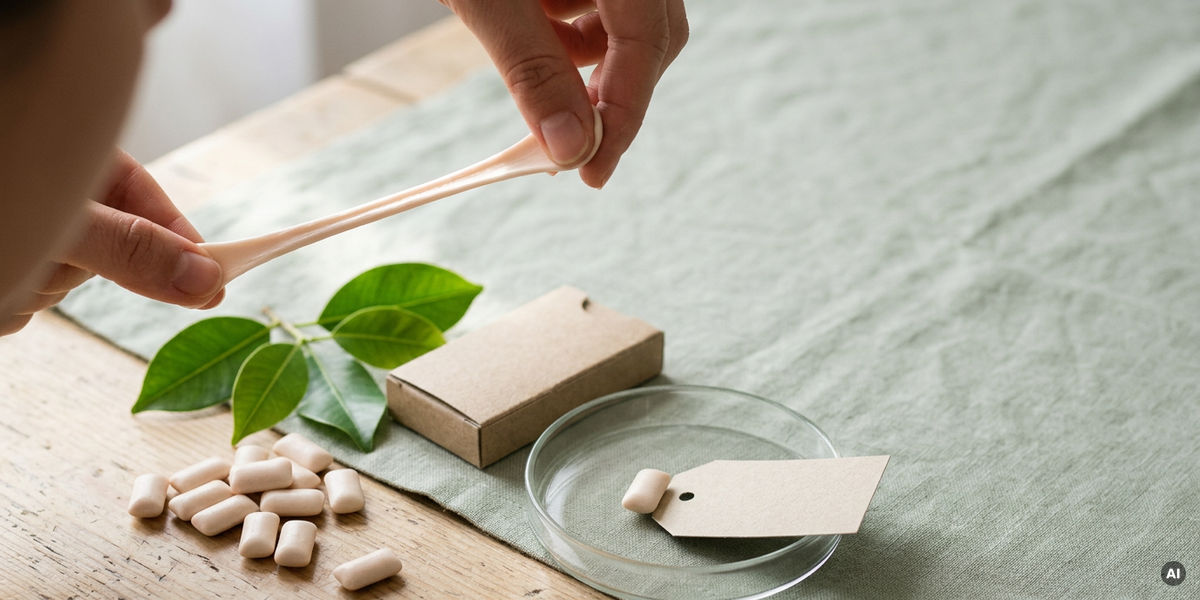
Forest Gum Becomes the World’s First chewing gum Brand to Scientifically Prove It Is Free of Microplastics/Stricter EU Regulations Were an Additional Motivation for the Move
People who chew gum rarely think about plastic. Yet the base of many conventional chewing gums contains plastics. The Cologne-based company Forest Gum, however, relies instead on a plant-based gum base made from natural rubber. It has now had the contents of its chewing gum independently tested and certified as free of microplastics: Forest Gum is the world’s first chewing gum brand to receive certification under the flustix program “PLASTIC-FREE – Product Contents Free of Microplastics.”
What’s inside the gum can neither be seen nor tasted. That’s why Forest Gum’s certification goes beyond its own claims: An independent laboratory analysis and an external certification body have verified that the product’s contents meet the specified requirements of the flustix program. The certification is publicly available.

Plant-Based Base Instead of Plastic
Forest Gum was founded in 2019 by Thomas Krämer. His idea: to produce chewing gum whose base is not made from synthetic plastics. To do this, the company uses natural rubber from 100% FSC-certified sources. The new certification applies to the contents of the gum, not its packaging, which for Forest Gum products consists of 100% cardboard.
“Many people don’t even realize that chewing gum is often made from plastic. That’s exactly what we at Forest Gum wanted to change from the very beginning. And while the new EmpCo regulations require more and stricter evidence to be provided, this inexplicably does not apply to microplastics. For us, this certification is therefore an important milestone: our claim is now an independently verified product characteristic. We hope that such verification—especially regarding microplastics—will become standard practice for food products as well in the future. After all, consumers shouldn’t have to rely solely on manufacturers’ promises,” says Thomas Krämer, founder of Forest Gum.
The new EU rules against misleading environmental claims (EmpCo) provided Forest Gum with an additional reason to have the information about its gum independently verified.
What was tested?
The established flustix program defines which small synthetic plastic particles are considered microplastics for the purposes of this analysis. It is based on EU Regulation 2023/2055 (REACH). The laboratory considers not only particles that may have been intentionally added, but also those that could inadvertently enter the product via raw materials or during manufacturing. The analyses are conducted according to defined testing methods and detection limits. While flustix develops the testing program, it does not perform the laboratory analysis or certification itself.
“Being free of microplastics is a product characteristic that consumers cannot verify on their own: they cannot see, feel, taste, or smell it. This makes independent and reliable evidence all the more important, as it provides guidance and assurance. With the certification of Forest Gum, this property is now also verifiably demonstrated for the chewing gum product category under our flustix certification program, flustix PLASTIC-FREE - PRODUCT CONTENT MICROPLASTIC-FREE—through independent laboratory testing and third-party certification,” explains Malte Biss, Founder & CEO of flustix.
Certification details at a glance:
Certified property: Product contents free of microplastics according to the flustix program “PLASTIC-FREE – Product Contents Free of Microplastics.” Scope: Tested chewing gum product contents, not the packaging. Basis: Definition of synthetic polymer microparticles according to REACH (EU) 2023/2055 and defined analytical testing requirements. Laboratory: CURRENTA Analytik (accredited according to ISO/IEC 17025). Certification: TÜV SÜD Austria (accredited according to ISO/IEC 17065). Proof: https://flustix.com/FPMT022/
Note: This article has been translated using a computer system without human intervention. LUMITOS offers these automatic translations to present a wider range of current news. Since this article has been translated with automatic translation, it is possible that it contains errors in vocabulary, syntax or grammar. The original article in German can be found here.

Other news from the department business & finance