A Lack of Connectivity Is Slowing Down the Digital Transformation of the Food and Beverage Industry
New Study Shows: Isolated Data and Systems Are the Biggest Operational Challenge
Advertisement


The food and beverage industry is increasingly investing in digitalization and artificial intelligence. Nevertheless, many companies are falling short of their potential. According to the latest study, "The State of digital transformation in Food & Beverage 2026" by TraceGains, the reason is a lack of interconnected data and systems.
TraceGains surveyed 423 professionals and executives from 28 countries, primarily from the fields of quality management, food safety, and regulatory affairs, but also including senior management as well as employees from research & development and procurement.
Operational resilience depends on operational connectivity.
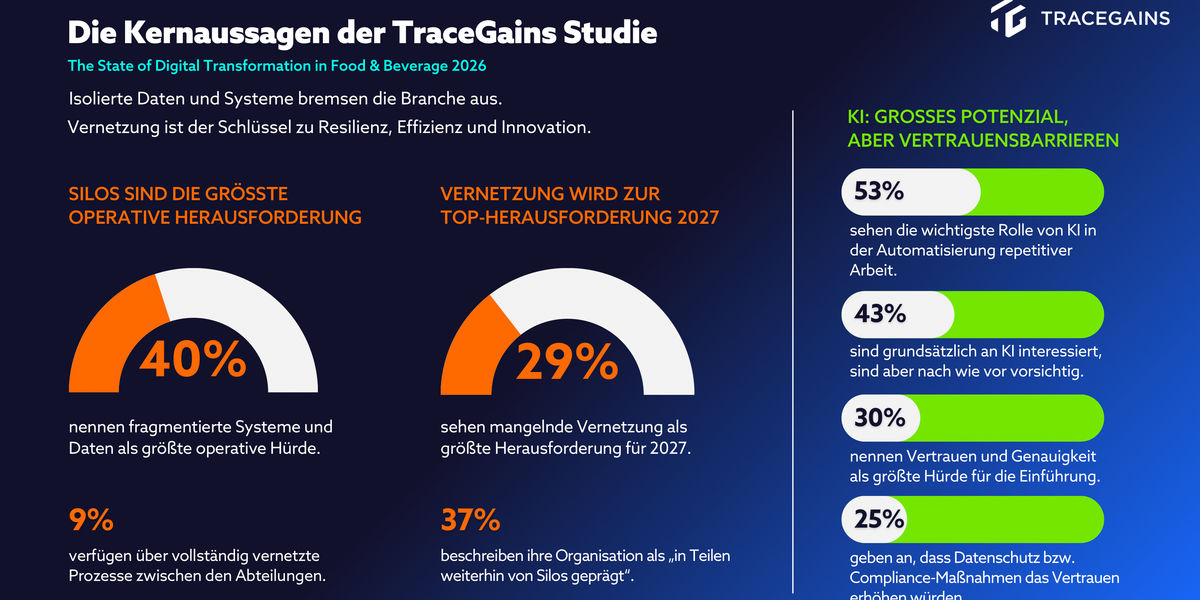
Forty percent of respondents cite disconnected systems and data as the biggest operational hurdle. At the same time, only nine percent say their organization already has fully interconnected processes across departments. Thirty-seven percent describe their own organization as “still characterized by silos in some areas.” The consequences include delays in operational processes, innovation development, compliance, and decision-making. Fragmented processes are thus not only inefficient but also increasingly costly. Consequently, 29 percent of respondents view a lack of integration as the greatest challenge for the coming year, 2027.

AI Faces Barriers of Trust, Not Technology
When it comes to the use of artificial intelligence, the picture is more nuanced. 53 percent see AI’s most important role as automating repetitive work. 43 percent are generally interested in AI but remain cautious. 30 percent cite trust and accuracy as the biggest hurdles to adoption. A quarter of respondents state that data protection at the corporate level or compliance safeguards would increase trust.
Connected data is becoming a competitive advantage
The study concludes that companies will increasingly rely on integrated data platforms. This is because 34 percent of respondents view end-to-end traceability as a critical success factor for the future. Thirty-two percent even consider connected real-time data to be the top operational priority for the coming years.
The study shows that only a connected ecosystem enables the seamless, cross-team exchange of supplier, quality, regulatory, product, packaging, and traceability data. Ultimately, this will serve as the foundation for sustainably increasing efficiency, resilience, and the pace of innovation.
For more information on the study, click here: TraceGains | Study: Status of Digital Transformation in F&B
About the Study
For the report “The State of Digital Transformation in Food & Beverage 2026,” TraceGains surveyed a total of 423 professionals and executives from 28 countries. The survey was conducted on May 27, 2026, and covers nine different functional areas of the food and beverage industry.
Note: This article has been translated using a computer system without human intervention. LUMITOS offers these automatic translations to present a wider range of current news. Since this article has been translated with automatic translation, it is possible that it contains errors in vocabulary, syntax or grammar. The original article in German can be found here.



Other news from the department business & finance














These products might interest you



Most read news






More news from our other portals


























See the theme worlds for related content
Topic world Food safety
Food safety is at the heart of the food and beverage industry. It ensures that the food we eat every day is not only nutritious, but also free of harmful contaminants. From field to plate, the industry monitors and regulates every step of the process with strict quality controls, advanced testing methods and continuous research.

Topic world Food safety
Food safety is at the heart of the food and beverage industry. It ensures that the food we eat every day is not only nutritious, but also free of harmful contaminants. From field to plate, the industry monitors and regulates every step of the process with strict quality controls, advanced testing methods and continuous research.
Artificial intelligence (AI) for food and beverages
Artificial intelligence (AI) is optimizing the food and beverage industry through automated quality control and more accurate demand forecasting. AI plays a particularly important role in product development by analyzing taste preferences and market trends. This allows new products to be developed that are better tailored to consumer needs, increasing efficiency and customer satisfaction.

Artificial intelligence (AI) for food and beverages
Artificial intelligence (AI) is optimizing the food and beverage industry through automated quality control and more accurate demand forecasting. AI plays a particularly important role in product development by analyzing taste preferences and market trends. This allows new products to be developed that are better tailored to consumer needs, increasing efficiency and customer satisfaction.