Innovative Filter Technology Opens New Perspectives for Water Treatment and Industry
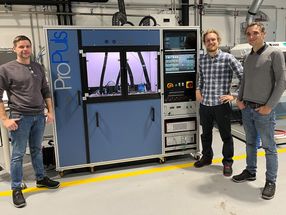
In collaboration with the startup CNM Technologies, Fraunhofer FEP developed a prototype

Advertisement


In spring 2026, the Fraunhofer Institute for Electron Beam and Plasma Technology FEP successfully completed the European project Convert2Green. One of the project's outstanding achievements is the development of a novel filtration technology based on ultrathin polymer layers that can purify water with exceptional efficiency. The technology offers new opportunities in applications such as food processing, water treatment, and energy technology. The process will be presented at pro flex 2027 in Dresden from May 25 to 26, 2027.
The goal of the Horizon Europe-funded project Convert2Green was to establish a comprehensive Open Innovation Test Bed (OITB) that facilitates companies’ access to technologies for climate-neutral and circular materials. At the heart of the three-year project was the creation of a Europe-wide innovation network involving 18 partners from academia and industry across nine countries. Together, they developed an infrastructure that supports material developers in bringing new solutions to market along key value chains such as Clean Energy, Smart Health, and Industrial IoT (Internet of Things).
From Research Network to Key Innovation
Fraunhofer FEP contributed its expertise in the development and scale-up of novel material and coating processes. A particular success emerged during the final phase of the project. In collaboration with the start-up CNM Technologies GmbH, Fraunhofer FEP developed a prototype for an innovative filtration technology.

At the core of this development is a highly cross-linked polymer layer made of carbon nanomembranes (CNMs), only a few nanometers thick, featuring exceptional filtration properties. The unique structure of this membrane allows water molecules to pass through easily while retaining dissolved ions, organic substances, and other molecules almost completely. Laboratory-scale tests demonstrated at least a fivefold improvement in salt rejection compared with conventional reverse osmosis membranes at comparable water fluxes.
This makes the technology particularly attractive for demanding water separation applications and opens up a wide range of potential uses, including water treatment, food technology, and energy technology. For example, CNM composite membranes can be used for the gentle concentration of aqueous solutions via forward osmosis. This may help reduce storage and transportation costs for beverages while enabling the recovery of valuable compounds such as flavors or proteins for food production. Unlike conventional thermal concentration processes, these substances are not exposed to high temperatures during this process. Furthermore, CNM composite membranes can be used to produce ultrapure water through low-pressure reverse osmosis.
In a further step of innovation, researchers at Fraunhofer FEP optimized the technology by integrating additional metal layers, enabling the production of ultrathin metal foils with thicknesses of only a few tens of nanometers. This development significantly broadens the range of potential applications. In particular, it opens up new opportunities for European manufacturers in miniaturized optics and sensor technologies to develop innovative and competitive products.
From the Laboratory to Industrial Implementation
A particularly significant milestone was the first-time implementation of all manufacturing steps, from the deposition of a molecularly thin layer to its cross-linking by electron beam irradiation, within a continuous roll-to-roll process. This represents a decisive advance toward industrial scale-up and the economic viability of the new technology.
“With Convert2Green, we have succeeded in transferring a promising filtration technology from the laboratory scale into an industrially relevant process environment,” explains Dr. Matthias Fahland, project manager at Fraunhofer FEP. “What is crucial here is not only the technological result itself, but also the fact that we have established structures within the project that will enable future innovations to be transferred more rapidly into market-ready applications.”
Although the Convert2Green project period has now come to an end, the services, processes, and networks established during the project will continue beyond its official duration. One opportunity to deepen the partnerships that have been created and develop them into new collaborations will be pro flex 2027, which will take place at Fraunhofer FEP in Dresden from May 25 to 26, 2027.
As an Open Innovation Test Bed, Convert2Green has built an innovation network with shared access and support structures that facilitate access, particularly for small and medium-sized enterprises, to pilot production facilities, development and testing services, and specialized expertise for climate- neutral and circular materials. These offerings include a joint service portfolio, a central access point, a multilingual digital platform, and support for the development and financing of new material solutions. As a result, innovative approaches can be evaluated, tested, and transferred into industrial applications more rapidly in the future.


Other news from the department research and development










Most read news



More news from our other portals











Something is happening in the food & beverage industry ...
This is what true pioneering spirit looks like: Plenty of innovative start-ups are bringing fresh ideas, lifeblood and entrepreneurial spirit to change tomorrow's world for the better. Immerse yourself in the world of these young companies and take the opportunity to get in touch with the founders.