New Deposit System for Soups, Spreads, Jams, and Vegetables
Circujar is developing decentralized washing systems to reduce transportation costs and emissions
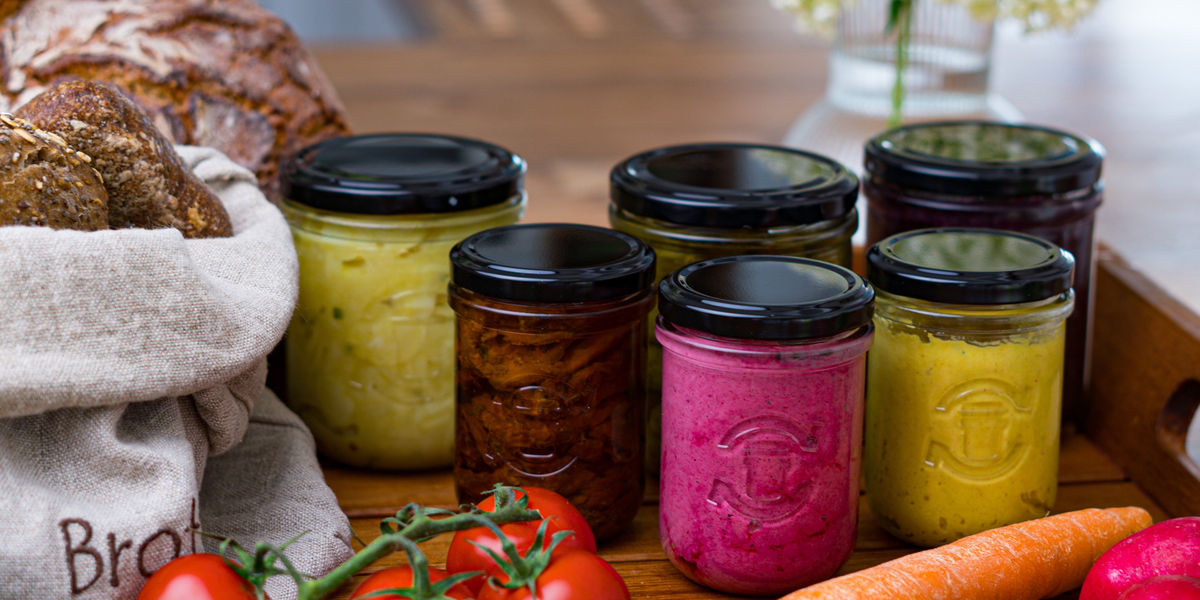
Disposable glass jars are among the most common types of packaging in the food retail sector. According to the Federal Environment Agency, approximately 3.8 million metric tons of glass containers were produced in Germany in 2024. A large portion of this is used for foods such as spreads, soups, jams, and vegetables. Until now, there has been no standardized reusable system for food packaging, as there is for beverages. The Munich-based startup Circujar is therefore working on a reusable cycle using standardized jars. The German Federal Environmental Foundation (DBU) is providing the company with 125,000 euros in funding.
DBU Provides 125,000 Euros in Funding to Startup Circujar
Osnabrück/Munich. Single-use glass jars are among the most common types of packaging in the food retail sector. According to the Federal Environment Agency, approximately 3.8 million metric tons of container glass were produced in Germany in 2024. A large portion of this is used for foods such as spreads, soups, jams, and vegetables. Until now, there has been no standardized reusable system for these products, as there is for beverages. Despite being recyclable, glass is very resource- and energy-intensive to produce. The Munich-based startup Circujar is therefore working on a reusable system using standardized glass jars. The German Federal Environmental Foundation (DBU) is providing the company with 125,000 euros in funding.
Returning food jars at a deposit machine
For DBU Secretary General Alexander Bonde, the deposit system for beverage bottles has long been a proven practice. “Until now, the concept has not been applied to other areas of the retail sector. Now, new, innovative ideas can fill this gap and make the food industry more sustainable,” said Bonde. The startup Circujar is pursuing this path by establishing a well-thought-out full-service offering with standardized jars. Founders Iris Vilsmaier and Dr. Christian Vilsmaier explain: “Consumers return the jars as usual at the deposit machine. Behind the scenes, we handle pickup, cleaning, and delivery to producers, as well as ensuring availability.” This creates an easy-to-implement all-in-one package for producers and retailers. The startup charges a 25-cent deposit on the bottles to encourage returns. Christian Vilsmaier: “Depending on in-store communication, we’re already achieving return rates of 55 to 95 percent—a steady increase since our founding in 2021.”
Reusable system reduces energy consumption in glass production
According to Iris Vilsmaier, the proportion of recycled materials in glass production for the retail sector currently stands at up to 60 percent. This means that new raw materials are inevitably used as well. “Glass can be easily recycled by melting it down. However, the material must be heated to up to 1,600 degrees Celsius for this,” says Iris Vilsmaier. This requires an enormous amount of energy, which, due to the energy sources used, results in high climate-damaging emissions and steadily rising costs. “The glass we’ve specially designed can be reused up to 50 times. And in a full-cost analysis, reusable packaging is already more cost-effective for many food manufacturers than constantly producing new single-use glasses,” says Iris Vilsmaier. This means companies could benefit financially from adopting sustainable packaging.
Decentralized washing systems reduce transportation costs and emissions
In addition to the cost advantage, Circujar aims to win over customers with easy implementation. “The Circujar platform, which we developed in-house, can be easily integrated into the processes of producers and wholesalers. We continuously adapt it to meet the needs of all partners within a growing system.” The startup is working to establish decentralized washing facilities throughout Germany with optimized processes, thereby reducing transportation costs and emissions. “Manufacturers can fill, label, and deliver the jars to retailers just as they normally would,” says Christian Vilsmaier. To create a truly seamless system, the startup has developed its own jar design—currently available in two sizes—along with a matching crate. “The standardized design makes logistics and usage more cost-effective and safer for everyone,” explains Christian Vilsmaier. “Food manufacturers can continue to display their product information and messages on the large labeling surfaces and lids.” Circujar’s jars are already available at many organic grocery chains as well as in some Edeka stores. Discussions are also underway with nearly all major retail chains.
New Campaign: “We’re Going Reusable”
The founders are currently launching the new campaign “We’re Going Reusable.” “After all, there are plenty of concepts and ideas—reusability is, after all, a long-established principle in Germany,” says Iris Vilsmaier. The campaign shows what is not only theoretically possible today but is already being implemented. In it, Circujar makes the easy use of reusable packaging tangible and highlights the pioneers who have been actively working with them for years. The founders say: “Circujar jars make reusable packaging widely accessible for pre-packaged foods and offer added value for everyone: price stability and resource availability for producers, toxin-free packaging with no hassle for customers, and customer loyalty without sorting chaos for retailers.”
Note: This article has been translated using a computer system without human intervention. LUMITOS offers these automatic translations to present a wider range of current news. Since this article has been translated with automatic translation, it is possible that it contains errors in vocabulary, syntax or grammar. The original article in German can be found here.

Other news from the department business & finance