Filling half of kids' plates with fruits and veggies helps increase consumption
Filling half of a child’s plate with fruits and veggies isn’t just recommended by the United States Dietary Guidelines, it also helps increase the amount of produce that kids end up eating, according to Penn State research.
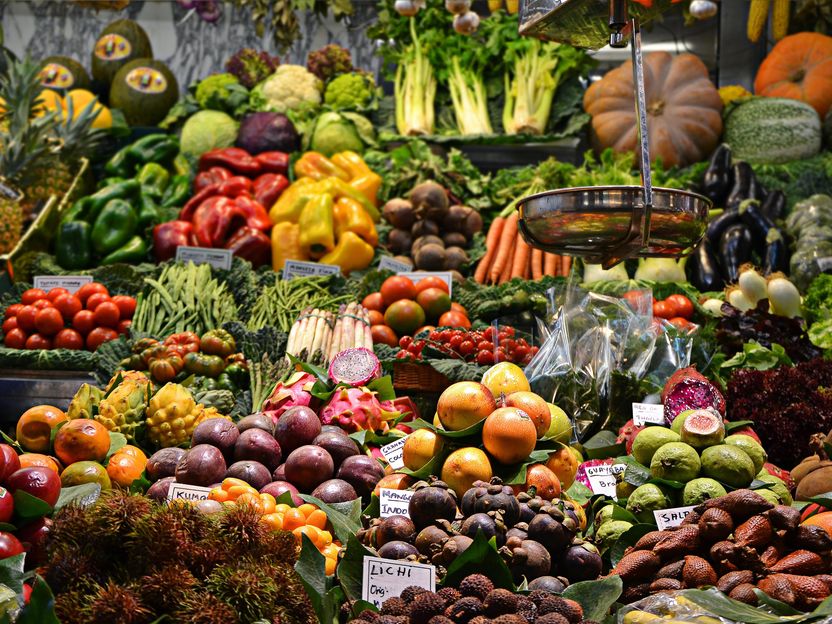
Photo by ja ma on Unsplash
In a controlled feeding study, the researchers tested two strategies for encouraging kids to eat more fruits and vegetables.
The first was simply adding 50 percent more to fruit and vegetable side dishes at kids’ meals throughout the day. The second was substituting 50 percent more fruits and vegetables for an equivalent weight of the other foods. For example, if they added 50 grams of veggies to the lunch meal, they also subtracted 50 grams of mac-and-cheese.
The researchers found that adding more fruit and vegetable side dishes resulted in the kids eating 24 percent more veggies and 33 percent more fruit compared to the control menus. Substituting fruits and veggies for some of the other foods resulted in kids consuming 41 percent more veggies and 38 percent more fruit.
Barbara Rolls, Helen A. Guthrie Chair and director of the Laboratory for the Study of Human Ingestive Behavior at Penn State, said the findings suggest ways parents, caregivers and schools can help encourage healthy eating.
“When deciding what to feed kids, it’s easy to remember that half of the food should be fruits and vegetables,” Rolls said. “If you start seeing that you’re serving too much and have more waste, you could cut back the higher calorie-dense food while adding more produce. Experiment and have some fun trying different fruits and vegetables to see what they like and so you can serve meals with a sensitivity to their personal taste.”
The study was recently published in the American Journal of Clinical Nutrition.
According to a previous study by the Centers for Disease Control and Prevention, about 60 percent of children don’t eat enough fruit and 93 percent don’t eat enough vegetables, suggesting a need for strategies to encourage kids to eat more produce.
Since 2011, the MyPlate dietary guidelines have encouraged people to fill half their plates with fruits and vegetables, with the hope that this would also increase people’s intake. But the researchers said that despite being a policy for a decade, the strategy had never been systematically tested in preschool children.
“For most foods, kids will eat more when served larger portions, so we wanted to test whether increasing the amount of fruits and vegetables that are served over five days would increase intake,” said Liane Roe, research nutritionist at Penn State. “We also wondered whether substituting produce for other foods would increase intake more than simply adding extra fruits and veggies.”
For the study, the researchers recruited 53 children between the ages of three and five who were enrolled in Pennsylvania childcare centers. Each participant was served all their meals and snacks for five days during three different periods in a random order.
For the control period, they were served meals they typically got in their childcare center, and for the period testing the addition strategy, the portions of fruits and vegetables were increased by 50 percent. For the period testing the substitution strategy, fruits and vegetables were increased by 50 percent and the other foods were reduced by an equivalent weight.
“We served the children all of their meals, snacks, and beverages for five consecutive days, and we weighed all the items we served, as well as the leftovers, to measure intake,” Roe said. “We sent home evening and morning snacks for the kids, but the majority of the meals were served in the childcare center.”
As a caution, Rolls said that even though the study was successful in getting kids to eat more fruits and vegetables, the majority of the kids still didn’t eat the recommended daily amount of vegetables for their age group -- about a cup and a half – although they did reach this target for fruits.
The researchers said that in addition to the strategies in the current study, there are additional things parents and caregivers can do to increase intake.
“Serving fruits and vegetables as a first course or snacks when kids are hungry can boost their intake, as can incorporating them into mixed dishes,” Rolls said. “For example, you can blend some cauliflower or squash into a sauce for mac and cheese or add fruit puree into a brownie or cake mix. You don't decrease the palatability of the dish, but the kids are eating more produce. You should also encourage them to eat the whole veggies on their own, as well as incorporating them into other foods.”
Christine Sanchez, Penn State; Alissa Smethers, Monell Chemical Senses Center; and Kathleen Keller, associate professor of nutritional sciences at Penn State, also participated in this work.
The National Institutes of Health helped support this research.
Other news from the department science