Ever heard of the barunut?
gebana brings the baruna nut to Europe as a novel food
Baruna nuts have only been allowed to be sold in the EU since 2025. gebana brings the protein-rich legume from the Brazilian Cerrado directly to Europe - where it is still considered a real discovery. Anyone who buys the nuts contributes directly to the preservation of one of the world's most species-rich ecosystems.
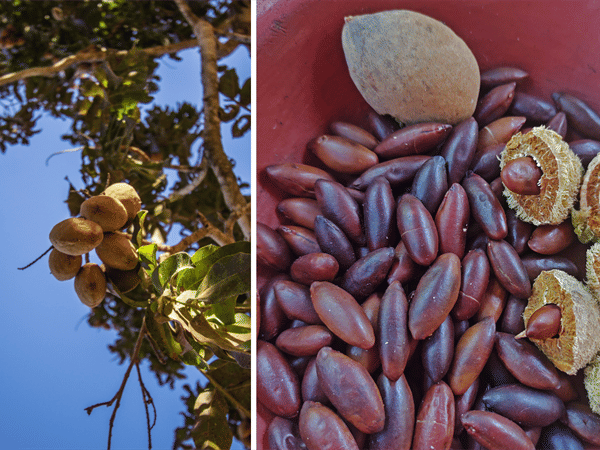
Barunuts
gebana
The "black diamond" from the Cerrado
Most people have never heard of baruna nuts - no wonder: even in Brazil, they are still an insider tip. In Europe, they are considered a so-called novel food, which means that they have only recently been approved. In their homeland, they are called "cumbaru", meaning "black diamond", and their origin is just as special: they grow wild in the Cerrado, a two million square kilometer savannah landscape with extraordinary biodiversity, on trees up to 25 meters high.
High in protein, low in fat
It is surprising that baruna nuts are so little known. This is because they are not only tasty, but also have interesting nutritional properties. Botanically, they are a legume and contain significantly more protein than walnuts or hazelnuts, but less fat and more fiber. A nutritional profile that also goes down well with athletes. Their taste is reminiscent of peanuts with notes of coffee and cocoa, and their thin shell can also be eaten. Coarsely chopped, they also go well in muesli or porridge and can also be used for baking. gebana supplies Barunuts in a 500 gram pack, which is filled locally in Brazil. This saves packaging material, simplifies transportation and logistics and helps to keep the supply chain efficient.
Collected wild instead of cultivated
Baruna nuts cannot be grown in monocultures, but are completely dependent on the natural ecosystem of the Cerrado. As soon as the nuts are ripe, they fall to the ground by themselves and are picked up by collectors between July and November. For around 130 families, including indigenous communities, the baruna nuts are an important source of additional income. gebana works together with the Brazilian processor Biodivér, which organizes the collection, cracking and processing of the nuts in Brazil. The baruna nut is an example of a different approach to trade: a consciously fair supply chain that grows organically and in which local people are involved in the economic success so that the added value remains in the country of origin.
Snack with an impact
The Cerrado is one of the most biodiverse ecosystems in the world, but is under increasing pressure: large areas are being cleared for soybean cultivation, maize fields and livestock farming. Because baruna nuts are collected in the wild, there is an economic incentive to leave the trees standing - and thus preserve the landscape in the long term.
Note: This article has been translated using a computer system without human intervention. LUMITOS offers these automatic translations to present a wider range of current news. Since this article has been translated with automatic translation, it is possible that it contains errors in vocabulary, syntax or grammar. The original article in German can be found here.
Other news from the department business & finance