Improving taste and texture in oat drinks
Greek-Swedish scientist selected as finalist for the European Inventor Award 2026
Advertisement


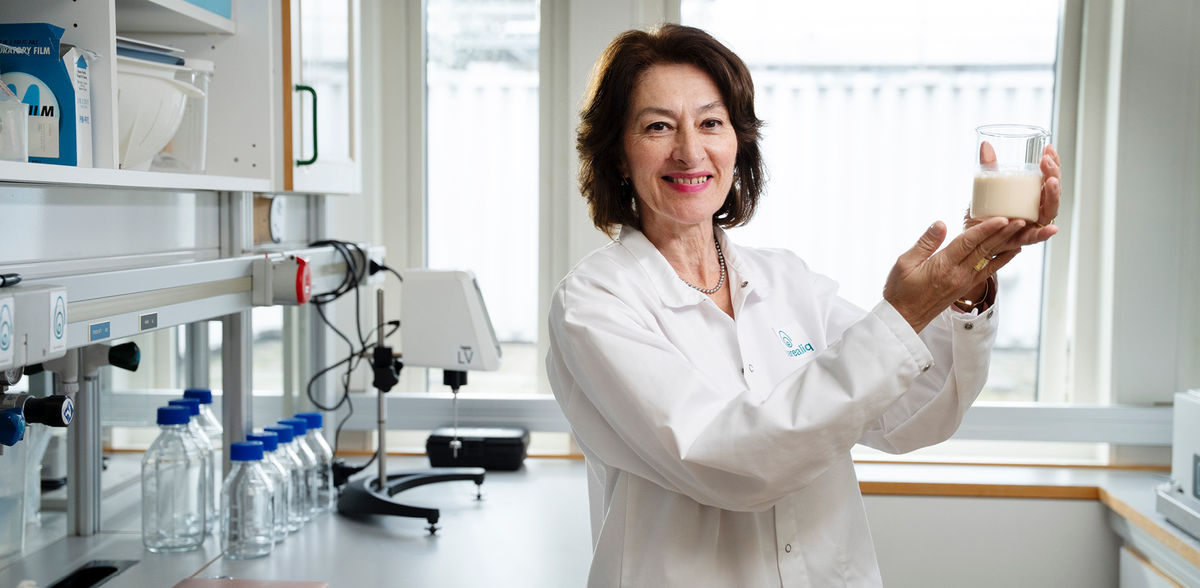
Lactose malabsorption is widespread globally, with academic studies published in Science Direct in 2025 estimating that up to 65% of the world’s population has a reduced ability to digest lactose. Moreover, according to the European Commission, people do not meet recommended intakes of dietary fibre which is a risk factor for ill health. This has driven demand for dairy-free alternatives that meet expectations for taste, texture, healthiness, and everyday use. Early oat-based drinks, however, often fell short due to heterogeneous consistency, instability, and poor performance in applications such as coffee. The biotechnology scientist Angeliki Triantafyllou developed a patented enzymatic process that overcame these limitations, enabling stable oat drinks suitable for large-scale production. For this work, she has been selected as a finalist in the ‘Industry’ category of the European Inventor Award 2026 by an independent jury.
Overcoming key barriers in oat-based drinks
Oat is a promising raw material for nutritious and digestible dairy alternatives, but early production methods struggled to deliver a product consumers would recognise as a true everyday substitute for dairy milk. Oat drinks were often grainy on the palate, sometimes bitter in taste and prone to separation when heated or stored. A central challenge was increasing the amount of soluble protein without degrading it, as conventional proteases broke proteins down into smaller fragments, leading to off-flavours, unwanted browning and reduced stability during high-temperature processing.
Triantafyllou addressed this while working at Swedish food company Oatly, where she developed an enzymatic process that combines protein deamidase enzymes with amylases to solubilise oat protein while degrading starch. Unlike many proteases, deamidases modify proteins without breaking them apart, preserving their structure while improving taste, colour and stability. The resulting oat base has a higher content of soluble protein, a whiter appearance and forms a fine, stable foam, making it suitable for uses such as coffee preparation. By enabling stable oat drinks suitable for everyday use, the invention supported the wider adoption of plant-based alternatives and contributed to more sustainable food consumption patterns, as such products are generally associated with lower resource use and environmental impact than conventional dairy products.
“For many years, the market viewed plant-based drinks as something for people with allergies, not for the general population. But this barista version was functional, well-performing, and tasty. It opened up a whole new area. It brought attention to all these vegetable-based drinks,” said Triantafyllou.
Scaling an enzymatic breakthrough for food production
The work originated at Lund University in the early 1990s as a research collaboration with the Swedish Farmers’ Association, aimed at finding value-added uses for oat by-products. At the same time, academic interest in food intolerances and allergies was increasing in Sweden/worldwide, supporting research into alternatives to cow’s milk. Triantafyllou joined the initiative, which would later become Oatly, while completing her PhD in biotechnology and played a central role in developing and refining the enzymatic process. This patented process was subsequently applied at an industrial scale, helping transform oat drinks from a niche product into a widely accepted dairy alternative, including products specifically designed to perform well in coffee. Triantafyllou continues her work in developing and refining enzymatic processes through her company Cerealiq AB, focusing on high-quality oat and legume-based drinks.
“We live in a changing world, with more people and fewer resources everyday. We need to make our basic food production systems smarter and more efficient. This invention demonstrates how science can be applied in a seemingly traditional field like food production,” said Triantafyllou.
Angeliki Triantafyllou is one of three finalists in the ‘Industry’ category of the European Inventor Award 2026. The other ‘Industry’ finalists are the Swiss-Greek electrical engineer Evangelos Eleftheriou and team for contributions to digital storage and the Italian inventor Giuseppe Crippa and his team for their advanced probe card production method. The European Patent Office will announce the winners during a livestreamed ceremony from Berlin on 2 July 2026. In addition to the four award categories, the Popular Prize will be decided through a combined vote by the public and the independent jury. Public voting opens on 12 May 2026 and will be running until the ceremony on 2 July 2026.


Other news from the department research and development