Enjoy a clever Christmas: from deluxe olives to speculoos soup
How small tricks on the table and plate enhance the taste experience, save resources and how soup recipes developed at TU Berlin contribute to a sustainable festive meal. Findings from the research of sustainability scientist Prof. Dr. Nina Langen
Christmas is a time of indulgence and abundance. Hardly any other festival makes it so clear how people make decisions about food: why they overestimate quantities, let themselves be guided by moods or perceive dishes as particularly festive or even more sustainable simply because of the way they are presented. Prof. Dr. Nina Langen from TU Berlin has been studying precisely these kinds of mechanisms for years. In her Department of Education for Sustainable Nutrition and Food Science, researchers work at the interface of behavioral economics, sensory science and sustainability research to understand how eating decisions are made and how they can be made easier in everyday life. For Langen, the festive season in particular shows how closely all these factors are interwoven: "There is no other time when you can see so clearly how intertwined emotions, habits, marketing and planning are."
Sustainable nutrition: an interplay of five perspectives Langen describes sustainable nutrition as an interplay of ecological, economic, food culture, health and social factors, and all five have a greater impact on Christmas dinner than on any other day.
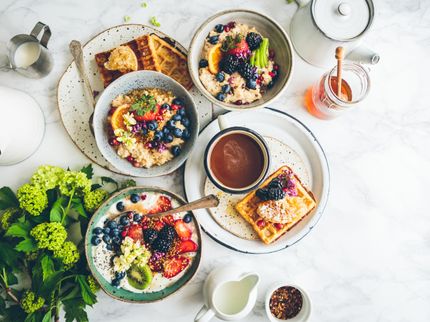
A meal is ecological above all when it is eaten. "Every product contains a chain of resources - from cultivation to washing up the pots." Origin and season also play a role: "Winter salads are very cheap," explains Langen. "You can even sow lamb's lettuce or postelein yourself in a raised bed. Then you'll have exactly the amount you need for Christmas."
Economically, Christmas is a challenge for many and a time of temptation. "Suddenly, retailers are praising everything as 'deluxe'. But what distinguishes the deluxe olive from the normal one? Often nothing apart from the label and the higher price." It's also sustainable not to overextend yourself: Good food doesn't have to be expensive and the remaining 364 days also deserve attention.
Food culture becomes personal: food is memory, belonging, biography. At the same time, according to Langen, food culture is not a rigid system. "I am allowed to evolve. If I no longer live in the country or no longer cook for eight people but for two, Christmas dinner can look different."
In terms of health, it's all about moderation - especially when it comes to fatty and hearty foods, which are lurking everywhere during Advent, while exercise tends to be in short supply.
And on a social level, working conditions and animal welfare play a role: under what conditions was the food I use produced?
The most important levers: planning and portions Despite all the complexity, according to Langen, a lot can be achieved with simple steps. "The most important thing is to eat up." The biggest sustainability losses occur in the household: 58% of food waste in Germany - 6.3 million tons in 2022 - comes from private kitchens. Good planning is therefore a scientifically proven lever for avoiding waste. This includes realistically estimating portions, planning to use leftovers and checking stocks. For example, there are often chestnuts left in the cupboard from the previous year. Overloaded plates are culturally ingrained at many Christmas tables, but less can also be more and even convey something exquisite, says the scientist.
If you have some time over the holidays, you can measure your own waste with the digital kitchen diary developed by the department in the 'Too good for the garbage can' app ( https://www.zugutfuerdietonne.de/app ), in which you can enter what was thrown away over the Christmas period. The app then shows where there are potential weaknesses in your own behavior and where you are already doing well.
Why taste is a matter of the mind Nina Langen's taste lab research shows how much psychological factors shape our food. "The same dish tastes different if I serve it on a porcelain plate or on a tablecloth that I only use once a year rather than on plastic." A red plate encourages you to eat up, gold-rimmed tableware can trigger positive memories. Colors also influence taste expectations. All of this can be used without buying anything new. "I can make my own olive 'deluxe' by putting it in a special bowl that I rarely use, or I can swap wine glasses or tablecloths with my neighbors - a simple trick that creates atmosphere without using up resources."
Meat, alternatives and thinking about ingredients together Langen recommends a pragmatic approach to people who traditionally serve meat. Smaller portions are a good way to go without breaking traditions. "Instead of a large goose, it could be a smaller one, or instead of the large sausage, three smaller ones could be served - it even looks better."
She gives three examples of vegetarian or flexitarian options: A colorful beetroot carpaccio, which is popular on the Internet right now and which she has already tested at conferences; a potato gratin that can be prepared with or without bacon; and a chocolate mousse with aquafaba, which is whipped chickpea water. "In our triangle tests, many testers didn't notice any difference to the classic version. The remaining chickpeas can be used straight away - you should think about things together."
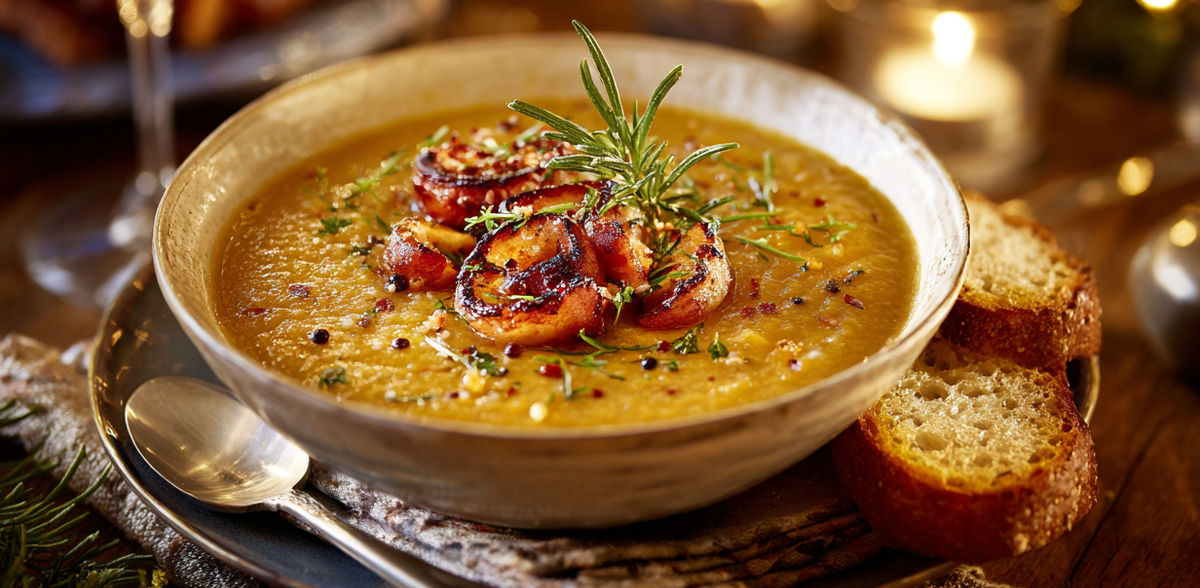
Christmas soups: versatile, sustainable, festive For the upcoming holidays, Langen's team has developed sustainable soup recipes that use typical Christmas leftovers under the motto "Best leftovers - colorful and festive". The idea arose from research into food waste and the observation that soups are particularly flexible. "Soup is currently experiencing an upswing because it's a thankful thing," says Langen. "You can cook it with anything you have left over. Whether it's crooked, seasonal vegetables, frozen leftovers or ingredients from a feast, almost anything is suitable for a new approach in the pot."
As a starter or main course, soups can be varied in terms of color, taste and texture - pureed, chunky or combined. "Soup can do just as much as a roast," emphasizes Langen, "not in terms of appearance, but it warms, fills you up and provides nutrients." If you want a stress-free meal, cook ahead, freeze or boil and still serve homemade food. With Christmas toppings such as speculoos crunch or caramelized orange or lemon peel, the soups even look surprisingly festive. Recipes for bread rolls, baguettes, bread confectionery, various pestos and a layered dessert round off the sustainable Christmas menu.
Best leftovers - colorful and festive: The recipes for the four different soups and the dessert, developed by the Department of Sustainable Nutrition and Food Science, can be found under the link on the right.
Note: This article has been translated using a computer system without human intervention. LUMITOS offers these automatic translations to present a wider range of current news. Since this article has been translated with automatic translation, it is possible that it contains errors in vocabulary, syntax or grammar. The original article in German can be found here.
Other news from the department science