"On a Knife's Edge": New Study Highlights Risks Facing the Food Industry Through 2040
Climate change, cyberattacks, and supply chain disruptions are increasingly occurring simultaneously and reinforcing one another
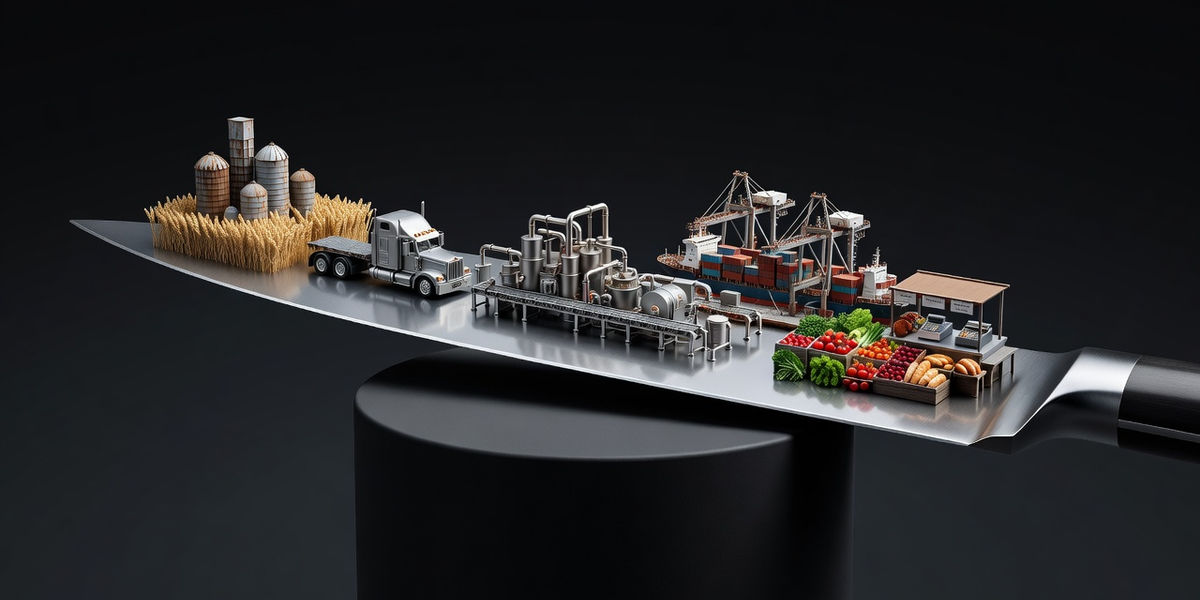
Companies in the food industry are increasingly confronted with risks such as geopolitical upheavals, climate change, cyberattacks, fragile supply chains, new technologies, and growing regulatory requirements—and, more and more, all at the same time. In this context, a new study by Fraunhofer ISI, commissioned by the Funk Foundation, has analyzed which risks could have a particularly significant impact on the food industry by 2040—and what action strategies companies, insurers, and other stakeholders can derive from this analysis. The study will be officially presented at the Food Future Forum in Bielefeld.
The food industry is a systemically important sector—yet its vulnerability has become clearly evident in recent years. Disrupted supply chains, extreme weather events, rising energy prices, and cyberattacks on networked production facilities are increasingly occurring simultaneously and reinforcing one another. This simultaneity fundamentally distinguishes the current risk landscape from that of previous decades.
The study “On a Knife’s Edge – Risks in the Food Industry: Trends, Scenarios, Action Strategies” is based on a multi-stage, participatory foresight process. As part of this process, more than 3,000 scientific publications were evaluated, 41 key trends were identified, and 183 individual risks were grouped into 19 risk clusters. In addition, the Fraunhofer ISI research team developed four future scenarios through 2040 to systematically analyze the dynamics and interactions of risks.
Risks Are Increasing—and Interconnected A key finding: Nearly all of the risks examined show rising trends. Even more important, however, is their growing interdependence. Risks that were once considered in isolation now interact simultaneously across multiple sectors.
For example, a cyberattack can not only disrupt production processes but also jeopardize product safety and reputation at the same time. Geopolitical tensions simultaneously influence supply chains, regulatory requirements, and market conditions. And climate risks have parallel effects on the availability of raw materials, energy prices, and infrastructure.
“The study shows that traditional risk management reaches its limits without a cross-functional perspective,” explains Dr. Ariane Voglhuber-Slavinsky of Fraunhofer ISI. “Companies must understand their value creation as an interconnected system in order to identify and limit chain reactions at an early stage.”
Focus on Six Key Risk Areas The study provides an in-depth analysis of six priority risk clusters requiring immediate action: climate change and resource risks, product safety and ingredient risks, reputational risks arising from public communication, cyber and IT risks, regulatory requirements, and disruptions in procurement and logistics.
The study identifies concrete courses of action for these areas. Measures that fall within companies’ direct sphere of influence are particularly effective—such as end-to-end traceability along the supply chain, automated quality assurance, robust IT security structures, diversified procurement, and systematic monitoring of regulations and public perception.
Recommendations for Action and Limits of Risk Transfer Based on this, the study formulates eight overarching recommendations —including the establishment of integrated risk management, more resilient supply chains through diversification and technology, a stronger link between cybersecurity and product safety, and a strategic approach to regulatory and climate-related risks.
At the same time, it becomes apparent that traditional risk transfer instruments are reaching their limits: For novel risks such as reputational damage caused by social media or geopolitical uncertainties, viable insurance models often do not yet exist.
“Proactive risk management is not a bureaucratic end in itself, but a genuine competitive advantage,” concludes Voglhuber-Slavinsky. “The most effective response to an increasingly interconnected risk landscape lies in a continuous dialogue between companies, insurers, and other stakeholders in the supply chain.”
Note: This article has been translated using a computer system without human intervention. LUMITOS offers these automatic translations to present a wider range of current news. Since this article has been translated with automatic translation, it is possible that it contains errors in vocabulary, syntax or grammar. The original article in German can be found here.

Other news from the department science









Most read news








More news from our other portals
















See the theme worlds for related content
Topic world Quality assurance
In the food industry, quality assurance is about much more than safety. It's about ensuring consistent standards that meet consumers' taste, nutritional and aesthetic expectations. Using state-of-the-art analytical methods and strict protocols, Quality Assurance ensures that every product delivers on the brand's promise. From appearance and taste to texture and shelf life, Quality Assurance ensures consumers get exactly what they expect.

Topic world Quality assurance
In the food industry, quality assurance is about much more than safety. It's about ensuring consistent standards that meet consumers' taste, nutritional and aesthetic expectations. Using state-of-the-art analytical methods and strict protocols, Quality Assurance ensures that every product delivers on the brand's promise. From appearance and taste to texture and shelf life, Quality Assurance ensures consumers get exactly what they expect.