Artificial intelligence could help close agriculture's broken nitrogen loop
A new framework combines satellite data, animal sensors, and language models into a unified decision-making system

Advertisement


artificial intelligence could help transform how farms manage nitrogen by connecting crop production, livestock feeding, manure recycling, and environmental monitoring within a single decision-making system, according to a new perspective published in Nitrogen Cycling.
Nitrogen fertilizers have played a central role in increasing global food production, but inefficient nitrogen use can contribute to air pollution, soil acidification, groundwater contamination, and emissions of nitrous oxide, a powerful greenhouse gas. One major cause of this problem is the separation of crop and livestock production. Manure often accumulates near intensive livestock operations, while farms in other regions continue to rely heavily on synthetic fertilizers.
The authors propose that AI can help rebuild this disrupted nutrient cycle by tracking nitrogen flows, improving scientific models, and turning complex information into practical recommendations for farmers.

"Artificial intelligence gives us an opportunity to see agricultural nitrogen as one connected system rather than a collection of separate problems," said corresponding author Xiuming Zhang. "By linking crops, animals, manure, and environmental processes, AI could help farmers produce more food while reducing nitrogen losses."
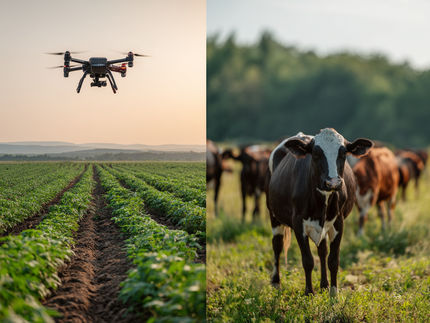
The proposed framework has three main components. First, AI-powered observation systems can collect information from satellites, drones, soil sensors, animal wearables, computer vision, and livestock housing monitors. These technologies could reveal how nitrogen moves through fields, animals, manure storage, and the wider environment.
Second, the researchers emphasize combining data-driven AI with models based on physical, biological, and chemical processes. Approaches such as physics-informed neural networks and knowledge-guided machine learning can improve predictions while maintaining essential rules, including nitrogen mass balance. These hybrid systems could support more accurate estimates of fertilizer demand, nitrous oxide emissions, animal nitrogen retention, and manure-related losses.
Third, agricultural large language models could translate scientific outputs into clear farm-level guidance. Such systems may help recommend the right fertilizer source, rate, timing, and placement, while also optimizing animal feed and identifying opportunities to move manure from livestock regions with nitrogen surpluses to croplands that need nutrients.
The long-term goal is a whole-farm intelligent agent capable of coordinating crop fertilization, livestock nutrition, and manure recycling at the same time. The paper highlights early examples of specialized agricultural AI systems that have reported reductions in fertilizer or feed nitrogen use while maintaining or increasing productivity.
However, the authors caution that major challenges remain. Agricultural data are often fragmented across institutions, AI models may be difficult to explain, and advanced technologies may be too expensive for smallholder farmers. Federated learning, edge computing, and lower-cost tools could help improve privacy, accessibility, and inclusion.
The researchers conclude that AI could become the central coordination system for circular agriculture, but success will require close collaboration among agronomists, animal scientists, biogeochemists, computer scientists, farmers, and policymakers.
Original publication


Other news from the department science










Most read news







More news from our other portals























See the theme worlds for related content
Artificial intelligence (AI) for food and beverages
Artificial intelligence (AI) is optimizing the food and beverage industry through automated quality control and more accurate demand forecasting. AI plays a particularly important role in product development by analyzing taste preferences and market trends. This allows new products to be developed that are better tailored to consumer needs, increasing efficiency and customer satisfaction.

Artificial intelligence (AI) for food and beverages
Artificial intelligence (AI) is optimizing the food and beverage industry through automated quality control and more accurate demand forecasting. AI plays a particularly important role in product development by analyzing taste preferences and market trends. This allows new products to be developed that are better tailored to consumer needs, increasing efficiency and customer satisfaction.