TÜV SÜD Provides Information on Food Made from Waste Materials
Brewer's grains in cookies, cocoa pulp in chocolate: What's the story behind "Upcycled Ingredients"?
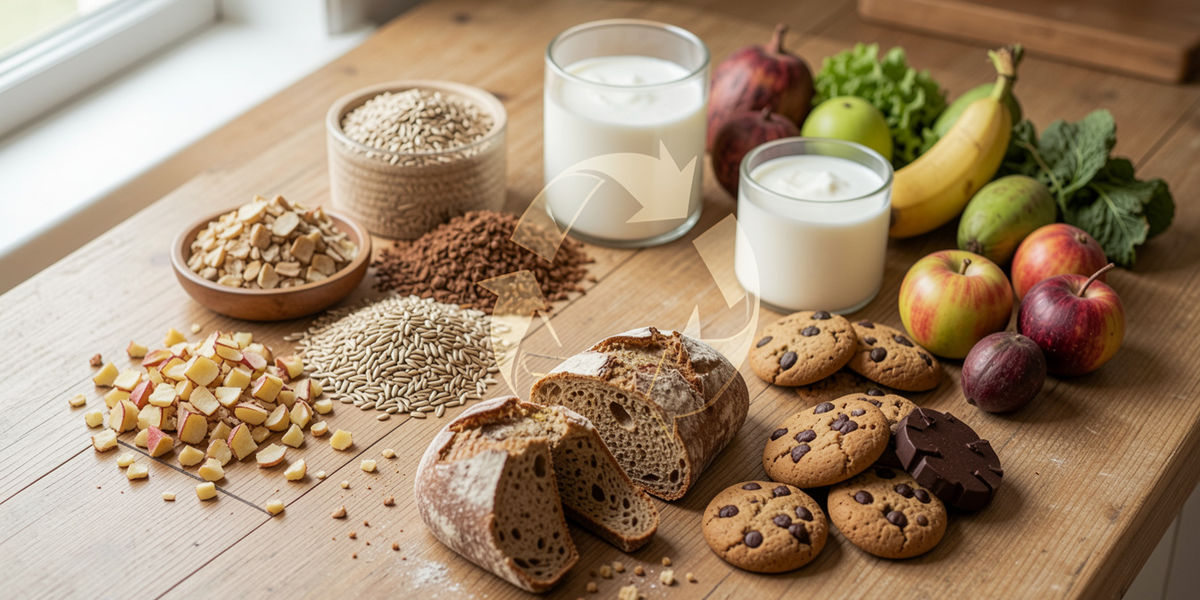
Even today, more and more foods contain so-called “upcycled ingredients.” These are ingredients derived from leftovers and byproducts of food production. The idea behind this is the consistent, sustainable use of resources while maintaining the high quality consumers have come to expect. TÜV SÜD explains what upcycled ingredients are all about.
Bread made from surplus bread, flour made from malt-containing residues of beer production (brewer’s grains) in cookies, or chocolate made from the pulp of the cacao fruit—which was previously hardly used at all. What looks like traditional waste utilization is known in technical jargon as “upcycled ingredients.” Specifically, this refers to ingredients produced from raw materials, leftovers, or surpluses from food production. In the past, these didn’t end up on our plates but in the trash or in animal feed—even though they could still be put to good use. For consumers, this means, first and foremost, that supermarket shelves may now feature products whose ingredients have a history.
“Upcycled ingredients aren’t ‘waste in food,’ but rather usable resources that are professionally processed so they aren’t lost. Their main promise is greater sustainability through less waste—and this even gives rise to the occasional interesting new product idea,” says Dr. Andreas Daxenberger, a food expert at TÜV SÜD.

Even though the term “upcycled ingredients” sounds as if it refers to a qualitative upgrade, it initially says only something about an ingredient’s origin—and not, for example, about its nutritional value. A cookie made with upcycled flour remains a cookie—albeit with added sustainability benefits. Whether an upcycled ingredient makes nutritional sense—for example, because it provides dietary fiber, protein, or phytochemicals, as is often the case—depends on the source material and the processing method.
Why Leftovers Become New Ingredients
The main reason for upcycling is to reduce food loss and waste while simultaneously generating economic benefits. If food that has already been produced goes uneaten, the resources used to produce it were, in part, wasted. This principle is closely linked to the circular economy. Nutrients that have already been grown, harvested, transported, and processed should remain within the human food system as much as possible. The Upcycled Food Association defines upcycled food as products that use ingredients that would otherwise not have ended up in the human food system, have verifiable supply chains, and have a positive environmental impact.
Typical upcycled ingredients include apple or fruit scraps from juice and cider production, brewer’s grains, whey from cheese production, rejected fruits and vegetables with cosmetic imperfections, surplus bread or fruit pulp, and the peel of the cacao fruit. They are used, among other things, in baked goods, snacks, beverages, pasta and cereals, dairy and protein products, soups and sauces, as well as in confectionery.
What’s on the label
There is no specific legal requirement to label products as “upcycled” in the EU. The General Food Information Regulation (EU) No. 1169/2011 requires that food information not mislead consumers—particularly regarding a product’s properties or effects. Upcycling claims must not create a false impression regarding safety, nutritional value, or environmental benefits. In addition, the ingredient must appear in the ingredients list with its correct name—for example, as apricot kernel paste, apple fiber, or spent grain flour. Allergens must be labeled as required.
Safety and Regulation: Not a Separate Category
Upcycled ingredients are not subject to any special controls in the EU or in Germany. They must meet the same food safety requirements as other ingredients and be safe, traceable, and correctly labeled.
Food standards ensure transparency and safety
Ultimately, what matters to consumers is whether an ingredient’s origin, processing, safety, and labeling are transparent and traceable. Globally recognized food certification standards such as IFS Food, FSSC 22000, or BRCGS Food help companies assess their supply chains, ensure traceability, and systematically manage risks. Such voluntary standards complement legal regulations by addressing important quality and safety aspects and creating transparency.
Note: This article has been translated using a computer system without human intervention. LUMITOS offers these automatic translations to present a wider range of current news. Since this article has been translated with automatic translation, it is possible that it contains errors in vocabulary, syntax or grammar. The original article in German can be found here.
Other news from the department science










Most read news








More news from our other portals

























See the theme worlds for related content
Topic world Food safety
Food safety is at the heart of the food and beverage industry. It ensures that the food we eat every day is not only nutritious, but also free of harmful contaminants. From field to plate, the industry monitors and regulates every step of the process with strict quality controls, advanced testing methods and continuous research.

Topic world Food safety
Food safety is at the heart of the food and beverage industry. It ensures that the food we eat every day is not only nutritious, but also free of harmful contaminants. From field to plate, the industry monitors and regulates every step of the process with strict quality controls, advanced testing methods and continuous research.