Viruses as Plant Protectors: Research at Jülich Shows the Potential of Bacteriophages
Bacteriophages protect plants from infections and suppress their immune response
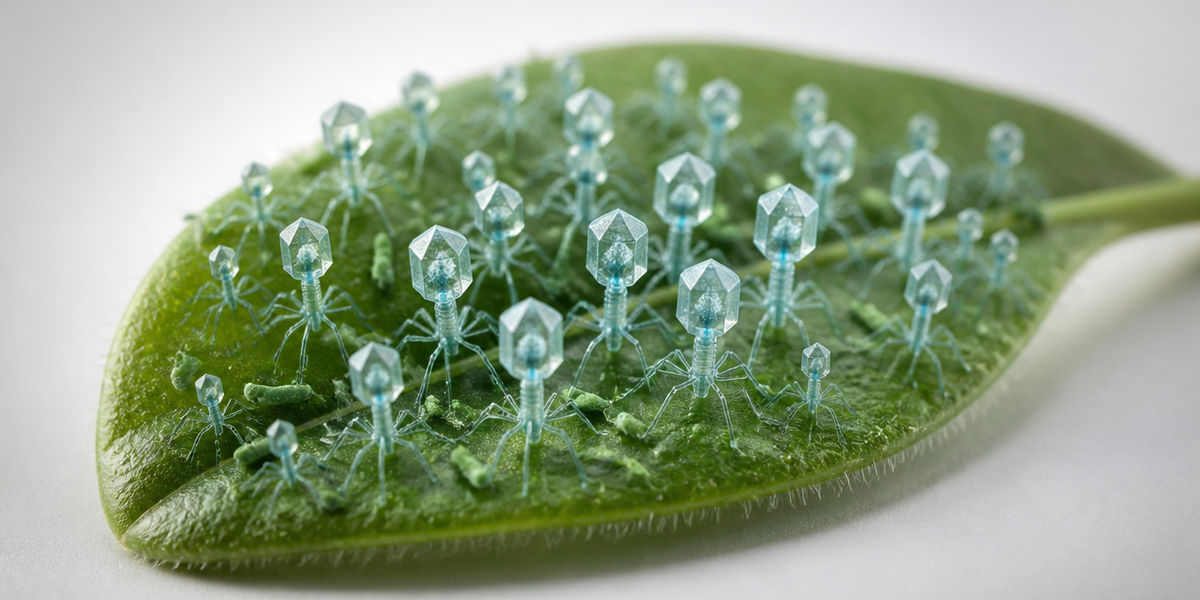
Researchers at Forschungszentrum Jülich are investigating how natural viruses that specifically target bacteria can protect plants from bacterial pathogens. These so-called bacteriophages open up new possibilities for more environmentally friendly plant protection—and, in light of increasing heat waves and growing pressures on agriculture, could make an important contribution to securing crop yields.
Bacteria can cause illness not only in humans and animals, but also in plants. Worldwide, bacterial plant diseases cause significant crop losses. This is a growing problem for agriculture: crops are under increasing pressure—from pathogens, heat, drought, and other consequences of climate change. When plants are already weakened by extreme weather conditions, protecting them becomes even more important. After all, stable harvests are a key prerequisite for a secure food supply.
Researchers at Forschungszentrum Jülich are therefore working on new, more sustainable ways to protect plants in a targeted manner. The focus is on so-called bacteriophages, or phages for short. These are natural viruses that exclusively infect bacteria. They are generally harmless to humans, animals, and plants. Their particular advantage: they attack specific bacteria in a highly targeted manner.
Precise Protection Instead of a Blanket Approach
Conventional antibacterial agents often have a broad spectrum of activity. This means they can target not only harmful bacteria but also beneficial microorganisms that are important for healthy soils and plants. Furthermore, frequent use of such agents can lead to pathogens becoming resistant. Over time, these agents lose their effectiveness.
Phages could offer an alternative here. They are specialized to target specific bacterial hosts and could combat pathogens without disrupting the plant’s entire microbiome. This makes them well-suited for a plant protection approach that aims to be more targeted, more resource-efficient, and more effective in the long term.
Plants Continue to Grow Normally Despite Infection
In a recent study published in the journal *Cell Reports*, Dr. Sebastian Erdrich investigated how bacteriophages act during a bacterial infection of plants. Erdrich completed his doctoral research at the Jülich Institute of Bio- and Geosciences in the departments of Biotechnology (IBG-1) and Plant Sciences (IBG-2). Also involved in the study were researchers from the teams of Prof. Dr. Julia Frunzke at IBG-1, Dr. Borjana Arsova at IBG-2, and Prof. Dr. Guido Grossmann from the Institute for Cell and Interaction Biology at Heinrich Heine University Düsseldorf.
Arabidopsis thaliana, a relative of rapeseed and cabbage frequently used in research, served as the model plant. The plants were infected with the bacterial pathogen Xanthomonas campestris pv. campestris. Some of the infected plants were additionally treated with a suitable bacteriophage.
The result: During the study period, the infected plants treated with phages grew just as well as uninfected control plants. The phages not only reduced the number of harmful bacteria. The bacteria also exhibited lower virulence—meaning they were less pathogenic. At the same time, the plants’ immune response was weaker than that of infected plants without phages. This suggests that the plants suffered less from the infection.
An Approach with Practical Potential
The research builds on earlier work in which scientists at Forschungszentrum Jülich had already isolated new phages against important bacterial plant pathogens. They also investigated how such phages can be concentrated on seed surfaces. This has already led to a technology offering from Forschungszentrum Jülich that can be further explored with interested partners: a seed coating containing biological active agents.
The idea behind it is simple and practical: the protection is applied directly to the seed. If the young plant later comes into contact with harmful bacteria, the phages could already be active on site. They would thus serve as a kind of biological protective barrier right from the start.
Contribution to Food Security
Such approaches are becoming increasingly important, particularly in light of climate change. Heat waves, droughts, and other stress factors can weaken crops and further jeopardize yields. According to estimates, around ten percent of global food production is already lost to bacterial plant diseases. Seeds are a major route of transmission for such pathogens: pathogens can travel on or inside seeds and infect young plants as soon as they germinate. This is precisely where Jülich’s technological solutions come into play. By coating seeds with biological agents such as bacteriophages, it may be possible in the future to interrupt this cycle of infection at an early stage.
The results from Jülich and Düsseldorf show that bacteriophages could do more than just reduce the number of harmful bacteria. They also appear to influence the interaction between the plant and the pathogen: the plant remains more resilient, while the bacteria cause less damage. In this way, the researchers are laying an important foundation for new, sustainable strategies in plant protection.
Note: This article has been translated using a computer system without human intervention. LUMITOS offers these automatic translations to present a wider range of current news. Since this article has been translated with automatic translation, it is possible that it contains errors in vocabulary, syntax or grammar. The original article in German can be found here.

Other news from the department science









Most read news











More news from our other portals



























See the theme worlds for related content
Topic world Food safety
Food safety is at the heart of the food and beverage industry. It ensures that the food we eat every day is not only nutritious, but also free of harmful contaminants. From field to plate, the industry monitors and regulates every step of the process with strict quality controls, advanced testing methods and continuous research.

Topic world Food safety
Food safety is at the heart of the food and beverage industry. It ensures that the food we eat every day is not only nutritious, but also free of harmful contaminants. From field to plate, the industry monitors and regulates every step of the process with strict quality controls, advanced testing methods and continuous research.