Made in Germany: More Sustainable Food Production in a Controlled Environment
New Research Strategy Aims to Make Controlled Environment Agriculture More Economically Viable and Export-Ready
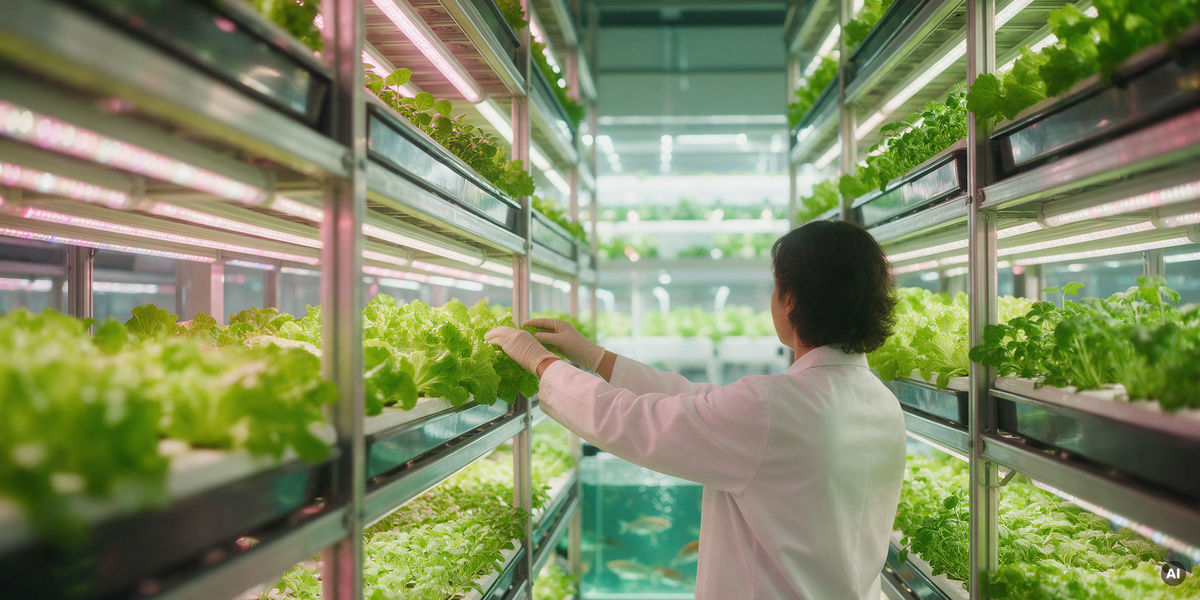
Food can be produced even under unfavorable soil or climate conditions—inside buildings. This is made possible by Controlled Environment Agriculture (CEA), which includes, among other things, vertical farming and aquaponics. Germany plays a key role in the development of this technology. Now, CEA products must become more economical and sustainable to promote their global adoption and contribution to food security. Exemplary facilities in Germany and their integration into the retail sector could serve as a showcase for export markets. A new strategy from DAFA outlines the top research priorities for achieving this.
Food production in controlled environment agriculture (CEA) systems can make a key contribution to global food security within planetary boundaries. A research strategy to increase the sustainability of CEA and promote export opportunities has been developed by leading scientists and has been the subject of intense public debate. Feeding a growing global population using existing agricultural production systems is reaching ecological limits, particularly in terms of climate, biodiversity, nutrient runoff, and land use. CEA can significantly reduce this pressure by producing plants, fungi, insects, crustaceans (e.g., shrimp), and fish in a largely closed-loop system.
CEA Technology as an Export Good and a Contribution to Global Sustainability Goals
Germany boasts excellent agricultural and natural science research, engineering expertise, and outstanding know-how in control systems, automation, and AI applications, all of which are already being utilized in experimental and commercial CEA facilities. These conditions make it possible to develop CEA technology in a way that is internationally competitive and to successfully export it. To establish a strong position in the global market, standardization for worldwide use, regulatory frameworks, and patents are just as crucial as the coordinated further development of the technology and the establishment of a pilot market in Germany. Policymakers and government agencies can significantly support this development through targeted funding for research, business, and innovation. CEA can thus make a decisive contribution to the implementation of several UN Sustainable Development Goals (SDGs)—including SDG 2 “Zero Hunger,” SDG 3 “Good Health and Well-being,” SDG 9 “Industry, Innovation, and Infrastructure,” and SDG 12 “Responsible Consumption and Production.”

Current Status of CEA Technology and Future Development
CEA enables the production of consistently high-quality food close to the consumer and independent of location-specific factors such as climate, weather, or soil quality. In addition, stacked CEA production areas for plants, fungi, insects, crustaceans, and fish massively increase land use efficiency. As a result, CEA enables significantly higher yields per unit area than “traditional” field-based agriculture, which currently provides over 60% of the global calories and protein for human consumption. The currently high energy costs of CEA can be significantly reduced through targeted research and development, particularly through advances in production processes, lighting technology, and the regulation of time-varying use of renewable energy. To establish CEA as a powerful complement to the agricultural sector, robust, automated, and scalable systems must be developed that are both ecologically and economically sound.
Key Challenges and Strategic Leverage Points
CEA technology intended for export must, above all, demonstrate its value through quality and cost-effectiveness. Since both climate change and technological developments—particularly in artificial intelligence—tend to progress exponentially rather than linearly, swift and coordinated action is essential. The research strategy therefore focuses on the areas of production efficiency, system efficiency, product quality, safety, and plant engineering, as well as the necessary conditions (regulatory adjustments, societal acceptance, demand, and training). The domestic and export markets build on one another and should be considered together. Therefore, appropriate coordination on funding and policy-making between the relevant ministries is recommended.
Most Urgent Measures for Technological Leadership and Market Opportunities
To achieve the goals of quality leadership and market viability, the strategy recommends prioritizing support for the following measures in research funding and closely integrating them into research projects:
- Increase production efficiency through optimized growing conditions, automated control systems, and breeding adaptations.
- Improve system efficiency through the integrated production of multiple crop types, a circular economy, and resource recovery.
- Ensure the highest product quality and safety.
- Strengthen the robustness, reliability, and level of automation of the facilities.
- Promote standardization, regulation, and scalability. —
- Strengthen public acceptance, market development, and educational structures.
- Establish pilot plants with research access on an industrial scale.
DAFA is a joint initiative of the German agricultural and food research community. Its members include over 60 German universities, colleges, non-university research institutions, as well as federal and state research institutes. The network pools the expertise of German agricultural research and addresses issues relevant to agriculture and society. Our goal is to improve the performance and international visibility of German agricultural research.
Note: This article has been translated using a computer system without human intervention. LUMITOS offers these automatic translations to present a wider range of current news. Since this article has been translated with automatic translation, it is possible that it contains errors in vocabulary, syntax or grammar. The original article in German can be found here.
Original publication

Other news from the department science









Most read news









More news from our other portals
















See the theme worlds for related content
Topic world Food safety
Food safety is at the heart of the food and beverage industry. It ensures that the food we eat every day is not only nutritious, but also free of harmful contaminants. From field to plate, the industry monitors and regulates every step of the process with strict quality controls, advanced testing methods and continuous research.

Topic world Food safety
Food safety is at the heart of the food and beverage industry. It ensures that the food we eat every day is not only nutritious, but also free of harmful contaminants. From field to plate, the industry monitors and regulates every step of the process with strict quality controls, advanced testing methods and continuous research.
Artificial intelligence (AI) for food and beverages
Artificial intelligence (AI) is optimizing the food and beverage industry through automated quality control and more accurate demand forecasting. AI plays a particularly important role in product development by analyzing taste preferences and market trends. This allows new products to be developed that are better tailored to consumer needs, increasing efficiency and customer satisfaction.

Artificial intelligence (AI) for food and beverages
Artificial intelligence (AI) is optimizing the food and beverage industry through automated quality control and more accurate demand forecasting. AI plays a particularly important role in product development by analyzing taste preferences and market trends. This allows new products to be developed that are better tailored to consumer needs, increasing efficiency and customer satisfaction.