Robot technology to measure plant growth
The different way plants grow in the world’s first solar glasshouse is the subject of a new Murdoch University research project which will deploy custom-built autonomous robot technology.
The glasshouse horticulture industry is worth $30+ billion ($US) per annum and allows growers to extend crop seasons and yearly growing cycles. The industry will play an increasingly significant role in sustainable food production for a growing global population expected to hit 9.5 billion by 2050.
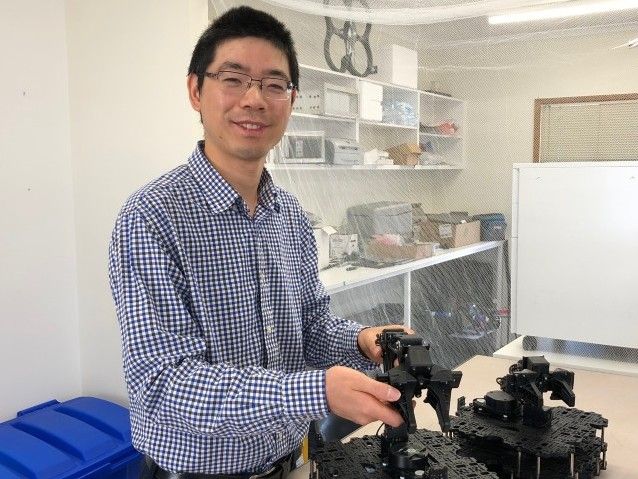
Murdoch University's Dr Hai Wang will build bespoke robots to provide real time monitoring of glasshouse plant growth.
Murdoch University
Earlier this year, a solar glasshouse developed by WA-based smart building materials company ClearVue Technologies, opened on the Murdoch campus.
It is fitted with clear solar photovoltaic glass panels that let visible sunlight in while using invisible light to generate electricity. The PV panels generate power to run the glasshouse air-conditioning system, lighting, fans, louvres, blinds and reticulation system to provide an optimum growing environment.
To understand how plants grow differently in the ClearVue glasshouse has proved to be very labour intensive with people required to monitor and regularly record germination rates and speed, plant height, leaf number, flowering time and fruit colour and yield.
Dr Hai Wang, Murdoch University Senior Lecturer in Electrical Engineering robotics and mechatronics expert from the Harry Butler Institute, has secured a Research & Innovation Seed Grant to build bespoke intelligent autonomous robots to conduct real-time crop monitoring.
“These robots will be equipped with high-resolution cameras and sensors and will work day and night recording information on crop physiological characteristics and growing environments,” Dr Wang said.
“They will have a mobile base and be able to move around the room autonomously using modern advanced control and artificial intelligence-based navigation techniques. The cameras will continuously take images of the crops every certain period while the sensors will measure humidity, temperature and other changes in the environment.
“They will have the capability to collect data on the way plants are growing, as well as valuable information like chlorophyll content, flowering time, harvest time, fresh biomass, the rate of CO2 entering and H20 exiting the leaves, and leaf health.”
Professor Chengdao Li, one of the world’s top researchers on crop genetics, has oversight of the Murdoch glasshouse precinct and also wants the research project to compare growth rates between the ClearVue glasshouse and a standard glasshouse that sits alongside.
“This solar glasshouse facility is a world first. Everything is new and there’s a lot we don’t know about the impact of plant growth in this facility,” Professor Li said.
“Anecdotally, we can see that compared to a standard glasshouse, some crops are growing faster in the ClearVue glasshouse and others are growing slower. We need to understand why, get the data and then in future, we might be able to build bespoke solar glasshouses that provide absolutely optimal growing conditions for different crops.”
Research Associate Hao Luo said as part of the research project, the ClearVue and standard glasshouses would be set up identically and monitored for six months.
“The bench position and rotation of benches, the amount of soil, water and fertiliser used, and the temperature will be exactly the same,” he said. “The robots will be doing exactly the same work at exactly the same time.”
Dr Wang said the project was an example of a great collaboration between two Murdoch research institutes – Harry Butler and Food Futures.
Once we observe the differences between the solar and standard glasshouses, we can optimise our robot system and maximise productivity in the solar-powered glasshouse.
“We would like to implement our theoretical research into practical areas and this is a very promising area. We also believe the technique could be further extended to many other industries, including real-time livestock monitoring, bushfire monitoring, mining inspection and autonomous agriculture.”
Dr Wang’s research is one of 21 projects funded through the Research & Innovation Seed Grants for Murdoch early to mid-career researchers, with a total of $302,000 allocated.
Announcing the grants, Acting Deputy Vice Chancellor Research & Innovation Professor Peter Davies said the standard of application was very high.
“All the successful applicants put forward projects that we felt could develop into full-blown research programs over time - they just needed a kickstart and that’s what this funding program is looking to provide,” he said.

Other news from the department science








Most read news








More news from our other portals






















See the theme worlds for related content
Artificial intelligence (AI) for food and beverages
Artificial intelligence (AI) is optimizing the food and beverage industry through automated quality control and more accurate demand forecasting. AI plays a particularly important role in product development by analyzing taste preferences and market trends. This allows new products to be developed that are better tailored to consumer needs, increasing efficiency and customer satisfaction.

Artificial intelligence (AI) for food and beverages
Artificial intelligence (AI) is optimizing the food and beverage industry through automated quality control and more accurate demand forecasting. AI plays a particularly important role in product development by analyzing taste preferences and market trends. This allows new products to be developed that are better tailored to consumer needs, increasing efficiency and customer satisfaction.
Last viewed contents

Julia Herz Named Executive Director of the American Homebrewers Association - Veteran craft beer advocate returns to the Brewers Association in new role devoted to the hobby of homebrewing
Ingredion invests to expand portfolio of plant-based proteins

Join the Uni Food Day about development of healthy foods

Coca-Cola acquires Moxie, soda beloved in Maine
Infarm targets a net-zero future - Vertical farming company Infarm has announced its science-based targets as part of its commitment to change food systems for good

A Collective Led By Ashton Kutcher And Guy Oseary Announced Today It Is Partnering With Cultivated Meat Leader MeaTech
Creating the leading Food Ingredients Distributor in the North American market - Brenntag to acquire JM Swank

Fairtrade Increases Banana Minimum Price as Producers Face ‘Financial Squeeze’ - The Fairtrade Minimum Price will provide ‘vital support’ to struggling producers

The 2017 corn crop heading into pollination

Sweetening with Sweet Potatoes: Carolina Sweet Replaces Undesirable Ingredients - The vegetable-based sweetening solution is a lower calorie alternative to other popular natural sweeteners

Natural food more mouth-watering to children than processed fare - Children are more likely to prefer foods they believe to be natural to man-made options, rating them higher for tastiness, safety and desirability, a study shows
