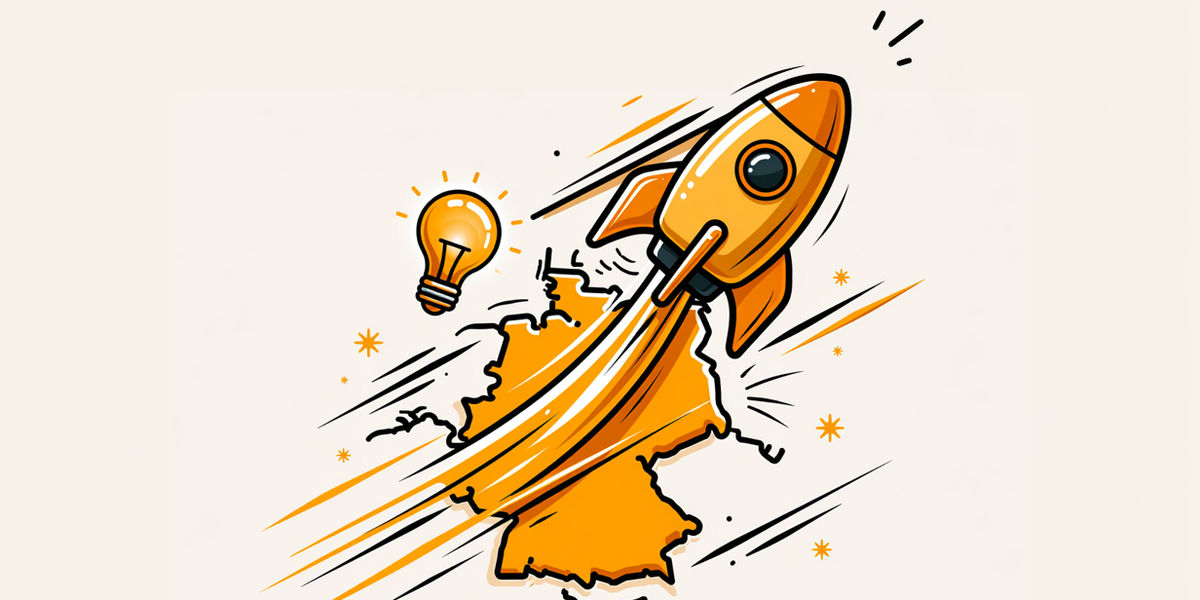
Germany Breaks Its Own Record for New Startups: More Than 3,000 New Startups in Just Six Months
"Germany is seeing more startups than ever—now we need to scale up"
Advertisement


The German startup ecosystem is off to a strong start in 2026: Between January and June, 3,053 new startups were founded. This represents a 52 percent increase compared to the second half of 2025 and means more startups were founded than in all of 2024. This is shown by the latest data from the report series “Next Generation – New Startup Foundings in Germany,” which the Startup Association has been publishing biannually since 2022 in collaboration with startupdetector.
“Over 3,000 new startups in six months—Germany has never seen such dynamic startup growth,” says Verena Pausder, CEO of the Startup Association. “AI significantly lowers the barriers to starting a business, and more and more people are seizing this opportunity. For the startup boom to turn into a growth boom, policymakers must now deliver on the issue of capital—otherwise, the ideas will be born here but the champions will emerge elsewhere.”
June Breaks All Records – Growth Rate Nearly Twice the Long-Term Average
The clear upward trend that began in mid-2025 continues to gain momentum: With over 600 new startups, June 2026 was the strongest month for startup activity since the survey began in 2019. Current startup activity is thus roughly twice the long-term average. In addition to the tailwind from AI, the overall economic situation and the tight labor market are also playing a role: For many talented individuals, starting their own business is becoming an attractive alternative, while established companies have become significantly more cautious about hiring new employees.
“The startup boom is no longer a phenomenon limited to individual hotspots,” says Dr. Felix Engelmann, co-founder of startupdetector. “We’re seeing the biggest growth precisely where startups intersect with strong industry and excellent universities—from Hamburg to Hesse to Baden-Württemberg.”
All federal states are seeing growth—with Hamburg experiencing the strongest surge
The startup wave is sweeping the entire country: The number of new startups is rising in all 16 federal states, led by Bavaria (626 new startups, 48% more than in H2 2025), North Rhine-Westphalia (539, +45%), and Baden-Württemberg (377, +55%), which recorded the largest absolute increases.
However, the winner of the half-year is Hamburg: Startup activity in the Hanseatic city grew by 83 percent to 212 new startups, meaning that, in absolute terms, more startups were founded in Hamburg than in Munich for the first time in several years. Although the capital (429) remains the clear number one among cities, its growth rate of 21 percent is significantly slower than that of the rest of the country.
In terms of population, in addition to the aforementioned metropolises—Munich (1st place), Berlin (2nd place), and Hamburg (6th place)—the major cities of Düsseldorf (tied for 2nd place with Berlin), Frankfurt am Main (5th place), and Cologne (9th place), as well as the university cities of Aachen (4th place), Potsdam (7th place), and Heidelberg (10th place).
One in three new startups focuses on AI
Artificial intelligence is the key driver of the boom: 1,038 of the newly founded startups have a clear AI focus—more than one in three—and thus more than in all of 2025. The software sector remains by far the strongest industry, with 844 new startups. But the boom is also evident in other fields: Medicine (274) and the food sector (181) are among the sectors with the highest number of new startups—AI applications and related technological advances are also key drivers of development here.
128 new startups can be attributed to the industrial sector—an increase of 125 percent compared to the second half of 2025. This is an exciting development, particularly in light of the growing challenges involved in transforming the established economy toward climate neutrality and the current question of how German industry can continue to hold its own in global competition in the future.
36 unicorns—but the exits are heading to the U.S.
Things are also happening at the top of the ecosystem: Six new unicorns have emerged since the beginning of 2026. In total, Germany now has 36 startups valued at billions. However, an international comparison reveals a widening gap compared to the U.S.—where there are around 900 unicorn startups. Most recently, two German unicorns, Tubulis and Contentful, were acquired by U.S. corporations.
Verena Pausder comments: “To create global champions ‘Made in Europe,’ we need a strong European capital market. The WIN initiative must be made a priority in government policy, and existing tax and regulatory barriers to venture capital must be replaced with incentives. The federal government is heading in the right direction with its pension reform: Now we must ensure that venture capital is firmly anchored in all three pillars of the pension system.”
Note: This article has been translated using a computer system without human intervention. LUMITOS offers these automatic translations to present a wider range of current news. Since this article has been translated with automatic translation, it is possible that it contains errors in vocabulary, syntax or grammar. The original article in German can be found here.


Other news from the department business & finance












Most read news






More news from our other portals






















Something is happening in the food & beverage industry ...
This is what true pioneering spirit looks like: Plenty of innovative start-ups are bringing fresh ideas, lifeblood and entrepreneurial spirit to change tomorrow's world for the better. Immerse yourself in the world of these young companies and take the opportunity to get in touch with the founders.
See the theme worlds for related content
Artificial intelligence (AI) for food and beverages
Artificial intelligence (AI) is optimizing the food and beverage industry through automated quality control and more accurate demand forecasting. AI plays a particularly important role in product development by analyzing taste preferences and market trends. This allows new products to be developed that are better tailored to consumer needs, increasing efficiency and customer satisfaction.
Artificial intelligence (AI) for food and beverages
Artificial intelligence (AI) is optimizing the food and beverage industry through automated quality control and more accurate demand forecasting. AI plays a particularly important role in product development by analyzing taste preferences and market trends. This allows new products to be developed that are better tailored to consumer needs, increasing efficiency and customer satisfaction.