Smoky Off-Flavors in Cocoa Aren’t Caused Solely by Smoke
Researchers show: Overfermentation can also cause undesirable flavors
Advertisement


Fermented cocoa occasionally exhibits off-flavors that can compromise the quality of chocolate and other cocoa products. But what causes these undesirable flavors? Researchers at the Leibniz Institute for Food Systems Biology at the Technical University of Munich have now shown that overfermentation of cocoa beans can cause smoky, leathery, and cheesy off- flavors. Smoky flavors, therefore, are not necessarily attributable to smoke contamination.
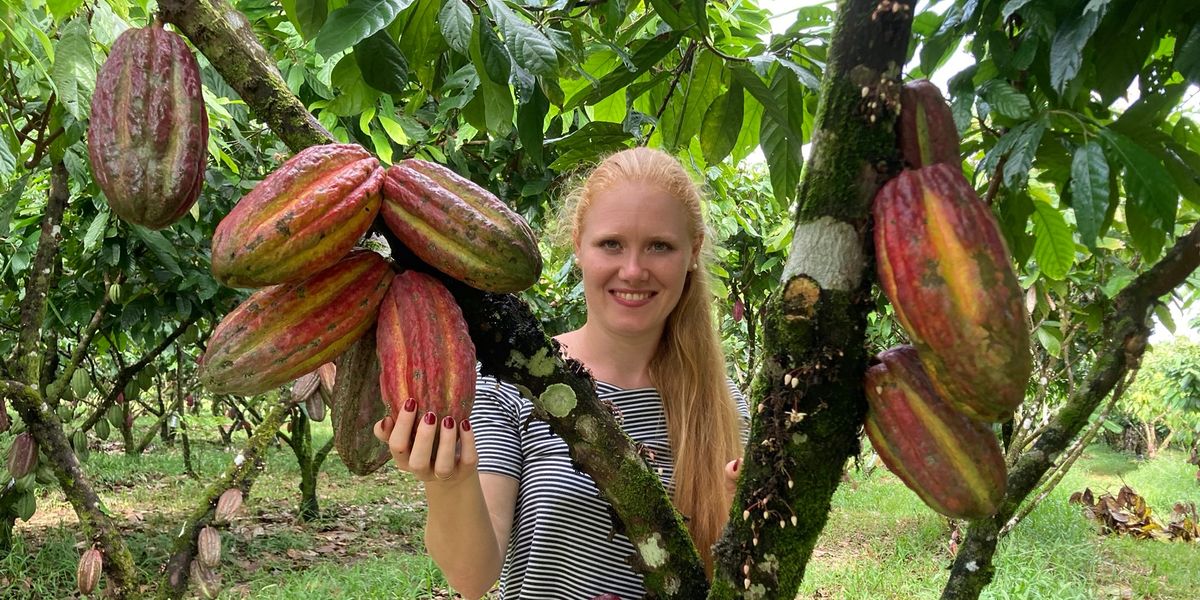
It has only been in the last few years that the odorants responsible for many cocoa off-flavors have been identified. However, how and under what conditions they arise is not yet fully understood. To get to the bottom of the causes, Franziska Krause and principal investigator Martin Steinhaus examined cocoa samples from various stages of fermentation and growing regions. Part of the work took place under real-world conditions on cocoa plantations in Nicaragua and Costa Rica, where Franziska Krause monitored the fermentation process on site.
Overfermentation promotes cheesy and smoky off-flavors
Using modern odorant analysis techniques in the laboratory, the researchers compared samples of optimally fermented cocoa beans with samples of intentionally overfermented beans. In doing so, they detected elevated concentrations of short-chain carboxylic acids in the overfermented samples. These compounds can cause off-flavors that smell like cheese, sweat, or vomit.

The overfermented samples also contained significantly higher concentrations of the compounds 2-methoxyphenol and 4-ethylphenol. Both substances have a smoky odor. While 2-methoxyphenol has a rather sweet, smoky smell, 4-ethylphenol also exhibits leathery, phenolic, and horse stable-like notes.
Better identifying and avoiding smoky off-flavors
In an earlier study, the research team had already identified and quantified off-flavor compounds typical of wood smoke contamination in cocoa beans. The new results now show that overfermented cocoa beans contain key smoke-like- smelling phenols in concentrations similar to those found in wood smoke- contaminated cocoa. “Our results thus demonstrate for the first time, objectively and at the molecular level, that smoky off-flavors can arise not only from smoke contamination but also from overfermentation,” says food chemist Martin Steinhaus.
Franziska Krause, a doctoral candidate at the Leibniz Institute, adds: “Another important finding of our study is that the quantitative spectra of the odor-active phenols differ between overfermented and wood-smoke- contaminated cocoa. These differences could help to identify the causes of smoky off-flavors more reliably in the future.”
However, the study not only provides new insights into the causes of off- flavors but also offers a practical approach to process control: At both study sites, the pH of the cocoa bean pulp in the fermentation mass increased significantly once the optimal fermentation duration was reached. A simple measurement using test strips could therefore complement the standard temperature, color, and odor checks, helping to detect the onset of overfermentation early on and prevent the development of off-flavors.
Despite differences in climatic conditions, cocoa varieties, and fermentation methods, the samples from Nicaragua and Costa Rica showed comparable results. The study thus provides important insights for the production of high-quality cocoa and for ensuring the sensory quality of cocoa products. Future research will now aim to clarify which microorganisms are involved in the formation of the identified compounds and at what concentrations these are actually perceived as off-flavors by consumers.
Original publication



Other news from the department science