Majority of healthcare professionals consider national dietary guidelines to be inadequate
A study involving 118 experts across six continents shows that legumes are underrepresented, while meat and dairy are overrepresented
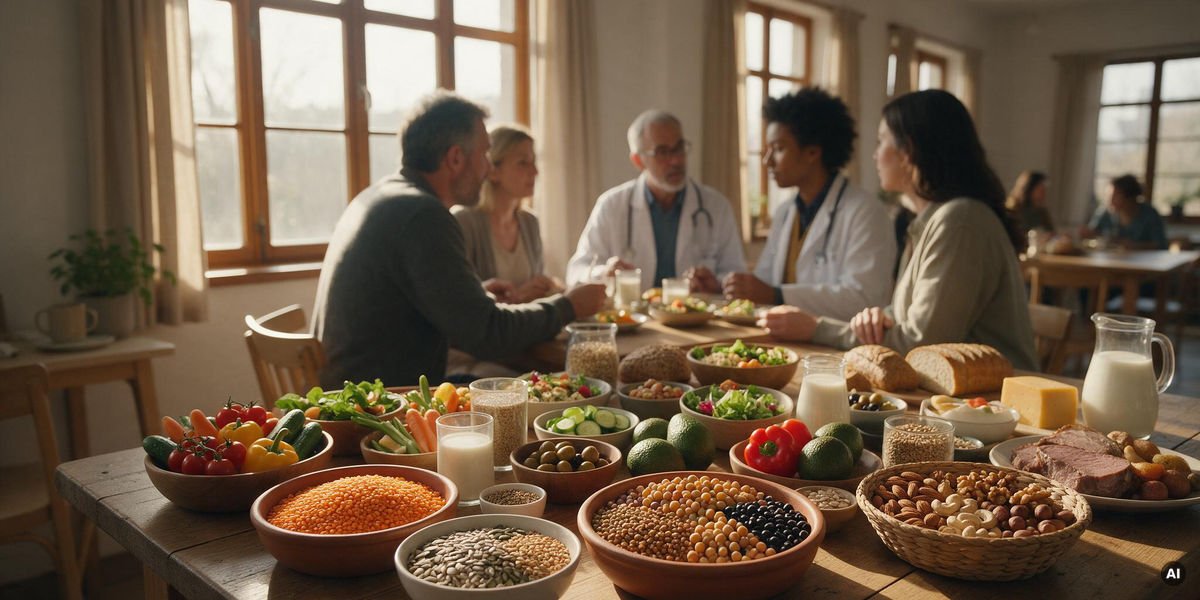
According to a new study by the University of Göttingen, Fulda University of Applied Sciences, and the nutrition organization ProVeg, published in the peer-reviewed journal *Current Developments in Nutrition*, professionals on every continent face similar obstacles when implementing national dietary guidelines.1 The team of authors, led by Anna-Lena Klapp, conducted 20 qualitative interviews across six continents as well as a global quantitative survey of 118 experts. The common consensus: National dietary guidelines lag behind the current state of scientific knowledge, overemphasize meat and dairy, and neglect healthy, plant-based alternatives.
Dietary guidelines, such as those from the German Nutrition Society (DGE), provide recommendations to the public and underpin national policy in the areas of nutrition, health, and education. According to the Food and Agriculture Organization (FAO), more than 100 countries worldwide have issued national guidelines covering approximately 90 percent of the world’s population.2 Health and nutrition professionals translate these guidelines into people’s daily lives: dietitians, nutritionists, and doctors translate them into concrete recommendations for their patients. Accordingly, the professionals surveyed expressed clear expectations.
Missing the Mark?
More than half of healthcare professionals worldwide (57.6 percent) rate their national guidelines as only moderately or slightly helpful in promoting healthy and sustainable food choices. Experts from high-income countries such as Germany are particularly critical.
Above all, legumes (62.7 percent), but also plant-based milk alternatives (47.5 percent) and nuts and seeds (42.4 percent) are underrepresented in the official recommendations, according to respondents. In contrast, most health professionals consider traditional dairy products (65.3 percent) and meat (60.2 percent) to be overrepresented. More than four out of five professionals advocate for the inclusion of plant-based alternatives to meat, milk, and dairy products, combined with guidance on healthy product selection, such as recommendations for low salt and sugar content.3 4 5
In most countries worldwide, there is a significant gap between national dietary guidelines and the actual diets of the population. Excessive meat consumption and insufficient vegetable intake are widespread. In Germany, average per capita meat consumption stands at 54.9 kilograms per year.6 The DGE recommends less than one-third of this amount.7
The Counseling Dilemma in Practice
The respondents’ criticism goes even further: In interviews, participating physicians consistently reported a lack of nutrition education during medical school. A physician from Germany summed up the shortcoming: “We don’t have an explicit course on nutrition in medical school. [I] remember perhaps hearing the term ‘DGE’ once or twice, but I can’t recall having gained any substantial knowledge about healthy eating.” And yet, for many people, doctors are the first point of contact when it comes to nutrition questions.
For their counseling practice, these professionals would also like to see closer integration between health and nutrition institutions. “I don’t view the German Nutrition Society (DGE) as a stakeholder in medicine at all, and that would be important,” notes a doctor from Germany. “We have a professional association for healthy eating; its flyers should be available on hospital wards, just like the flyers from the railway company [...]. Why aren’t there any DGE flyers there? I can imagine a bit more proactive collaboration in this area.”
System Design Rather Than Individual Responsibility
Experts do not place the responsibility for daily eating habits solely on the individual but hold policymakers and everyday conditions accountable. Nearly two out of three respondents (65.3 percent) call for price reductions on healthy and sustainable foods, for example through tax breaks or subsidies. Furthermore, 47.5 percent stated that dietary guidelines should include information on healthy and sustainable eating for those on a tight budget.
“There are many measures that people call for in surveys: healthy institutional food services, regulations or changes to taxes, and healthier food environments overall,” emphasized a German physician in an interview. “Politicians always listen to surveys [...] except when it comes to nutrition.” Nevertheless, the doctor senses momentum: “I have the feeling that there’s a lot of momentum building right now.”
Healthy school meals that meet dietary guidelines are considered a key lever by experts. In five German states—Berlin, Bremen, Hamburg, Saarland, and Thuringia—compliance with the DGE guidelines for school meals is mandated by law. Just over two-fifths of the professionals surveyed (42.4 percent) call for mandatory national nutrition standards in public cafeterias: in schools, daycare centers, and hospitals.
Transparent Development of Guidelines
A previous study led by Anna-Lena Klapp found in 2022 that national guidelines in countries where meat production accounts for a large portion of the gross domestic product are less likely to include plant-based options. Furthermore, 83 percent of the professionals surveyed view the influence of the industry as a barrier to the implementation of healthy guidelines. 99.1 percent of them call for a fully transparent development process. A German physician viewed positively the fact that the DGE involved experts in the recent revision of its recommendations as part of an open consultation process. At the same time, he emphasized that a transparent process must be “free from economic and political interests.”
Note: This article has been translated using a computer system without human intervention. LUMITOS offers these automatic translations to present a wider range of current news. Since this article has been translated with automatic translation, it is possible that it contains errors in vocabulary, syntax or grammar. The original article in German can be found here.
Original publication
Other news from the department science