Portable sensor enables community lead detection in tap water
Lead contamination in municipal water sources is a consistent threat to public health. Ingesting even tiny amounts of lead can harm the human brain and nervous system — especially in young children. To empower people to detect lead contamination in their own homes, a team of researchers developed an accessible, handheld water-testing system called the E-Tongue. This device, described in ACS Omega, was tested through a citizen science project across four Massachusetts towns.

The E-Tongue is an easy-to-use device that tests for potential lead contamination in drinking water at home.
Adapted from ACS Omega 2025,

symbolic picture
computer generated picture

“I was driven by the reality that families could be unknowingly exposed to lead,” says Pradeep Kurup, principal investigator. “With the E-Tongue, we are putting knowledge and power directly into people’s hands so they can protect their health and advocate for safer water in their communities.”
Traditional water tests are costly and time-consuming, requiring specialized scientific equipment and long processing times. Furthermore, while water treatment plants do an excellent job of removing contaminants, old lead pipes and plumbing fixtures in homes can still be a source of lead contamination. To address this issue, a team of researchers led by Kurup designed a portable device called the E-Tongue that can analyze water samples and can be operated by the average person.

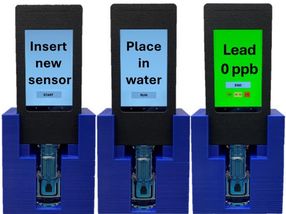
The E-Tongue works by applying a voltage to a water sample, causing any lead ions present to stick to the sensor’s gold electrode. Then, the voltage is reversed, causing the lead to come off the sensor and produce an electrical current. The strength of this current indicates how much lead is in the water sample. If lead is detected, a smartphone app linked to the device alerts the user with a color-coded reading and a concentration value that indicates the severity of contamination. A green screen indicates that the lead concentration is below the U.S. Environmental Protection Agency’s (EPA) regulatory limits. A red screen indicates that the lead concentration exceeds the regulatory limits.
To test the E-Tongue’s usability and performance, the researchers worked with 317 residents from four local towns. The residents first combined a sample of their tap water with a premade buffer solution in a glass vial. Then, they followed three steps on the smartphone app: click “start” after placing the sensor into the vial, click “run” to begin the test and click “end” to save test results and share them with the researchers and local municipalities. If lead was detected above the EPA’s maximum allowed level of 10 parts per billion, the researchers verified the results through a certified laboratory using traditional detection methods to ensure E-Tongue’s accuracy.
The researchers found that:
- The amounts of lead contamination in tap water samples varied across the four Massachusetts towns.
- Ten of the 634 samples collected by the residents exceeded the EPA’s maximum allowed level of lead, with several other samples approaching this value.
- The E-Tongue’s readings were as accurate as traditional laboratory tests.
This study demonstrates the effectiveness of the E-Tongue as a rapid and reliable device for at-home detection of lead in drinking water. The researchers hope this tool will soon be a practical option for detecting and mitigating heavy metal contaminants in municipal water sources, thereby empowering communities to keep themselves safe.
The authors acknowledge funding from the National Science Foundation.
Original publication
Other news from the department science