Mushroom Containers on the Research Campus: Fraunhofer Tests Urban Food Production
The Fraunhofer Institute Center in Stuttgart, in collaboration with Kleinblatt and Fungi Feeds, is testing mushroom containers as a building block for the food supply of the future
Advertisement


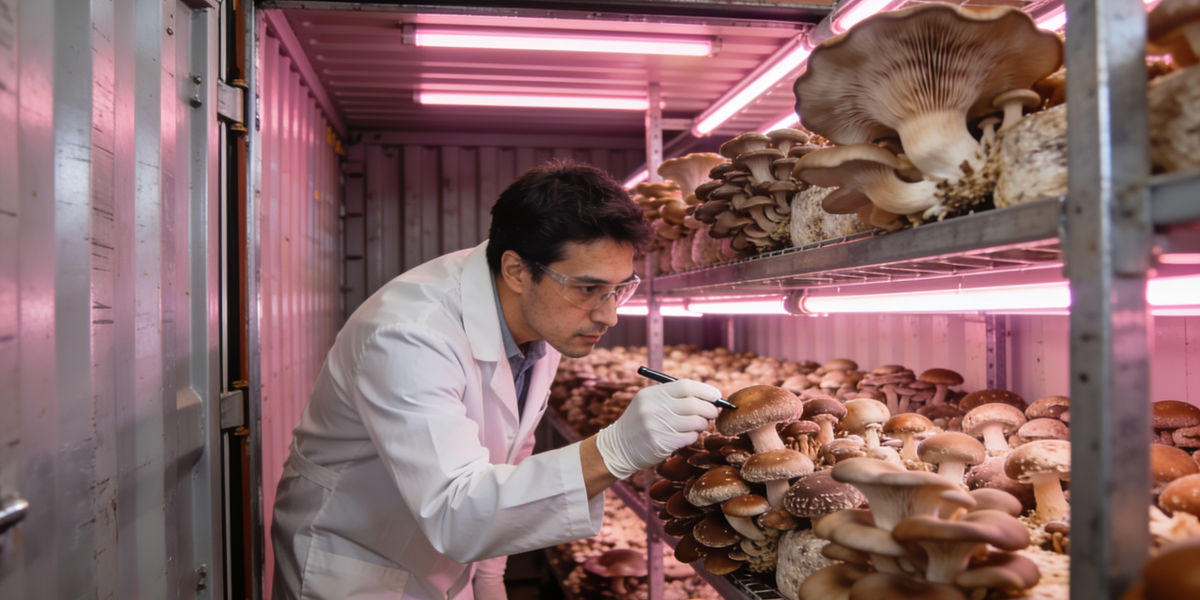
A 12-meter-long mushroom container for the Fraunhofer Campus: Since June, the Fraunhofer Institute Center in Stuttgart has been collaborating with Kleinblatt and Fungi Feeds as part of the “Stuttgart Climate Tech Hub” to test how food can be produced locally, in a resource-efficient manner, and regardless of weather conditions.
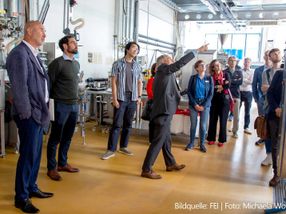
With rising demand and a growing market, edible mushroom cultivation is considered a promising component of sustainable food production. Container-based solutions require little space, integrate well into urban areas, can be operated in a completely climate-neutral manner, and—thanks to controlled environmental conditions—enable year-round mushroom cultivation. Since mid-June, a mushroom cultivation container over twelve meters long has been on the grounds of the Fraunhofer Institute Center Stuttgart (IZS). As part of the “Stuttgart Climate Tech Hub (S-CTH)” project platform, the research campus is an ideal location for the container operated by the Stuttgart-based AgTech company “Kleinblatt” and the FoodTech startup “Fungi Feeds.” Kleinblatt is already growing seedlings and gourmet mushrooms locally in the heart of the city at a so-called “city farm” for regional restaurants. The new mushroom container expands production capacity for both regional supply and nationwide distribution. With Kleinblatt and Fungi Feeds, the S-CTH gains two technology partners that are driving innovative FoodTech product development, regional food production, and the circular economy. The S-CTH is responsible for the operational implementation of the container.
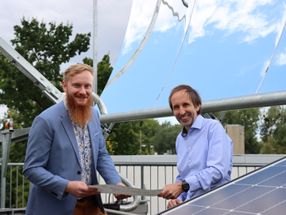
“The collaboration with local partners such as Kleinblatt and Fungi Feeds demonstrates how, through the S-CTH, we can offer companies the ideal operational framework while simultaneously supporting them—through our research expertise and network—in testing such novel approaches to sustainability and, above all, integrating them with other technologies.” Dr. Steffen Braun, project initiator and deputy director at the Fraunhofer Institute for Industrial Engineering IAO

Mushroom Cultivation in Containers: Climate-Friendly and Efficient
Container-based mushroom cultivation enables highly efficient, consumer-oriented, and consistent production of edible mushrooms compared to conventional outdoor cultivation. By controlling environmental conditions such as temperature, humidity, and CO₂ levels, edible mushrooms can be cultivated year-round in a space-saving and predictable manner. Under favorable conditions, several hundred kilograms of edible mushrooms can be harvested each month, and these are considered a high-quality “superfood” rich in bioactive nutrients. While Kleinblatt supplies the freshly harvested gourmet mushrooms to restaurants, hotels, and institutional food service providers in the region, Fungi Feeds makes the products available to private customers. In addition, innovative premium foods based on mushrooms are being developed and processed into products such as mushroom bratwurst, mushroom steak, mushroom ground meat, and a plant-based interpretation of foie gras. This creates a seamless value chain on the Fraunhofer Campus, spanning from regional production to innovative food processing. Local mushroom cultivation facilities thus strengthen supply security and resilience, as well as the regional circular economy.
“The demonstrator at the Fraunhofer Campus marks the first building block of a modular and decentralized food infrastructure. The concept aims to show how regional food production can be made more resilient to climate change and supply chain disruptions in the future. In the long term, Kleinblatt, together with Fungi Feeds, is pursuing the vision of a network of modular production units that supply cities and regions with fresh mushrooms and innovative mushroom products on a regional basis.” Jedrzej Cichocki, Managing Director of Kleinblatt GmbH and co-founder of Fungi Feeds GmbH
S-CTH: Innovation Platform for Climate-Neutral Technologies on Campus
The “Stuttgart Climate Tech Hub (S-CTH)” project is creating an innovative multi-project platform at the Fraunhofer Institute Center in Stuttgart, as well as a modular and regulatory test bed for climate-neutral technologies, sustainable transformation, and co-innovation between research and industry. All five Fraunhofer Institutes based there—Fraunhofer IAO, Fraunhofer IBP, Fraunhofer IGB, Fraunhofer IPA, and Fraunhofer IRB—are participating. The Baden-Württemberg Ministry of Economic Affairs, Crafts, and Tourism is funding the project with over four million euros through the end of 2027.
Companies as Key Players for Future Projects
Interested companies can become part of the growing partner network surrounding the Climate Tech Hub Initiative and proactively contribute their own demonstrators, technologies, or research questions. To this end, the S-CTH provides the necessary, open infrastructure as well as the scientific expertise of the five Fraunhofer Institutes on campus for these projects. The S-CTH thus creates a unique research and testing environment where innovative ideas for climate and resilience technologies can be developed, tested, scaled, and further refined to market readiness for numerous properties and corporate locations.
Note: This article has been translated using a computer system without human intervention. LUMITOS offers these automatic translations to present a wider range of current news. Since this article has been translated with automatic translation, it is possible that it contains errors in vocabulary, syntax or grammar. The original article in German can be found here.



Other news from the department science