Deworming medication for grazing animals disrupts the food chain between plants and insects
Moxidectin enters strawberry plants through the soil and feces, where it triggers a tenfold increase in aphid reproduction
Advertisement


A commonly used antiparasitic agent enters plants and insects through the soil—and disrupts the ecological balance there.
Researchers at Christian-Albrechts-University of Kiel (CAU) and the University of Trier have demonstrated for the first time that a widely used deworming agent for grazing animals not only harms individual plants and insects but also alters entire ecological networks. The study examined the active ingredient moxidectin in the product Cydectin®, which farmers frequently use to treat parasites in grazing animals.
It was previously known that deworming agents can affect individual species: for example, the seeds of typical grassland plants alter their germination behavior when they come into contact with deworming agents. Beetle and fly larvae living in the feces of treated grazing animals show lower survival rates. Until now, no one had investigated how these effects impact the interactions among multiple species.
Grazing livestock farmers use deworming agents to keep their animals healthy and operate efficiently. Therefore, doing without these treatments is usually not an option. The product studied contains the active ingredient moxidectin. This belongs to the group of macrocyclic lactones—antiparasitic agents with long-lasting effects. The animals’ bodies hardly break down the active ingredient at all. As a result, large amounts of it end up in the soil via the feces of treated animals—or when farmers fertilize their fields with liquid manure or solid manure.
Fewer Fruits, More Aphids
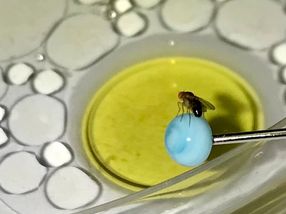
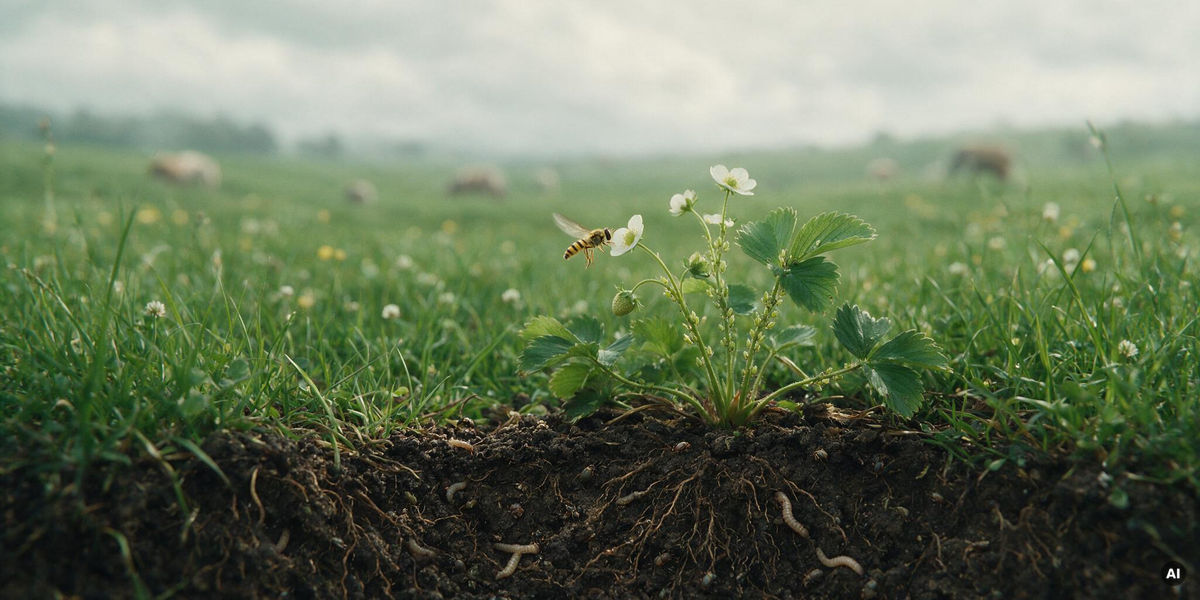
For their study, the researchers recreated a food chain using a simple model. They combined three species: the cultivated strawberry, the green peach aphid, and the hoverfly. The strawberry plant served as food for the two insects. The aphid sucked plant sap. The hoverfly fed on pollen and nectar from the flowers as an adult and ate the aphids during its larval stage. The team placed the animals and plants in small, insect-proof cages. Half of the cages contained strawberry pots with soil treated with a nematicide, while the other half contained untreated control plants. The researchers then recorded how many fruits the plants produced, how many aphids were present on the plants, and how many eggs the hoverflies laid.
All three species reacted to the dewormer: Under the influence of the dewormer, the strawberry plants produced about a quarter fewer fruits, and the aphids multiplied ten times more rapidly—though only when no hoverfly larvae were present. One possible explanation: The nematicide weakens the plant’s defenses against aphids. The hoverflies also reacted: Females that visited the flowers of nematicide-treated plants laid four times as many eggs. However, these eggs were more uneven in size and appeared less vigorous. Ultimately, this could reduce the reproductive success of the hoverflies.
“We were surprised at how profoundly a single product can alter the interaction between plants and insects,” says Dr. Andrés García. “This shows that when evaluating veterinary drugs, we must consider not only individual species but entire ecological relationships.”
It remains unclear exactly how the dewormer triggers these effects. Further studies are planned to determine the respective contributions of the active ingredient moxidectin, the other ingredients, and their degradation products to these effects, as well as how they are passed along the food chain. The authors of the study call for greater consideration of complex ecological relationships between species in the future when investigating the environmental impact of veterinary drugs.
Andrés García, Tim Diekötter, Jitin Sabu, Laura Olivia Greene, Lilli Kuhtz, Tobias W. Donath, and Carsten Eichberg recently published their findings in the journal *Science of the Total Environment*. Lead author Andrés García conducted the study as part of a Georg Forster Research Fellowship from the Alexander von Humboldt Foundation.
Note: This article has been translated using a computer system without human intervention. LUMITOS offers these automatic translations to present a wider range of current news. Since this article has been translated with automatic translation, it is possible that it contains errors in vocabulary, syntax or grammar. The original article in German can be found here.
Original publication


Other news from the department science