Global yield models underestimate how strongly rice responds to extreme heat
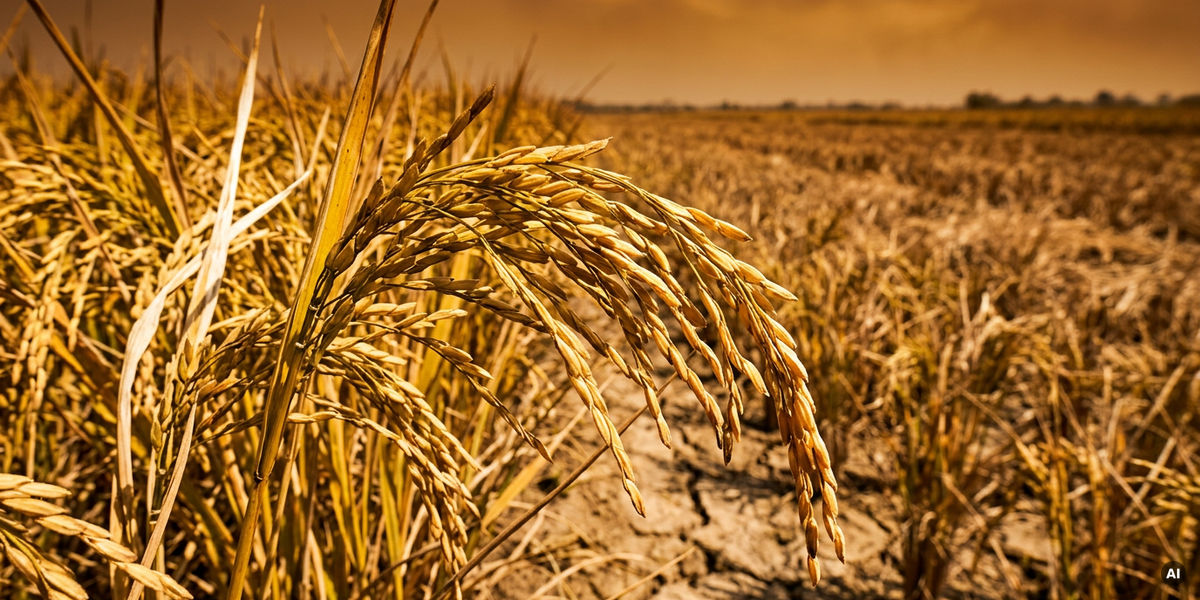
A new study published in the journal *Science Advances* examines how rising temperatures affect rice yields. To do so, it compares 214 observations from field experiments with simulations from seven global yield models. According to the study, the models significantly underestimate temperature-related yield losses associated with 1-degree global warming: they predict a decline of 3.8 percent, whereas the experimental results indicate a decline of 8.1 percent. The study was led by the Helmholtz Centre for Environmental Research (UFZ), with the Potsdam Institute for Climate Impact Research (PIK) also participating.
Rice is a staple food for more than half of the world’s population. Estimates of how climate change will affect rice production vary widely. One reason for this is that many scientific studies have so far only to a limited extent distinguished between the gradual effects of higher average temperatures and the immediate damage caused by extreme heat.
In the new study, the researchers analyzed 214 observations from field experiments. The results show that intense heat—that is, temperatures above 30 degrees Celsius—is the most important factor contributing to yield losses caused by warming. At more than 70 percent of the sites studied, heat was responsible for more than half of the absolute change in yield.

A comparison with seven global yield models, however, shows that these models are less sensitive to heat extremes than the observations from the experiments.
“The discrepancy between observations and models seems to stem primarily from the fact that many current yield models do not yet adequately account for heat damage during the reproductive phase of rice. The study’s observations show that rice is particularly vulnerable to extreme heat precisely when panicles and grains are developing,” explains lead author Yiwei Jian of the Helmholtz Centre for Environmental Research.
After the researchers adjusted the model results based on the observational data, their analysis revealed that global rice yields would decline by an average of 8.1 percent solely due to the temperature effect if the global mean temperature were to rise by 1 degree Celsius. That is roughly twice as much as the original estimate of 3.8 percent from the crop yield models. The authors emphasize that this calculation takes only temperature effects into account and therefore should not be interpreted as a complete forecast of future rice production.
“For the models, this is a significant jump. The result underscores that the expected yield losses are determined not only by average temperatures but especially by heat extremes. This is quite easy to understand: When we check the weather forecast in the summer to prepare for the heat, we’re primarily interested in the daily high, not the daily average,” explains Christoph Müller, a PIK researcher and co-author of the study.
The adjustment to the model results also changes the geographic pattern of the expected yield losses. The estimates for yield losses are revised upward most significantly for South and Southeast Asia, where rice crops are particularly frequently exposed to extreme heat. For Pakistan, India, and Bangladesh, the estimated yield loss rises from 2.1 to 6.6 percent. For Thailand, the Philippines, and Myanmar, it increases from 3.7 to 7.7 percent.
The research team emphasizes the importance of adaptation measures that protect rice, particularly during its reproductive phase. These include the development and cultivation of heat-tolerant varieties, adjusted planting dates, optimized irrigation, and improved soil quality.
Note: This article has been translated using a computer system without human intervention. LUMITOS offers these automatic translations to present a wider range of current news. Since this article has been translated with automatic translation, it is possible that it contains errors in vocabulary, syntax or grammar. The original article in German can be found here.
Original publication
Other news from the department science