Sprayable mulch made from renewable raw materials for weed suppression
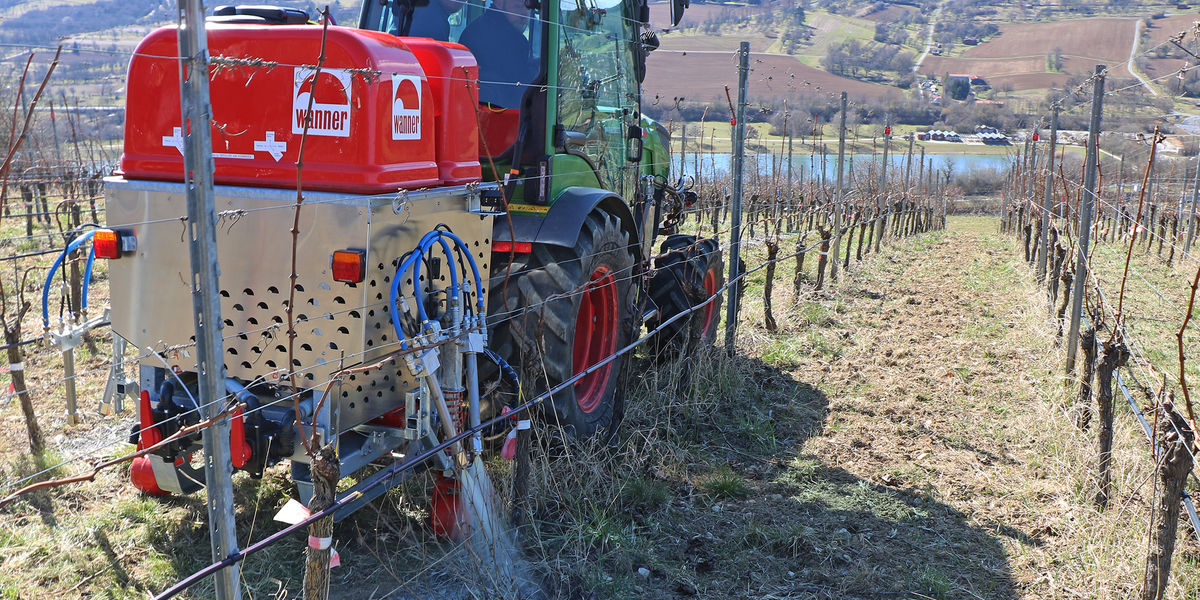
The sprayable LiquiMulch gels after application and forms a physical barrier against weed growth
To protect crops in fruit, wine, and vegetable cultivation from competing weeds, scientists at the Technology and Support Center (TFZ) in Straubing have developed a sprayable mulch material. It is made from renewable raw materials and biodegrades completely after it has served its purpose. The material, called LiquiMulch, is intended to help reduce the use of plastic films and herbicides in agriculture. The TFZ has now published two research reports on the subject.
Weed management poses a major challenge in fruit, vegetable, and grape cultivation, as weeds compete directly with crops for water and nutrients. At the same time, the use of chemical herbicides is increasingly restricted, while mechanical methods are labor-intensive and plastic mulch creates plastic waste. Against this backdrop, scientists at the TFZ have developed a sprayable mulch material based on renewable raw materials. LiquiMulch consists of two liquid components. In addition to the carrier liquids—rapeseed oil and water—the material contains starch, the gelling agent sodium alginate, and cellulose fibers. The mixture can be sprayed onto the ground in strips, where it gels within a short time and forms a continuous physical barrier that reliably suppresses the emergence and growth of weeds. The method can be flexibly adapted to different crops, as both the strip width and the application rate can be adjusted accordingly. In collaboration with the companies Hans Wanner and Amazonen-Werke H. Dreyer, suitable application equipment was developed to enable practical use.
The effectiveness of the mulch material was investigated under real-world field conditions in collaboration with the Bavarian State Institute for Viticulture and Horticulture (LWG). To this end, scientists conducted scientifically standardized field trials in vineyards, orchards, and vegetable fields under conditions that closely mimic real-world practice. The results show that LiquiMulch forms a continuous mulch layer and effectively suppresses weed growth. In addition, the material helps stabilize soil moisture, providing an additional benefit to crops, particularly during dry periods. “Due to the way it works, the material is suitable for a wide variety of applications,” says Dr. Michael Kirchinger, project manager at the TFZ. For example, the sprayable mulch material can also be successfully used to keep pasture fences clear or for weed control around the trunks of newly planted urban trees.
The completion of the research has demonstrated the practical feasibility of the process. The next step is to find an industrial partner or service provider to bring the process to market and make it available for agricultural use.
The research projects on LiquiMulch were funded by the German Federal Environmental Foundation (Optimulch) and the Bavarian State Ministry of Food, Agriculture, Forestry, and Tourism (ABOWprax and OptimulchErtrag). TFZ Research Reports Nos. 91 and 92 can be downloaded at www.tfz.bayern.de.
Note: This article has been translated using a computer system without human intervention. LUMITOS offers these automatic translations to present a wider range of current news. Since this article has been translated with automatic translation, it is possible that it contains errors in vocabulary, syntax or grammar. The original article in German can be found here.
Original publication
Bayerl, T., Räß-Mücke, J.-C., Kirchinger, M., Dressler, D., Hollmach, W., Schulz, M., Remmele, E.& Technologie- und Förderzentrum. (2026). Alternatives Verfahren zum Beikrautmanagement im Feldgemüsebau mit LiquiMulch. In Berichte aus dem TFZ (Vol. 91). Zenodo
Kirchinger, M., Menger, A., Hafner, J., Heßdörfer, D., Remmele, E.& Technologie- und Förderzentrum. (2026). Alternatives Beikrautmanagement im Obst- und Weinbau mit einem spritzbaren Mulchmaterial – LiquiMulch. In Berichte aus dem TFZ (Vol. 92). Zenodo.
Other news from the department science