Helicopter Spraying with Ambrilia in Viticulture Suspended for the Time Being
The BVL confirms: The DUH’s appeal has suspensive effect—the permit is not currently in effect
Advertisement


The German Environmental Aid Association (DUH) scored an important victory in the fight against helicopter spraying in viticulture. The DUH had filed an objection with the Federal Institute for Risk Assessment (BVL), the pesticide approval authority, against the approval for helicopter application of the pesticide Ambrilia, marketed by BASF. Ambrilia consists of the active ingredients mefentrifluconazole and fluxapyroxad, which are classified as “forever chemicals” or degrade into such substances.
On July 14, 2026, the Federal Office for Consumer Protection and Food Safety (BVL) issued the following statement regarding the DUH’s objection: “The objection has suspensive effect until further notice. This means that the approval is currently not in effect.” As a result of the approval’s ineffectiveness, the plant protection product Ambrilia (approval number: 00B221-00) may not currently be applied using aircraft (helicopters).”
The DUH views this as a landmark victory with nationwide significance. The environmental protection organization is calling on the BVL to permanently ban the application of Ambrilia and other toxic pesticides by helicopter.
DUH Federal Executive Director Jürgen Resch comments:
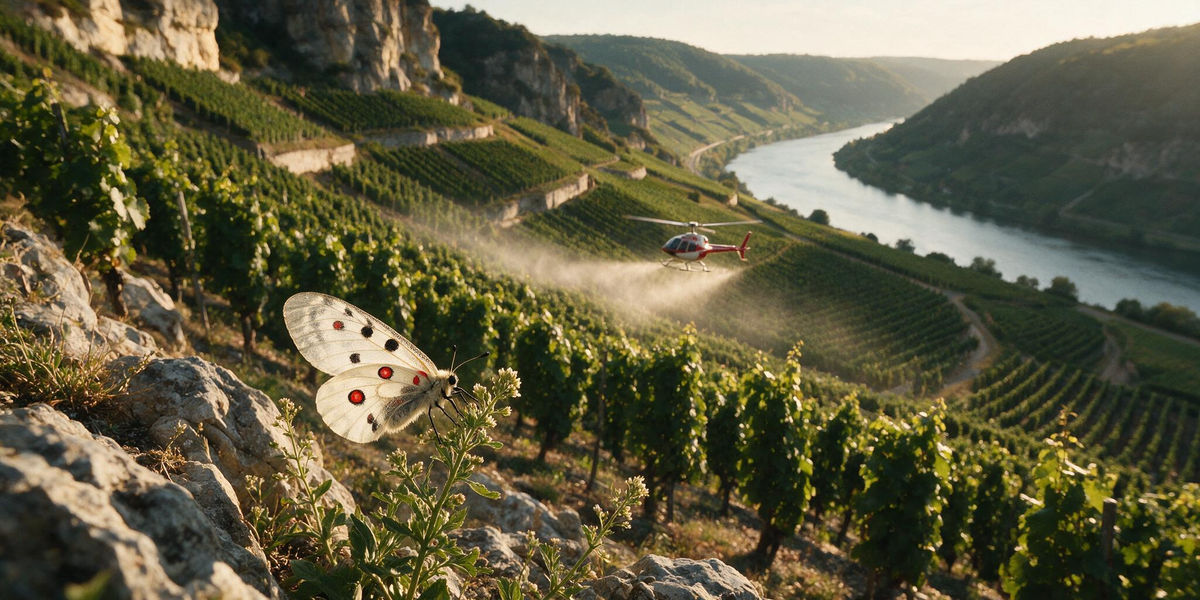
"Thanks to our objection, there is finally a long-overdue emergency brake in place for the first chemical that had previously been approved for application by helicopter. Rhineland-Palatinate has now been violating the legal principle—for 15 years—that helicopter spraying must be avoided to protect the environment and public health. The persistent chemicals involved not only pose a long-term and irreversible threat to the habitats of many rare plant and animal species in the Moselle Valley, but also to the health of the people who work, vacation, or live there. We will use all legal means at our disposal to ban helicopter pesticide spraying in viticulture that endangers the Moselle Apollo butterfly and the ecosystem in the Lower Moselle Valley. This applies to the persistent toxin Ambrilia as well as to all other pesticides that are used and have been negligently approved."
Background:
Helicopter spraying has been generally prohibited since 2011. However, the Rhineland-Palatinate state government grants short-term exemptions every year, which, in the DUH’s view, have contributed to the strictly protected Moselle Apollo butterfly now being on the brink of extinction.
The strictly protected Moselle Apollo butterfly is found worldwide only in the Lower Moselle Valley on exposed rock formations. In the Red List of Butterflies published at the end of 2025, the species is classified as critically endangered (Red List Category 1). For the past three years, the DUH has been campaigning to end the use of toxic pesticides in viticulture in the Lower Moselle Valley.
Note: This article has been translated using a computer system without human intervention. LUMITOS offers these automatic translations to present a wider range of current news. Since this article has been translated with automatic translation, it is possible that it contains errors in vocabulary, syntax or grammar. The original article in German can be found here.



Other news from the department politics & laws