Land Grabbing in the Supply Chain?
Small farmers in Brazil's Cerrado file complaints against German meat producers
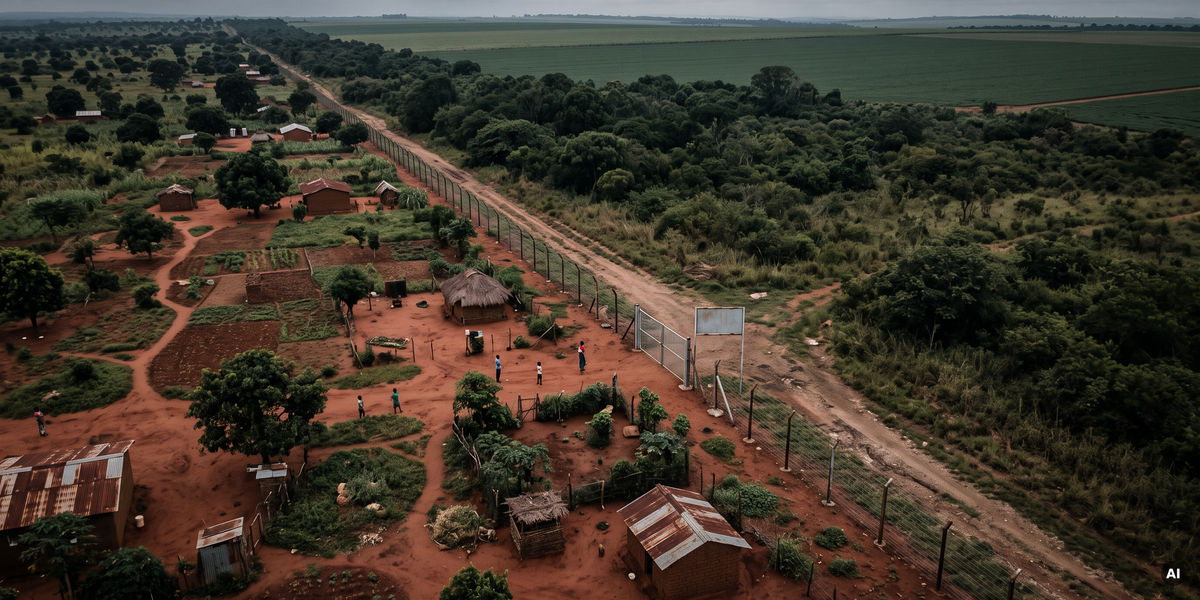
Possible Violations of the Supply Chain Act: Small-scale farmers in Brazil have filed a complaint against the German meat producers Premium Food Group (formerly Tönnies) and Rothkötter, demanding the return of their land. German authorities must investigate whether the meat companies took sufficient measures in response to indications of risks. DUH, ECCHR, ISPN, and other organizations support the complaint
Residents of the traditional territory of Capão do Modesto in Brazil’s Cerrado have filed a complaint with the Federal Office for Economic Affairs and Export Control (BAFA) against two German meat companies. They accuse the Premium Food Group (formerly Tönnies) and Rothkötter of violating the Supply Chain Due Diligence Act (LkSG). In doing so, they cite specific practices described as “green land grabbing” by actors in the Brazilian soy sector. The complaint is supported by Deutsche Umwelthilfe (DUH), the European Center for Constitutional and Human Rights (ECCHR), the Brazilian organizations Associação dos Advogados de Trabalhadores Rurais (AATR), Comissão Pastoral da Terra (CPT), Instituto Sociedade e População e Natureza (ISPN), and the British organization Earthsight. The organizations are calling on the meat producers to advocate for the return of the land to those affected and to consistently prevent human rights violations in their feed supply chains. If the meat companies fail to comply with these demands, the organizations believe sanctions by the BAFA are necessary.
Both companies were notified of potential violations of the Supply Chain Act involving soy produced in violation of human rights by the DUH and other organizations no later than 2024. Nevertheless, no effective measures in accordance with the LkSG have been evident to date. According to reports, human rights violations in Brazil are continuing and have even intensified in some places.

Sascha Müller-Kraenner, Federal Executive Director of the DUH: “The business model of industrial meat production is an attack on people, animals, and nature. The massive expansion of soybean cultivation for animal feed destroys natural vegetation, threatens biodiversity and water resources, and exacerbates land conflicts as well as human rights violations against indigenous and traditional communities. If the meat companies in question fail to fulfill their responsibilities in this regard, we will compel them to do so through legal action.”
Lisa Pitz, a lawyer at the ECCHR: “Soy suppliers in Brazil are designating token nature reserves—on land that doesn’t even belong to them. Traditional smallholder farming communities that have lived on and used this land for generations are being forcibly displaced as a result. This is not nature conservation, but neocolonial ‘green grabbing.’ If German companies knowingly profit from these practices that violate human rights, the BAFA must intervene.”
Aryelle Almeida, legal advisor at AATR: “We’re talking about families who have lived in this area for generations. Today, they face the threat of losing their land to land grabbing and must live with fences, threats, and restrictions—including on access to basic utilities like electricity. The loss of this area means far more than just the loss of their land: it threatens the history, identity, and future way of life of these communities.”
Amanda Alves, head of the Comissão Pastoral da Terra in the state of Bahia: “We have already sought solutions within Brazil, filed complaints, and exhausted all possible institutional channels, but the process is not moving forward and our communities remain under threat. That is why it has become necessary to involve international bodies. The case must also be made known outside the country so that pressure can be exerted on the companies and the relevant authorities, and concrete measures can finally be taken to guarantee our rights and ensure that families can remain in their territories.”
Background:
The complaint targets a specific form of land grabbing known as “green land grabbing” (“grilagem verde”). Green land grabbing refers to the unlawful appropriation by agribusiness conglomerates of territories that traditional communities have collectively managed for centuries, in order to declare them as ecological compensation areas for their destructive soy cultivation. According to reports and documentation, areas are fenced off and monitored by armed security forces; the freedom of movement of local people is restricted; and access to their grazing lands and natural resources is sometimes prevented through the use of force.
Note: This article has been translated using a computer system without human intervention. LUMITOS offers these automatic translations to present a wider range of current news. Since this article has been translated with automatic translation, it is possible that it contains errors in vocabulary, syntax or grammar. The original article in German can be found here.

Other news from the department politics & laws