Finally Provide Better Protection for Turkeys
Ten associations are calling for statutory minimum standards for turkey farming in Germany
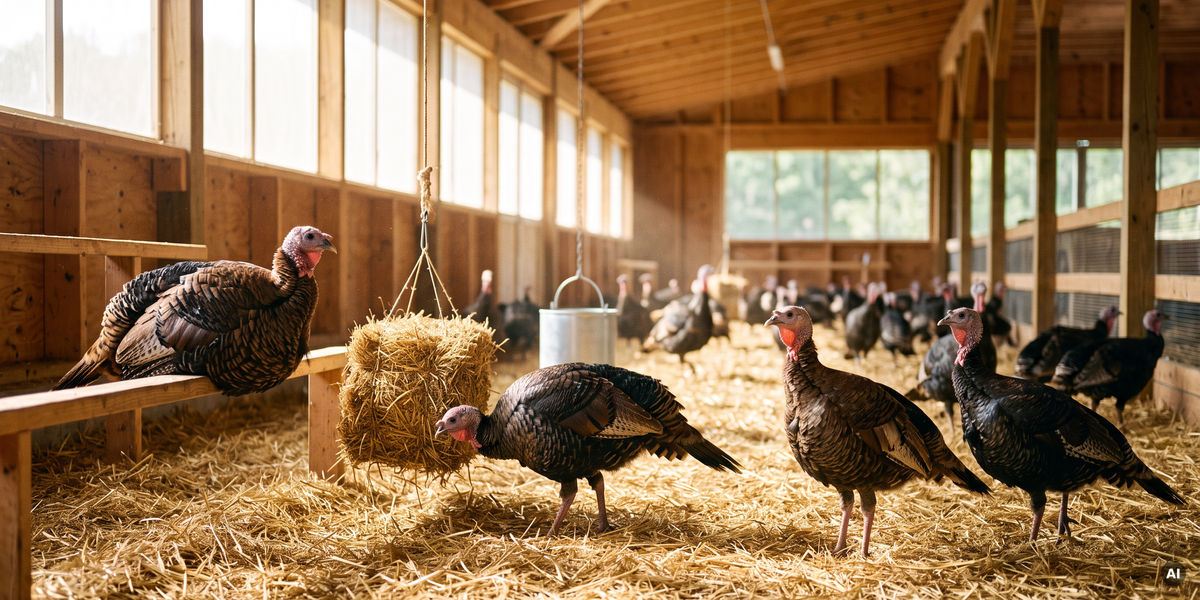
The German Nature Conservation Ring (DNR), the Albert Schweitzer Foundation, Animal Equality, the bmt, the BUND, the German Animal Welfare Association, the DJGT, People for Animal Rights, PROVIEH, and VIER PFOTEN are calling on the federal government to finally establish binding legal requirements for turkey farming and to incorporate them into the Animal Welfare in livestock farming Ordinance.
In a position paper published today, the organizations outline how inadequate the housing conditions for turkeys are in most German barns. The animals have far too little space and hardly any opportunities for enrichment. They cannot retreat, avoid other turkeys, or rest in elevated areas, even though this is in line with their natural behavior. The Federal Administrative Court has already ruled that these housing conditions violate the Animal Welfare Act. Added to this is breeding for very rapid growth, which frequently leads to leg injuries. To prevent the stressed animals from injuring one another, their beaks are routinely trimmed. However, an initiative by the federal government to finally introduce binding legal standards for their housing has yet to materialize.
“There are legal requirements for broiler chickens and laying hens, but not for turkeys. This regulatory gap is no longer acceptable. The federal government must act now instead of shifting responsibility onto courts, states, and individual local veterinary offices,” the organizations state.
Instead of binding regulations, the so-called “Uniform Federal Guidelines” have been applied to date. These are a voluntary agreement that was largely shaped by the poultry industry. It stipulates stocking densities of up to 58 kilograms of body weight per square meter for male turkeys and 52 kilograms for female turkeys. For male turkeys with a final weight of around 20 kilograms, this means that nearly three adult birds share a single square meter. On average, a female turkey has barely more space than the area of three DIN A4 sheets of paper.
In April 2026, the Federal Administrative Court also made it clear just how inadequate the industry’s guidelines are: The benchmarks do not constitute a standard for housing that complies with animal welfare law. Nevertheless, the poultry industry is pressing the Federal Ministry of Agriculture to codify the stocking densities of these benchmarks in a regulation. This would turn a court-established violation into applicable law. Yet the scientific basis for animal-welfare-compliant turkey farming already exists. In early 2026, the European Food Safety Authority (EFSA), among others, issued specific recommendations for turkey husbandry in an opinion.
“There are no more excuses. Thanks to the EFSA’s opinion, we know the minimum requirements that turkey farming must meet from an animal welfare perspective,” the associations stated.
The states are also striving for better conditions. In Lower Saxony, the state with the largest turkey population, regulations regarding the rearing of broiler turkeys are currently being discussed as part of the animal welfare plan. The organizations expect a result there that will tangibly improve conditions for the animals, but a solution in a single state does not replace nationwide regulations. It is therefore essential that the federal government finally incorporate regulations for the rearing of turkeys and other animal species into the Animal Welfare and Livestock Farming Ordinance.
The position paper was co-signed by: Albert Schweitzer Foundation for Our Common World, Animal Equality Germany e. V., German Association for the Environment and Nature Conservation (BUND), German Association Against Animal Abuse e. V. (bmt), German Nature Conservation Ring (DNR), German Animal Welfare Federation, German Legal Society for Animal Welfare Law (DJGT), People for Animal Rights—Federal Association of Opponents of Animal Experimentation, PROVIEH e. V., FOUR PAWS – Foundation for Animal Welfare
Note: This article has been translated using a computer system without human intervention. LUMITOS offers these automatic translations to present a wider range of current news. Since this article has been translated with automatic translation, it is possible that it contains errors in vocabulary, syntax or grammar. The original article in German can be found here.

Other news from the department politics & laws








Most read news










More news from our other portals

























See the theme worlds for related content
Topic world Food safety
Food safety is at the heart of the food and beverage industry. It ensures that the food we eat every day is not only nutritious, but also free of harmful contaminants. From field to plate, the industry monitors and regulates every step of the process with strict quality controls, advanced testing methods and continuous research.
Topic world Food safety
Food safety is at the heart of the food and beverage industry. It ensures that the food we eat every day is not only nutritious, but also free of harmful contaminants. From field to plate, the industry monitors and regulates every step of the process with strict quality controls, advanced testing methods and continuous research.