Gentle Encouragement for Greater Animal Welfare
Researchers at the University of Bonn tested two types of posters in a virtual supermarket—their effects were cumulative without influencing each other
Advertisement


Gentle purchasing incentives can encourage consumers to choose foods produced under higher animal welfare standards more often. This is suggested by a recent study conducted at the University of Bonn. The researchers used two different posters featuring the animal welfare label as “nudges.” Even when used individually, each poster altered the purchasing behavior of test subjects shopping in a virtual supermarket. When both posters were combined, the proportion of products meeting higher animal welfare standards in the shopping cart was highest. It remains to be seen to what extent these results can be applied to real-life shopping situations. The study was published in the Journal of Behavioral and Experimental Economics.
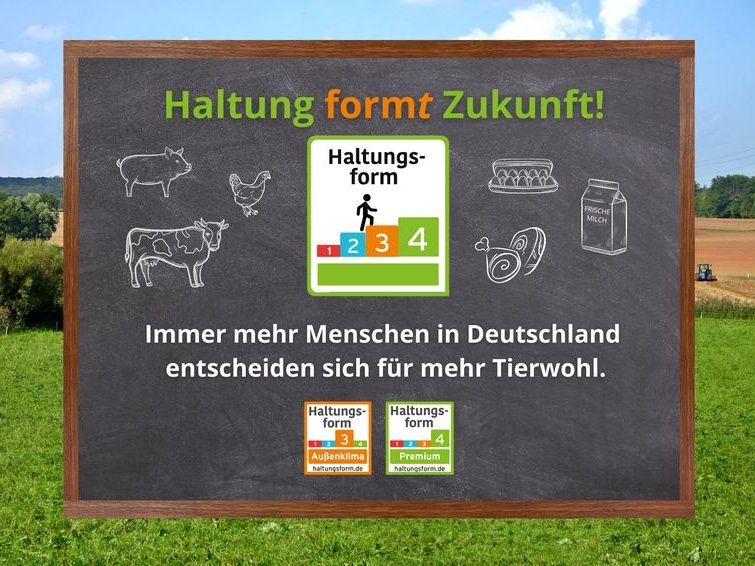
Social Norm Nudge: On a poster at the entrance to the virtual supermarket, the researchers pointed out that more and more people are choosing products with higher animal welfare standards.
Abbildung: ILR/Uni Bonn
“Nudges” are measures that help people make decisions—in a gentle way, without restricting their freedom of choice. For example, healthy or sustainable options can be highlighted so that they are given greater consideration when making a purchase decision.
In the current study, three researchers from the University of Bonn investigated how nudging can influence the purchase of food products produced with animal welfare in mind. In Germany, there are various labels that provide information about the housing conditions of farm animals, such as the “Haltungsform” label for meat and dairy products and the egg labeling system. These labels indicate how animal-friendly the farming practices are.

850 Test Participants on a Virtual Shopping Trip
“We designed two different posters,” explains Leonie Bach from the Institute for Food and Resource Economics (ILR) at the University of Bonn. “Participants saw the first poster before entering the virtual supermarket: With the slogan ‘More and more people in Germany are choosing greater animal welfare,’ we highlighted a social norm. The second poster hung above the shelves in the supermarket and used clear graphics to explain the conditions associated with the different farming categories. This poster was therefore primarily about providing information on the animal welfare label.”
The ILR researchers recruited more than 850 participants for an online experiment through a market research agency. Participants were able to shop in a virtual supermarket from their home computers. In addition to animal-welfare products, they could also choose products from conventional farming—at standard retail prices. The participants were randomly assigned to one of four groups: one group saw neither of the two posters, a second group saw only the poster on social norms, a third group saw only the informational poster above the shelves, and a fourth group saw both posters.
Nudging seems to work—and is most effective when combined
The result: “In our experimental study, both informational and social-norm nudges had a positive influence on the selection of products with higher animal welfare standards,” explains Prof. Dr. Monika Hartmann. The researcher heads the Department of Market Research in the Agricultural and Food Industry at the University of Bonn and is a member of the Transdisciplinary Research Area (TRA) “Sustainable Futures.”
Accordingly, nudging could significantly increase the purchase of animal-welfare foods. Combining different messages appears to be particularly promising in this regard. “The key point is that the two measures do not influence each other; rather, their effects add up independently of one another,” says Leonie Bach. In practice, this means that each measure works on its own and can be implemented or omitted independently without altering the effect of the other.
However, the participants made only a hypothetical decision. They did not actually have to pay for their purchases and did not receive any real products at the end. The extent to which the results can be applied to real supermarket visits remains to be seen. Overall, the results suggest that nudges influence purchasing decisions toward higher animal welfare standards and can serve as one component of a broader package of measures.
Note: This article has been translated using a computer system without human intervention. LUMITOS offers these automatic translations to present a wider range of current news. Since this article has been translated with automatic translation, it is possible that it contains errors in vocabulary, syntax or grammar. The original article in German can be found here.
Original publication



Other news from the department science