When AI recommends regional pumpkin seeds instead of imported capers
The citizen science project "No kitchen is an island" explores how algorithms can support sustainable nutrition
Advertisement


The Huguenots brought sugar beet, cauliflower, cucumbers and lettuce to Berlin. The Spanish conquistadors brought the potato from South America to Europe. And tourists to Italy in West Germany tried to recreate and cook La Dolce Vita, including cappuccino and pasta. "Food and food cultures spread in the pre-digital age through conquests, voyages of discovery, migration and tourism. Since the advent of the internet, it has become another factor that has also become more important than tourism and migration. Because with the increasing hybridization of all areas of life, our way of discovering food is also changing: Culinary tourism shows that trips are now often planned around dishes that people have previously seen online and now want to try during their trip, rather than the other way around," says researcher Alisa Goikhman. "But algorithms don't just spread culinary traditions. Algorithms quantify and rate food without algorithms even knowing what anything tastes like. They select what internet users get to see and thus reshape preferences."
Alignment with a global trend Alisa Goikhman investigated the spread of Levantine food in Germany to see how algorithms help determine what ends up on our plates. "The appetite and demand curves for Levantine dishes such as the vegan eggplant dip baba ganoush, falafel or shakshuka - which are not part of the repertoire of the established Turkish diaspora in Germany - have been increasing significantly for years and are rising steadily. My analysis of Google Trends data from the past 20 years showed a clear alignment in Germany with a global trend that cannot be explained by the merely sporadic migration from the Levant region until the 2015/2016 wave of immigration," says Goikhman. She is currently conducting research at the "Education for Sustainable Nutrition and Food Science" department at TU Berlin. Prof. Dr. Nina Langen heads the department.
Based on the fact that algorithms now largely determine our relationship with food, Alisa Goikhman is investigating how this human-machine collaboration can be made more sustainable and within planetary boundaries. The question is whether this new hybrid form of consumer decision-making has the potential for sustainable nutrition.
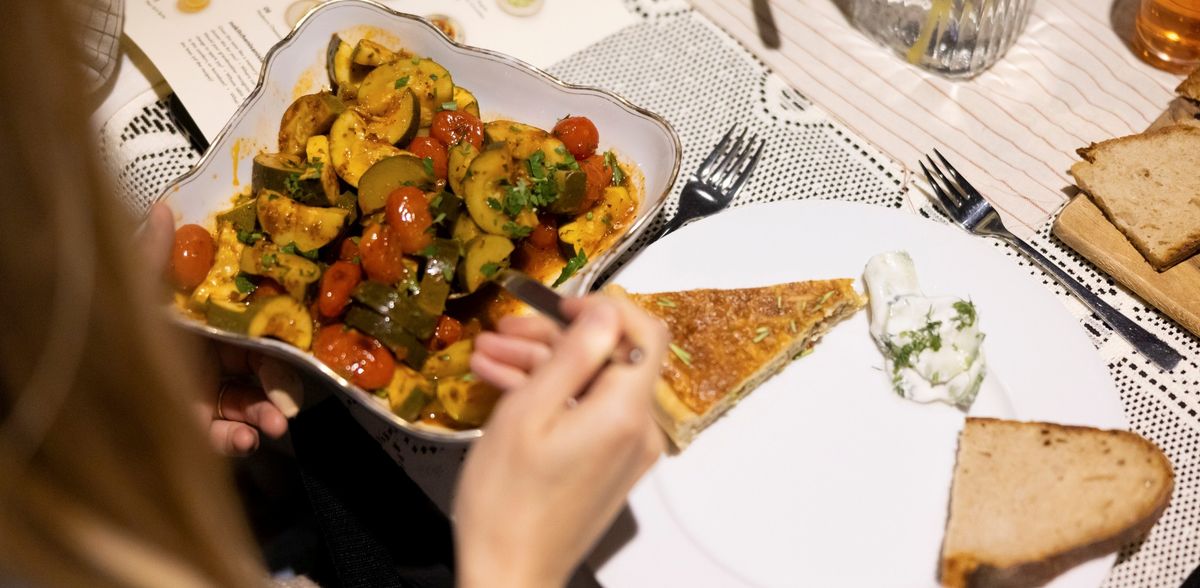
To explore this, the designer launched a citizen science project as part of a public experimental brunch during Berlin Science Week 2025 and created the website https://nokitchenisanisland.com. Dishes can be found there - from vegetable soup to shakshuka, zucchini stew, cucumber salad, cheesecake and sourdough bread. Goikhman selected them from around 50 dishes that German households have searched for most frequently online over the past five years. Alisa Goikhman: "97 percent of all clicks take place on the first Google page. If you search for a quiche recipe there, for example, you will see up to 14 different variations - the ones that the algorithms classify as 'best'. These 14 variants become a recipe on my website: it is therefore the average of all these variants. The result is a recipe that reflects what is actually prepared and eaten as a quiche in Germany."
Compromise between climate requirements and human preferences Every recipe page on https://nokitchenisanisland.com has a comments column. Users can discuss the recipes there, make suggestions for changes, express criticism and point out things that don't work. In addition to these human comments, there are AI-generated comments based on current local climate reports. The user and AI climate comments are then reported back to OpenAI, which uses these comments to create a new recipe for the respective dish. This means that the new recipe version is a compromise between climate-related requirements and human preferences. For the original version of the German cucumber salad, for example, the AI climate comment reads: "In light of the recent articles on water, soil and air quality, I would modify this recipe slightly: Use oat or soy yogurt instead of sour cream, regional cold-pressed oil and leftover apple cider vinegar. Replace imported capers and sesame seeds with pickled nasturtium seeds and pumpkin seeds from the region." While sour cream, sugar and virgin olive oil were still on the list of ingredients in the original recipe, these are missing in versions 2 and 3. For the average
kimchi, the AI comment frames the dish as a "small collaboration with microbes" and suggests replacing the fish sauce with miso and using leftover cooked rice for the fermentation mash instead of imported rice flour, of which almost a whole packet is left unused in the pantry in this country. The human commentators who had tasted the kimchi during Berlin Science Week said that they liked kimchi but had little experience with it. According to Goikhmann, this shows that small sustainable adjustments would probably not even be noticed.
What was previously hidden becomes visible On the website, visitors can observe how the recipes evolve from their average initial versions to the latest variants negotiated between humans, algorithms and nature. "We are making visible on our website what has so far been hidden, the influence of algorithms on our diet. After all, online recipes have long been products of a negotiation between humans and algorithms.
The platform investigates what form this negotiation can take and, more importantly, what it could taste like. However, this requires public participation. The https://nokitchenisanisland.com platform is therefore accessible to everyone, as the experiment only unfolds its value in contact with reality. "A recipe only takes you so far, you only really understand a dish when you cook it yourself," emphasizes Alisa Goikhman.
Her research is part of the "DINER" project, which is part of the "Education for Sustainable Nutrition and Food Science" department. The aim of the project is to develop an innovative, user-friendly and personalized recommendation system to encourage more sustainable eating habits. DINER is funded by the Federal Ministry of Food and Agriculture.
Note: This article has been translated using a computer system without human intervention. LUMITOS offers these automatic translations to present a wider range of current news. Since this article has been translated with automatic translation, it is possible that it contains errors in vocabulary, syntax or grammar. The original article in German can be found here.



Other news from the department science