Frozen Food as Fresh as If It Came Straight from the Field? EDEKA Launches Awareness Campaign
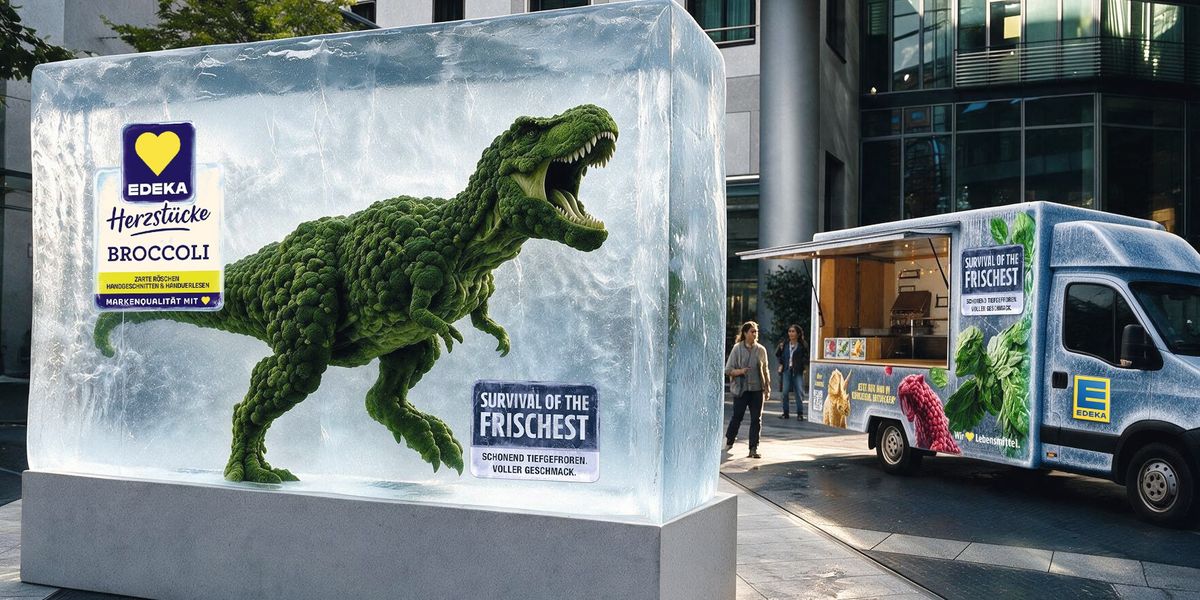
A five-meter-long ice installation at Potsdamer Platz is intended to demonstrate how flash freezing preserves freshness
Advertisement


- Campaign Shows How Frozen Foods Retain Freshness and Flavor
- Berlin Wakes Up to the Ice Age: Oversized T-Rex Installation Brings the Effect of Flash-Freezing to Life
- Twelve new packaging designs bring prehistoric motifs to the frozen food aisle
Many people still consider frozen fruits and vegetables to be less fresh or less healthy than fresh produce. With the “Survival of the Frischest” campaign, EDEKA is countering this stigma and making the topic of fruits and vegetables accessible to all generations. It shows that freshness applies to both worlds. Highlights include a spectacular T-Rex installation at Potsdamer Platz in Berlin, as well as twelve products from the EDEKA Herzstücke private label, which are now available in the frozen food aisles of EDEKA stores featuring creative prehistoric motifs.
Whether it’s a broccoli T-Rex, a mango Triceratops, or a raspberry saber-toothed tiger: With an imaginative visual world of prehistoric-looking creatures on twelve selected EDEKA Herzstücke products, “Survival of the Frischest” connects the world of fruits and vegetables with fascinating prehistoric creatures. However, the campaign addresses an important issue—because frozen foods still face a common misconception: Many consumers associate freshness primarily with unprocessed products from the produce section. Frozen fruits and vegetables, on the other hand, are often considered less natural or of lower quality. Yet it is precisely the limited shelf life of fresh produce that highlights how important practical alternatives are: fruits and vegetables are still thrown away far too often. Frozen fruits and vegetables are not the opposite of freshness, but rather another way to preserve them for longer.
For freezing, fruits and vegetables are typically flash-frozen immediately after harvest. This process creates particularly small ice crystals, ensuring that the cellular structure is largely preserved. As a result, flavor, color, texture, and many valuable nutrients are exceptionally well preserved—in other words, everything people value in fresh produce. “Survival of the Frischest” translates this effect into an accessible and imaginative campaign concept, bringing the topic of fruits and vegetables to life in an exciting way—especially for children.
T-Rex at Potsdamer Platz
From September 10 to 13, prehistoric times will come to life right in the heart of Berlin: At the venue Das Center on Potsdamer Platz (formerly the Sony Center), an installation approximately five meters long and three meters tall will be created, depicting a prehistoric creature preserved in ice. More specifically: a T-Rex made of broccoli. On site, an EDEKA food truck will also invite visitors to taste the freshness for themselves—with smoothies made from various frozen fruits and vegetables. Customers can now find additional prehistoric creatures made from fruits and vegetables nationwide in the frozen food sections of EDEKA supermarkets. The twelve promotional packages consistently carry forward the campaign’s visual theme. Together, the installation and the new packaging tell the story of freshness that lasts—united under the slogan “Survival of the Freshest.”
Note: This article has been translated using a computer system without human intervention. LUMITOS offers these automatic translations to present a wider range of current news. Since this article has been translated with automatic translation, it is possible that it contains errors in vocabulary, syntax or grammar. The original article in German can be found here.


Other news from the department business & finance