Enjoyment Amid Climate Change, Preventive Health Care, and AI
What will Germany be eating in 2040?
Advertisement


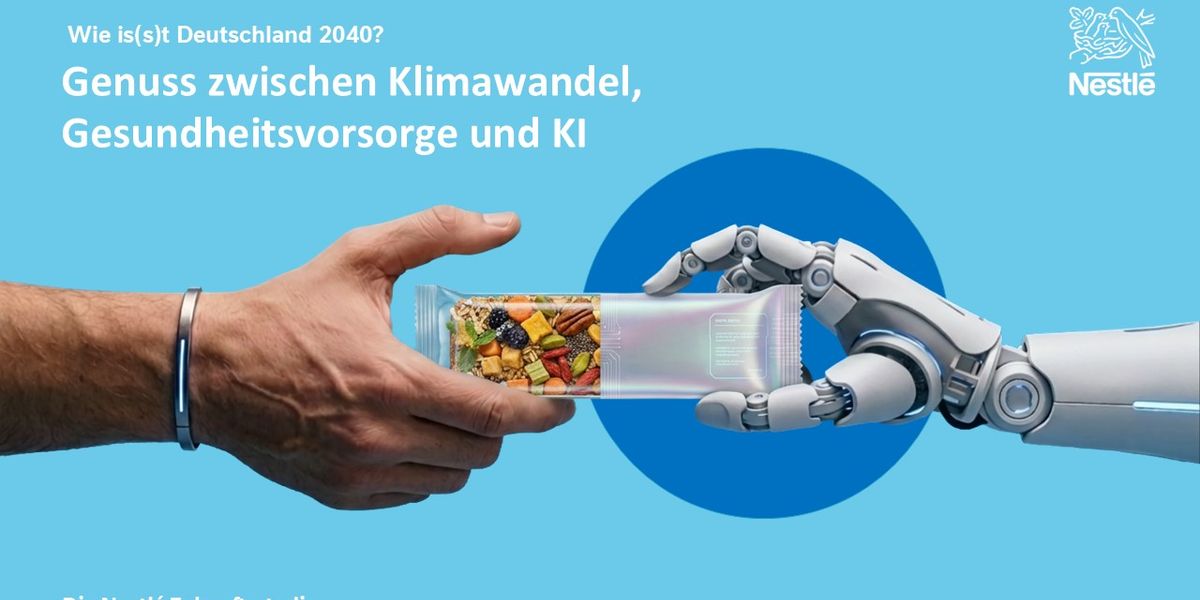
A new Nestlé Future Study shows: climate change is becoming a matter of food security, nutrition is becoming a form of personal health care, and artificial intelligence is becoming a part of everyday life. Enjoyment and community remain non-negotiable.
Climate change, preventive health care, and artificial intelligence will fundamentally transform what and how people in Germany eat in 2040. This is shown by the new Nestlé Future Study “How Will Germany Eat in 2040?” . People are pragmatically adapting to new conditions and are open to new ingredients, digital support, and more personalized nutrition solutions. At the same time, they expect more from their food than ever before. It should promote health, be readily available, and be suitable for everyday use—but above all, it should taste good, enhance quality of life, and bring people together.
The study highlights three fundamental trends: Climate change is affecting the availability, prices, and production of food. Artificial intelligence is evolving from a standalone tool into a constant companion capable of integrating nutrition, health data, shopping, and daily planning. At the same time, prevention is taking on new significance: People want to take proactive measures and consciously use their daily diet to stay healthy and productive for as long as possible.
Despite all this openness to change, one thing remains constant: enjoyment is non-negotiable. 92 percent of respondents describe food as an important source of enjoyment. 81 percent say that eating is best when shared with others. And 78 percent are convinced that food must continue to taste good in the future. It is within this context that the future of nutrition is taking shape.
Daniela Wippler, Head of Consumer and Marketplace Insights & Analytics at Nestlé Germany: “The study results make it clear: Nutrition will become more diverse, more complex, and increasingly a matter of guidance, trust, and personal responsibility. This presents challenges, but also opportunities to actively shape the future of nutrition and support people in meeting their needs.”
Alexander von Maillot, CEO of Nestlé Germany: "We want to help shape the nutrition of tomorrow so that it becomes healthier, more resilient, and better suited for everyday life, without losing what makes good food great—namely joy, pleasure, and connection. New solutions must be judged by whether they preserve taste, quality of life, and community while also addressing changing realities and needs. We are setting the course for 2040 today.
We are driving innovation, connecting people through our strong brands, and creating targeted offerings. It is crucial to recognize changes early and, together with partners, develop scalable solutions that work on a broad scale and support people in their daily lives.”
Climate Change: From a Matter of Attitude to a Supply Issue
The effects of climate change will increasingly shape the availability, prices, and production of food. People are responding pragmatically, are open to new solutions, and expect sustainable food to be, above all, affordable, available, and suitable for everyday use.
For people, climate change is shifting from an abstract future risk to a concrete factor affecting what ends up on their plates. Extreme weather, crop failures, and dwindling resources are changing which raw materials are available, how stable supply chains are, and what prices consumers must pay. 65 percent expect that climate change and crises will make food scarcer, more expensive, and more prone to supply shortages.
People are responding to this not only with concern, but with a pragmatic attitude that is open to change and innovation. 55 percent expect that people will have to adapt their eating habits to the effects of climate change and food availability. 43 percent could imagine using alternative products if traditional raw materials such as coffee, cocoa, or grains become scarce. Just as many are open to foods made from new raw materials, such as fermented proteins or algae.
This is also changing the understanding of sustainable nutrition. The focus is less on whether diet is an expression of a particular attitude. What is becoming more important is whether solutions work in everyday life and help maintain supply, quality, and affordability. 68 percent say that sustainable eating will only catch on if the corresponding options are affordable, available, and appealing. 71 percent see opportunities for new, more sustainable approaches in agriculture.
This shift is also evident when compared to the 2015 Nestlé Future Study, which looked ahead to the year 2030. At that time, sustainable eating was seen more as a moral choice and an expression of personal lifestyle. Looking ahead to 2040, this question of attitude is increasingly becoming a question of resilience: How can people continue to eat well under changing conditions? 71 percent of respondents expect a future shaped by climate change and a pragmatic approach to dealing with it.
Preventive Health Care: From Good Intentions to Daily Prevention
Health is evolving from the treatment of diseases to a matter of personal prevention. Nutrition is increasingly seen as a daily contribution and investment in a long, healthy, and productive life, while at the same time remaining easy to integrate into everyday life.
Health is increasingly becoming a matter of securing one’s personal future. People do not want to wait until symptoms become acute to treat them; rather, they want to remain healthy, productive, and mentally balanced for as long as possible. Nutrition, in this context, becomes a lever they can influence themselves on a daily basis. Eating healthily is thus no longer just a good intention, but is becoming part of long-term prevention and self-efficacy.
Already today, 67 percent say, “I should eat healthier.” 68 percent expect mental health to become even more important in the future. 44 percent believe that by 2040, many people will specifically tailor their diets to maintain physical and mental performance.
At the same time, acceptance of personalized nutrition is growing. 37 percent see it as an important tool for maintaining their own health. 78 percent view a future with a strong focus on individual prevention as progressive. Instead of general recommendations for everyone, people increasingly expect solutions that take personal needs, life stages, and available health information into account.
At the same time, preventive health care must fit into everyday life. 40 percent say they often lack the time to eat the way they would like to. 54 percent are convinced that injections or pills for weight management will be used by more people in the future. As part of their daily routine, about one-third of respondents can imagine taking advantage of preventive health screenings at health stations in retail settings. The challenge, therefore, is not to constantly formulate new requirements, but to make health-promoting decisions simpler, more understandable, and more appealing
Artificial Intelligence: From Tool to Ecosystem
Artificial intelligence is becoming an everyday companion for many people when it comes to nutrition, health, and shopping. It is accepted above all where it offers guidance and support; skepticism arises when decisions are automated and transparency or control could be lost.
According to respondents, artificial intelligence will be more deeply integrated into everyday nutrition in the future. Digital systems can analyze health data, provide recommendations, prepare or handle shopping, and help reduce food waste. Decisions are increasingly becoming invisible—prepared, suggested, or automated in the background—rather than being made by individuals themselves. The technology is thus changing its role: individual apps and digital services are evolving into a connected ecosystem for nutrition and health.
People are particularly open to AI when the benefits are concrete and clear. 46 percent support AI as a personal nutrition advisor. 42 percent would use AI in the future to analyze health data and derive recommendations from it. 34 percent already use AI today to make purchasing decisions. This acceptance is therefore based not solely on enthusiasm for technology, but on the promise of less effort, better guidance, and suggestions more closely aligned with personal needs.
At the same time, however, there is also skepticism: 40 percent fear a loss of control and being controlled by AI. 43 percent reject humanoid robots that cook independently at home. 38 percent do not want to use implanted sensors that continuously collect bodily data. People welcome assistance but want to be able to understand the basis on which recommendations are made and decide for themselves which systems they trust. Transparency, data security, and freedom of choice are therefore becoming key prerequisites. Younger people are more willing than older people to delegate decisions to reliable systems they consider trustworthy. For example, 33 percent of younger people can imagine using an AI agent for shopping, but only 17 percent of older people. The transition from assistance to delegation is thus becoming a key future trend.
Nestlé as a Shaper of the Future
Enjoyment and community as a vision for the future remain a key benchmark for 69 percent of respondents. Even in a future of nutrition shaped more by health, technology, and the impacts of climate change, taste and shared experiences must retain their place.
Based on the study’s findings, Nestlé has identified three key areas of action:
Making health and prevention part of everyday life. A focus on health should not lead to overwhelming demands. Across its entire portfolio, Nestlé is continuously working on improved recipes and clear guidance, such as serving size recommendations, additional nutritional information, and the Nutri-Score. Underlying all of this is the goal of making healthier nutrition accessible, practical for everyday use, and appealing to various target groups. In addition, Nestlé is constantly expanding its portfolio with new products and services, such as the new Maggi Airfryer Fixes and Maggi High Protein Cups. Furthermore, as part of its Nutrition & Health business, Nestlé offers, under brands such as Solgar, Vital Proteins, and Pure Encapsulations, a wide selection of protein, fiber, micronutrient, and collagen supplements—which, among other things, contribute to women’s health—as well as products tailored to specific nutritional needs. For the focus areas of Women’s Health and Longevity, there are also global research partnerships as well as the global brand Nestlé Vital as part of the “Smart Aging” program. For pets, the Purina brand also offers specialized solutions for different life stages. Strengthening resilience and supply security. As climate impacts alter the availability and prices of raw materials, resilient agriculture and stable supply chains become all the more important. Nestlé’s commitment to regenerative agriculture and social improvements in raw material cultivation is aimed precisely at this: protecting natural resources and making farms and supply chains more resilient. Globally, 20.7 percent of Nestlé’s key raw materials already come from farms that use regenerative practices. New ingredients, alternative products, and plant-based offerings can also help address the growing scarcity of raw materials and promote the transition to a more resilient and sustainable food system. Using technology where it supports people. Nestlé is working to ensure that brands, products, recipes, nutritional recommendations, and other science-based information can be accurately understood and reliably conveyed, even in an AI-driven world of information and shopping. This involves targeted strategies: clearly structured content, high-quality product data, understandable answers to consumer questions, and verifiable sources of information. In addition, Nestlé continuously measures and analyzes its visibility to optimize and further develop its activities.
About the Study
For the future-oriented study “How Will Germany Eat in 2040?” Nestlé, in collaboration with the market research agency Bonsai Research and futurist Prof. Peter Wippermann—and drawing on the expertise of 14 specialists in trend research, nutrition, health, agriculture, retail, and society, as well as creative consumers—developed five equally valid and plausible future scenarios (see appendix). These were then evaluated by 1,581 people in Germany as part of a representative online survey conducted in April 2026. In the envisioned futures, the three megatrends are expressed to varying degrees. These include a culture of enjoyable and communal eating (Enjoyment and Community), individual preventive health care (Preventive Health), pragmatic nutrition under climate pressure (Climate Realism), largely automated convenience (Seamless Convenience), and technology-supported performance optimization (Biohacking). These future scenarios may overlap and vary in relevance depending on one’s life situation and needs. The current study builds on the 2015 Nestlé Future Study, which looked at nutrition in the year 2030.
Note: This article has been translated using a computer system without human intervention. LUMITOS offers these automatic translations to present a wider range of current news. Since this article has been translated with automatic translation, it is possible that it contains errors in vocabulary, syntax or grammar. The original article in German can be found here.



Other news from the department business & finance
















Most read news






More news from our other portals























See the theme worlds for related content
Artificial intelligence (AI) for food and beverages
Artificial intelligence (AI) is optimizing the food and beverage industry through automated quality control and more accurate demand forecasting. AI plays a particularly important role in product development by analyzing taste preferences and market trends. This allows new products to be developed that are better tailored to consumer needs, increasing efficiency and customer satisfaction.

Artificial intelligence (AI) for food and beverages
Artificial intelligence (AI) is optimizing the food and beverage industry through automated quality control and more accurate demand forecasting. AI plays a particularly important role in product development by analyzing taste preferences and market trends. This allows new products to be developed that are better tailored to consumer needs, increasing efficiency and customer satisfaction.