How Agriculture Is Becoming More Resilient: New Study Highlights the Benefits of Crop Diversity in Arable Farming
Spatial field rotation with soybean integration protects farms better than crop rotation
What farming strategies can help agricultural businesses better manage yield risks caused by climate change and fluctuating prices in the agricultural product market? A study by ZALF uses model simulations to show that farms can significantly reduce their income risk by focusing on diversification—that is, adopting a wider variety of farming methods. The study examined the effects of diversified crop rotations as well as small-scale cultivation, in the form of so-called strip cropping or parceling. In addition to production risks, the study also considers the growing—but often overlooked—impact of market risks on farm income.
Agriculture is heavily dependent on the weather. Extreme weather events such as drought and heavy rain can cause farms to earn less or even incur losses. At the same time, agricultural incomes also depend on developments in the global market, such as fluctuating prices for grain or fertilizer. The study, published in the journal *Agricultural Systems*, shows that farmers who grow only a few crops face the highest risk in terms of both climate and price developments.
The study examined nine representative arable farms in eastern Germany with varying farm characteristics. The farms studied are located in the Märkisch-Oderland and Oder-Spree districts in Brandenburg. This region is one of the driest areas in Germany and is therefore particularly vulnerable to climate risks such as drought. Using a model, three different diversification strategies were compared for these farms using established cultivation methods. The diversified strategies focused on the integration of soybeans.

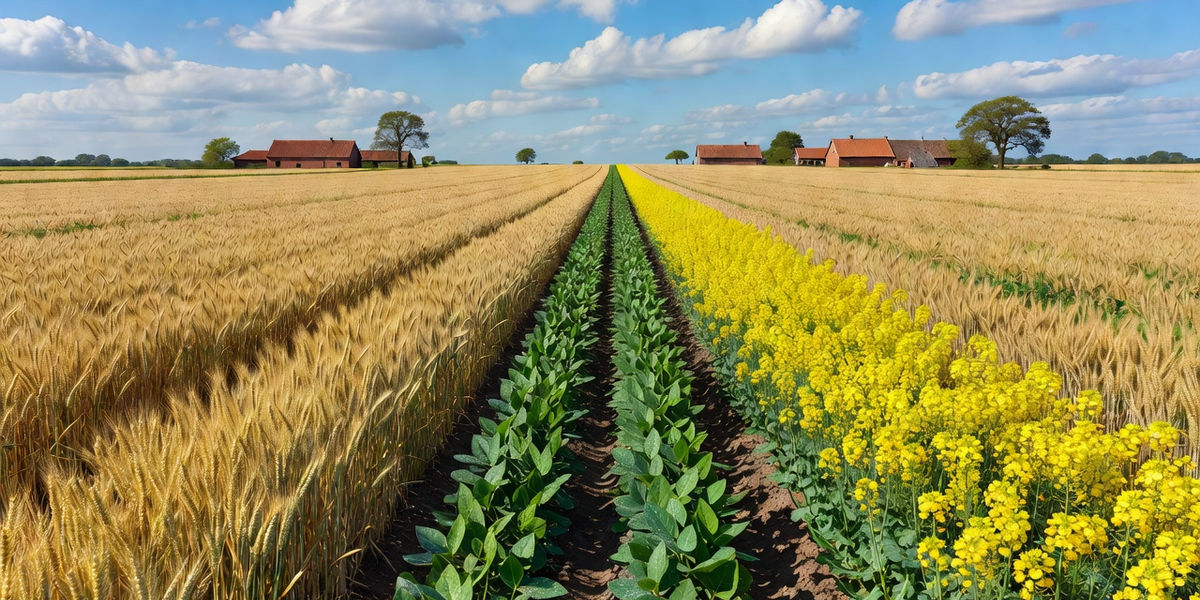
Temporal diversification in the form of varied crop rotations—that is, growing different crops over several years—parceling: dividing fields into smaller subplots and growing different crops, and strip cropping: dividing fields into 12-meter-wide strips planted with different crops, where multiple crops in a crop rotation grow side by side.
The width of the strips in strip cropping is based on the typical working width of many agricultural machines. This means the farm does not need to purchase additional equipment.
These three diversification strategies were compared with narrow crop rotations consisting primarily of grains, canola, and silage corn. In contrast to the diversified methods, these cropping systems did not include legumes, such as soybeans.
The result: Risks are better distributed under diversified farming methods. If one crop grows poorly, other crops can compensate for this.
Strip cropping offers great opportunities but also presents challenges
Diversification consistently reduces economic risk compared to narrow crop rotations and monocultures, with the division into subplots and strip cropping showing greater effects than temporal diversification. In particular, dividing fields into smaller plots significantly reduced risk—in some cases by more than 200 euros per hectare, measured in terms of potential losses during difficult years. At the same time, expected income remained stable.
Strip cropping reduced economic risk but, unlike subdivision, was associated with income losses. It requires more labor and is therefore not economically viable on all land, as machinery cannot work as quickly and must turn more frequently. This results in more field margins that can be used less efficiently. At the same time, however, ecological benefits were evident, such as the promotion of biodiversity.
The study therefore tested a novel subsidy in its model calculations—one that does not yet exist in this form. The area-based subsidies from the current CAP 2023 were replaced by a model payment to farms, the amount of which is calculated based on the length of field margins. The goal is thus to promote smaller field structures. The payment could be funded by EU resources and would be cost-neutral for the national budget. With a subsidy of 1.50 euros per 100 meters of field edge length, incomes from strip cropping were kept stable for all farms, while the economic risk decreased significantly
“Our results show that spatial diversity within the field—that is, the simultaneous planting of different crops—is an effective means of mitigating climate risks, as each crop reacts differently to drought or heat. This is also a strategy against market risks: if the price of wheat were to fall, a farm using diversified cultivation methods could better offset this and generate the necessary income from the soybean harvest, for example. It is important to create a policy framework that promotes such farming practices,” says ZALF researcher Dr. Hannah v. Czettritz, the study’s lead author.
Why the findings are important for society
The study makes it clear that agriculture must rely more heavily on diversity in the future. By 2050, more food will be needed due to global population growth. At the same time, climate risks and geopolitical uncertainties are increasing. Strategies such as growing a diverse range of crops can help maintain stable harvests and ensure food security.
What is new about this study is that, in addition to climate-related crop failures, it also takes into account price fluctuations for agricultural products in the market. The researchers used the bioeconomic farm model MODAM (Multi-Objective Decision Support Tool for Agro-ecosystem Management). This computer model integrates yield fluctuations of the crops grown as well as simulations of market fluctuations in crop and fertilizer prices. For the study, various combinations of weather, prices, and cropping systems were analyzed over a 30-year period.
However, the researchers also point out limitations. For example, the model does not account for extreme weather events or the distribution of additional labor requirements throughout the year. Furthermore, the study did not include other land uses, such as livestock farming or biogas production, in the modeling.
The results show that policy measures play an important role. Support programs, such as the premium tested in the study as an incentive for smaller field units, could help farmers implement new farming systems. In the long term, more diverse cropping systems could not only reduce income risks for farms but also strengthen the environment and biodiversity. At the same time, further studies are needed to clarify practical issues, such as costs, labor requirements, and technical solutions, including automated machinery.
Note: This article has been translated using a computer system without human intervention. LUMITOS offers these automatic translations to present a wider range of current news. Since this article has been translated with automatic translation, it is possible that it contains errors in vocabulary, syntax or grammar. The original article in German can be found here.
Original publication
Other news from the department science