Germany's appetite for fish is growing
Salmon tops the popularity list. Discount stores account for just under half of all fish purchases.
Advertisement


13.9 kilograms—that’s how much fish and seafood Germans consumed at home and on the go in 2025. The Fish Information Center (FIZ) in Hamburg has now released the latest market data for 2025.
In 2025, per capita consumption of fish and seafood rose from 12.3 kilograms (in 2024) to 13.9 kilograms. This represents a 13 percent increase compared to 2024. “Fish is consumed in all situations. The rising consumption figures underscore that fish has a firm place not only in food retail and at-home consumption but also when eating out—in restaurants, bistros, and cafeterias. This makes fish a valuable component of a varied diet,” says Julia Steinberg-Böthig, PR and Communications Officer at FIZ.
Salmon Remains the Top Choice
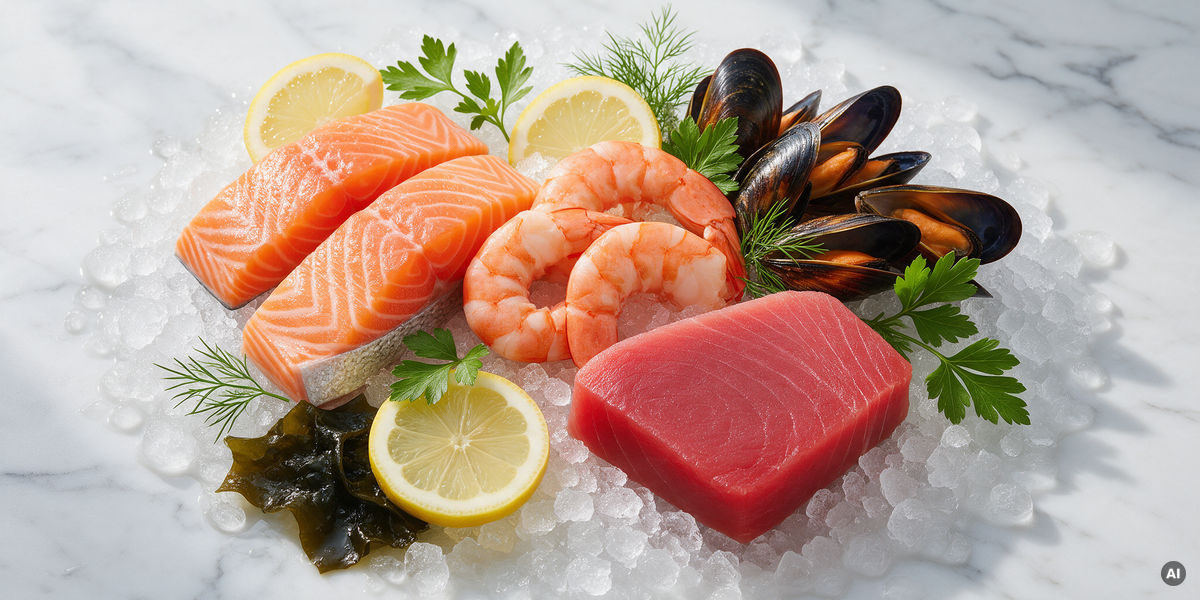
The picture is familiar when it comes to the most popular types of fish: Salmon leads with 19.2 percent, followed by Alaska pollock with 18.5 percent. Next come tuna at 13.9 percent, herring at 9.7 percent, and shrimp at 9.3 percent. This ranking aligns with the preferred product forms: Salmon and Alaska pollock are major species in the frozen segment, tuna dominates the canned fish market, and herring is frequently found in marinated products and deli salads. The most popular species thus also reflect the forms in which fish is most commonly purchased.
Fish is simply part of the shopping cart
A look at shopping locations also shows that fish has a firm place in the shopping cart, particularly during everyday shopping at discount stores and supermarkets. 89 percent of fish purchases by private households are made at traditional food retailers—discounters, full-range retailers, and self-service department stores. The role of discounters is particularly pronounced: 49 percent of the total volume of fish purchased goes through their checkout lanes. Full-range retailers account for 26 percent, and self-service hypermarkets for 14 percent. Specialty fish retailers account for 4 percent in terms of volume.
The various shopping venues have different strengths. In the grocery sector, availability and convenience for everyday shopping are the top priorities. In specialty fish stores, on the other hand, the focus is more on expert advice, freshness, selection, and premium quality. “Today, fish is available where people shop for groceries anyway. This lowers the barrier to purchase and makes fish a hassle-free part of the weekly shopping trip,” says Steinberg-Böthig.
Fish Is Not the Price Driver
Price also plays a role in shopping decisions. Fish, fish products, and seafood have become more expensive in recent years. Compared to the general trend in food prices, however, the increase has been more moderate. After significant price increases in 2022 and 2023, the fish price index remained largely stable in 2024 and 2025. In 2025, it stood at 130.2 points (2020 = 100), while the overall food price index reached 135.9 points. In the first half of 2026, the fish price index rose to 133.3 points, continuing to rise at a slower rate than the food index, which stood at 137.7 points. Although fish has thus become more expensive, it is not among the products that have driven the general rise in food prices.
The North Leads—But Not Everywhere
Household purchases in Germany remained close to the previous year’s level, averaging 5.1 kilograms of product weight per capita (5.4 kilograms, a 5.8 percent decrease). There is a clear north-south divide: Households in Bremen and Hamburg consumed 21.5 percent more fish and seafood than the national average (100 percent). The Saarland is 22.6 percent below the national average, placing it last in a comparison of German states.
Fish Is Part of Everyday Life
The latest market data shows that fish and seafood are firmly established as part of everyday dining in Germany. The rise in consumption, the wide variety of product forms, and broad availability in food retail show that for many people, fish is a natural part of their shopping and meals. Salmon remains the most popular type of fish, while different product forms and shopping locations cater to various needs.
At the same time, a look at prices and regions reveals that fish consumption is not developing at the same rate everywhere. Fish has become more expensive, but recently its price has risen less sharply than that of food overall. And while Bremen and Hamburg lead in per capita consumption, Mecklenburg-Western Pomerania shows that proximity to the sea alone does not guarantee high fish consumption.
The bottom line is that fish remains versatile, readily available, and relevant to consumers.
Note: This article has been translated using a computer system without human intervention. LUMITOS offers these automatic translations to present a wider range of current news. Since this article has been translated with automatic translation, it is possible that it contains errors in vocabulary, syntax or grammar. The original article in German can be found here.



Other news from the department business & finance