A Historical Collapse of Fisheries as a Lesson for the Present
The Öresund Collapse in the 16th Century: Climate Change, Overfishing, and Society All Played a Role
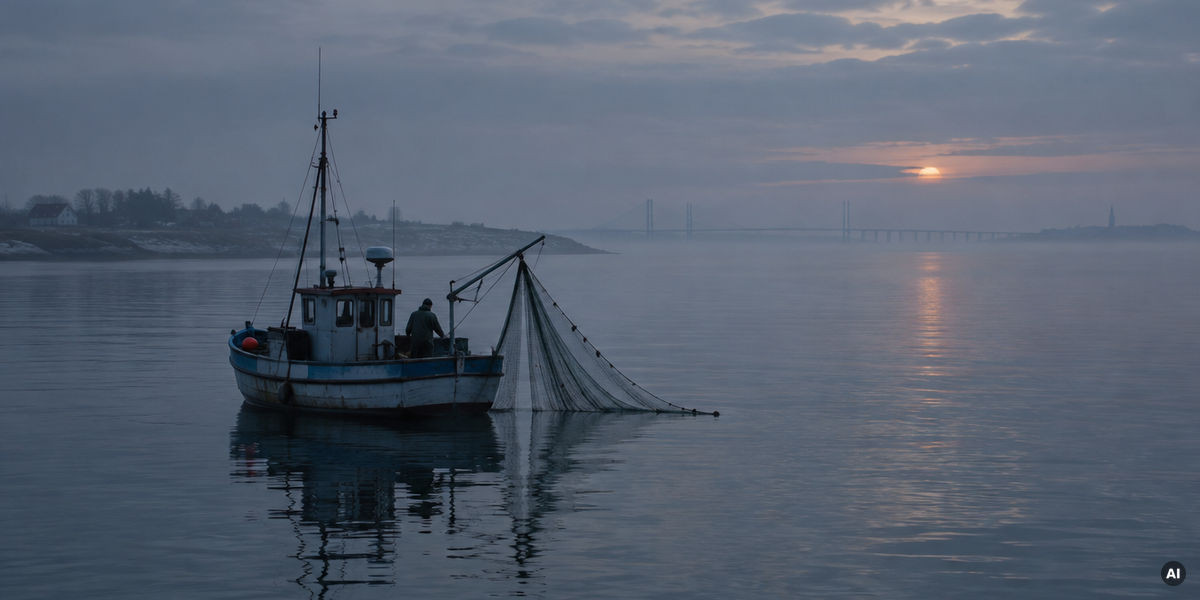
A new study—published in the journal *Nature Sustainability* and led by Kiel University (CAU) and the German Center for Integrative Biodiversity Research (iDiv)—shows that the collapse of the fishing industry in the Öresund in the 16th century cannot be explained by a simple stock collapse. Rather, it was the interplay of multiple factors—including climate change, overfishing, and societal changes—that led to the sudden end of the once-abundant herring fishery in the Baltic Sea. The findings have implications for today’s fisheries policy.
From the 13th to the 16th century, herring from the Öresund—the strait in the Baltic Sea between Denmark and Sweden—was one of Northern Europe’s most important commodities. Salted herring from the so-called Skanör-Falsterbo fishery fed large parts of Europe. Around the year 1570, however, this fishery collapsed within a short period of time—with far-reaching consequences for trade, politics, and society. It took nearly 400 years before comparable catch levels could be achieved again in the 1950s. An international team of fisheries economists, ecologists, and historians, led by Kiel University (CAU) and the German Center for Integrative Biodiversity Research (iDiv), has now investigated why this fishery—which had been stable for centuries—collapsed so suddenly. The results show that the collapse of the fishery cannot be explained by a simple stock collapse. Although the herring stock itself shrank significantly in the 16th century, it did not collapse entirely. It was only the combined effect of several factors—including environmental change, overfishing, and societal changes—that led to the sudden end of the prosperous fishery. The new study was published on September 28 in the journal *Nature Sustainability*.
“Only when climate, ecology, and socioeconomic conditions are considered together does a coherent picture of this historical collapse emerge. None of these factors alone would have brought the fishery to a halt. It is their interaction that explains the dynamics,” says lead author Dr. Rudi Voss, a fisheries economist at iDiv and at the Center for Ocean and Society (CeOS) within the CAU’s Kiel Marine Science (KMS) research cluster.

An Extraordinary Time Series: 450 Years of Fishing History
The study is based on a unique dataset comprising a 450-year time series of herring catches in the Öresund from 1200 to 1650. It was reconstructed from fragmentary historical sources, including customs records, royal preemptive rights (“kongekøb”), and other archival records documenting trade volumes for specific years and locations. Gaps in the data were filled using economic and ecological indicators, such as the availability of salt—the most important production factor in the herring industry at the time—and reconstructed climate data. This provides researchers with a fisheries dataset that extends far beyond the usual modern time series, which typically cover only a few decades. This has enabled them to examine dynamics related to climate change, economic crises, and overfishing across decades and centuries and to determine how these factors reinforce one another.
Interplay Rather Than a Single Cause
To reconstruct the dynamics of the fishery, the team combined two methodological approaches: a newly developed bio-economic stock assessment (BESA), which uses historical catch and price data to estimate both sustainable catch levels and the state of the herring stock over time, and a so-called loop analysis —a method from ecology that allows complex interactions between ecological, economic, and social factors to be modeled within a single framework without requiring all variables to be precisely quantified. The details reveal that overfishing had already weakened the stock and increased fishing costs. At the same time, the “Little Ice Age” brought about a cooling phase in the Baltic Sea region, which affected the stock’s productivity and further depleted it. At the same time, social and economic conditions deteriorated. Shifting sand dunes destroyed the infrastructure of the fishing grounds, a newly introduced mandatory plaice quota diverted labor away from the fishing industry, and inexpensive herring from the burgeoning North Sea fishery drove Baltic Sea herring out of the market.
A Lesson for Today’s Fisheries Management
According to the authors, the interdisciplinary approach—the close integration of fisheries economics, climate research, ecology, and economic history—not only yields new historical insights but also allows these insights to be directly applied to contemporary fisheries policy. Anyone who seeks to assess the state of a fishery based solely on biological stock data may overlook critical risk factors. The herring in the western Baltic Sea is currently outside safe biological limits and on the brink of collapse. A zero-catch recommendation is already in effect for this stock. Here, too, comparable factors are at play in the fishery: overfishing, unfavorable environmental conditions, and economic constraints. Although the focus today is on a different biological stock, what both have in common is that, in addition to fishing, environmental conditions are also hindering the recovery of the herring stock. Instead of a cooling trend during the “Little Ice Age,” the warming of the Baltic Sea due to climate change now poses an additional burden.
The study thus supports the approach of ecosystem-based fisheries management, which takes both ecological and socio-economic factors into account—such as infrastructure, economic diversification, and the social situation of fishing communities. “A look back at history clearly shows that sustainable fishing can only succeed if we take social and economic conditions just as seriously as the state of the stock itself. That is the lesson from 450 years of herring fishing in the Öresund—and it is just as relevant today as it was then,” concludes fisheries biologist Rudi Voss.
Note: This article has been translated using a computer system without human intervention. LUMITOS offers these automatic translations to present a wider range of current news. Since this article has been translated with automatic translation, it is possible that it contains errors in vocabulary, syntax or grammar. The original article in German can be found here.
Original publication
Other news from the department science