FEI Research Report: University of Hohenheim Once Again Leads in Food Research
21 percent of all ongoing FEI projects are based in Hohenheim. The Technical University of Munich ranks second with 33 projects
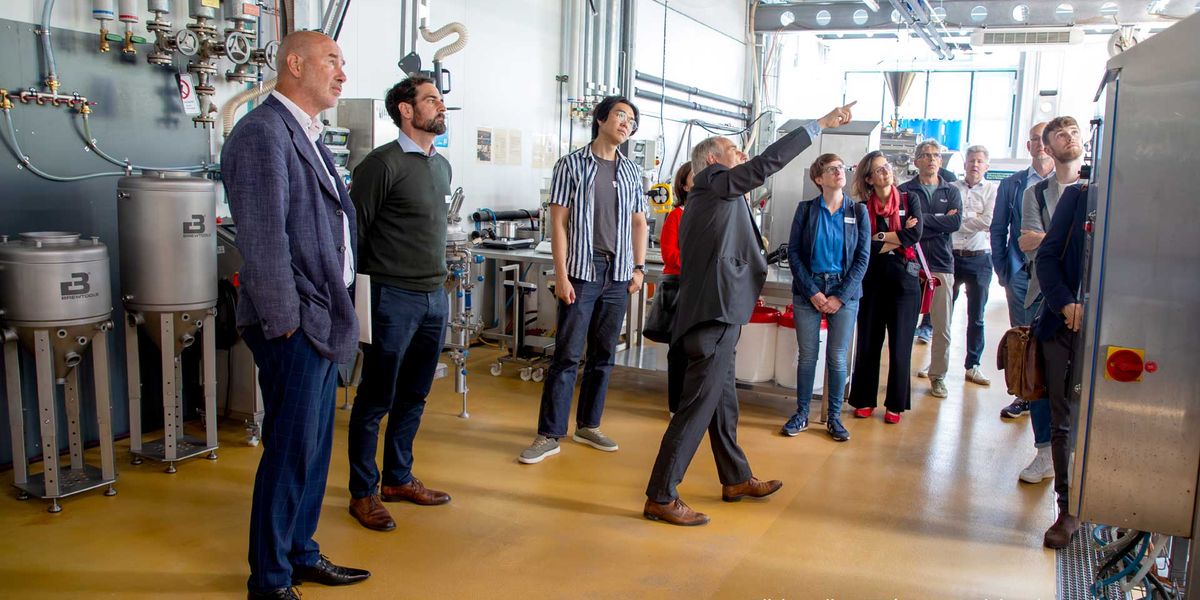
The University of Hohenheim ranks first in food research in Germany. According to the FEI research funding report, 41 out of 195 (sub)projects are based there
The University of Hohenheim remains the leading center for food research in Germany. The FEI (Research Association of the Food Industry)’s funding report for 2025 shows that the University of Hohenheim received more funding than any other participating research institution. In total, the University of Hohenheim accounts for 21 percent of all ongoing (sub)projects, with funding totaling nearly 10 million euros. The FEI’s annual conference took place from September 8 to 10, 2026, at the University of Hohenheim in Stuttgart.
To drive innovation and the transfer of research findings into practice through collaborative projects, the Food Industry Research Association funded a total of 41 (sub)projects at the University of Hohenheim in 2025, with a total funding amount of 9.57 million euros. In second place is the Technical University of Munich, with 33 ongoing (sub)projects and 8.12 million euros in funding.

University of Hohenheim in the FEI Network
The University of Hohenheim’s special role in the FEI network is also evident at the institutional level. This year’s annual conference took place in Hohenheim in September. As a result, this leading research center also served as the host for the central gathering of academia and the food industry within the FEI network.
In addition, there is a notable personnel development: Since September 2025, Prof. Dr.-Ing. Jörg Hinrichs of the University of Hohenheim has headed the FEI’s Scientific Advisory Board. Hinrichs has been a member of the committee since 2002 and served as its vice chair from 2005 to 2025. At the University of Hohenheim, he heads the Department of Dairy Science and Technology at the Institute of Food Science and Biotechnology, as well as the research and teaching dairy and a technology transfer center. His work exemplifies the broad spectrum of research that the University of Hohenheim covers in the field of food science.
University of Hohenheim Impresses with Broad Research Spectrum
At the University of Hohenheim, the Institute of Food Science and Biotechnology brings together a diverse range of research approaches related to food production and processing. The focus is on the sustainable use of agricultural raw materials and their processing into foods that meet high quality and safety standards. Among other things, the institute investigates the interactions between molecules, microorganisms, enzymes, and technological and biotechnological processes.
Various current projects at the institute demonstrate just how broad this field of research is. For example, a joint research project between the University of Hohenheim and the German Institute of Food Technology (DIL) is investigating crystal formation in raw ham. The researchers are investigating which factors influence crystal formation during drying, aging, and storage, and how undesirable precipitation can be prevented. The goal is to develop practical strategies that manufacturers can use to ensure product quality and avoid customer complaints. https://www.fei- bonn.de/gefoerderte-projekte/projekte-des-monats/pdm-2025-07
Another research project is investigating how artificial intelligence can help reduce food waste. To this end, digital process models of food production facilities are being developed and integrated with artificial intelligence methods. The goal is to detect critical process conditions and potential quality deviations as early as during processing. This will help reduce defective batches and food loss, conserve energy and water, and bring new products into production more quickly and in a more resource-efficient manner. https://www.fei-bonn.de/gefoerderte-projekts/projektdatenbank/01if22840n.projekt
Another example is a joint research project between the University of Hohenheim and KU Leuven on plant-based alternatives to meat and dairy products. The project focuses on how fermentation can be used to naturally produce vitamin B12, thereby improving the nutritional profile of plant-based products. In their work, the researchers are examining, among other things, fermentation conditions, starter cultures, and the composition of plant-based foods. https://www.fei- bonn.de/gefoerderte-projekte/projekte-des-monats/pdm-2026-03
Award-Winning Food Research
Prof. Dr. Reinhard Kohlus also conducts applied research through his work on drying, spray drying, agglomeration, and the diverse properties of powders—research areas of direct relevance to dairy processing companies. In 2025, he was awarded the “Dr. Gisela Runge Prize,” the Dairy Science Innovation Award. The German Dairy Industry Association (Milchindustrie-Verband e.V.) recognized his outstanding scientific achievements with this award. The prize comes with a cash award of 10,000 euros.
Note: This article has been translated using a computer system without human intervention. LUMITOS offers these automatic translations to present a wider range of current news. Since this article has been translated with automatic translation, it is possible that it contains errors in vocabulary, syntax or grammar. The original article in German can be found here.

Other news from the department science








Most read news







More news from our other portals
























See the theme worlds for related content
Topic world Food safety
Food safety is at the heart of the food and beverage industry. It ensures that the food we eat every day is not only nutritious, but also free of harmful contaminants. From field to plate, the industry monitors and regulates every step of the process with strict quality controls, advanced testing methods and continuous research.

Topic world Food safety
Food safety is at the heart of the food and beverage industry. It ensures that the food we eat every day is not only nutritious, but also free of harmful contaminants. From field to plate, the industry monitors and regulates every step of the process with strict quality controls, advanced testing methods and continuous research.
Artificial intelligence (AI) for food and beverages
Artificial intelligence (AI) is optimizing the food and beverage industry through automated quality control and more accurate demand forecasting. AI plays a particularly important role in product development by analyzing taste preferences and market trends. This allows new products to be developed that are better tailored to consumer needs, increasing efficiency and customer satisfaction.

Artificial intelligence (AI) for food and beverages
Artificial intelligence (AI) is optimizing the food and beverage industry through automated quality control and more accurate demand forecasting. AI plays a particularly important role in product development by analyzing taste preferences and market trends. This allows new products to be developed that are better tailored to consumer needs, increasing efficiency and customer satisfaction.