Germany is the gateway to the EU coffee market: One out of every three metric tons comes through Hamburg
34.4 percent of all EU coffee imports pass through Germany. The industry accounts for 70.2 billion euros in economic output.
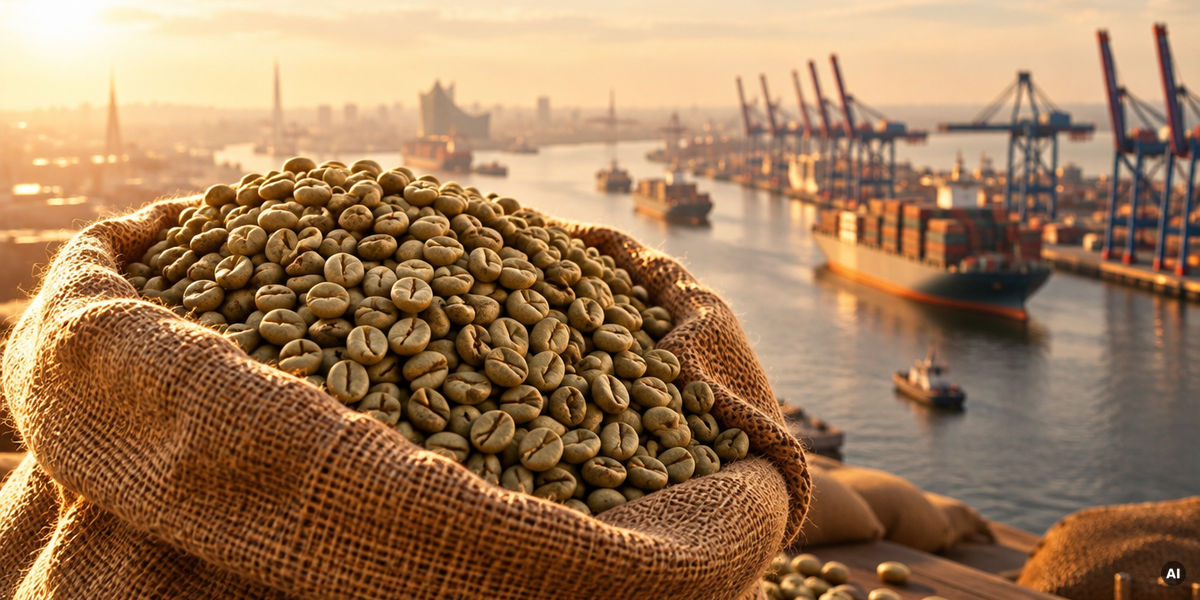
The coffee industry accounts for 70.2 billion euros in economic output and supports more than 500,000 jobs
Germany is a coffee-loving country. 34.4 percent of coffee imports from countries outside the EU enter the EU customs territory via Germany. In 2025, this amounted to approximately 1.01 million metric tons of coffee.
At the same time, the coffee industry in Germany—including its suppliers and service providers—accounts for a total economic output of 70.2 billion euros and approximately 517,000 jobs. This is shown by the study “Economic Impact of Coffee in Europe,” which Europe Economics conducted on behalf of the European coffee industry.
The German Coffee Association is publishing the results on the occasion of “Coffee Day” on October 1.
Germany as the Hub of the European Coffee Industry
Coffee is imported, traded, processed, transported, sold, and prepared in Germany. Part of the imported volume is re-exported after processing, while the rest is consumed in Germany.
As a result, Germany serves as a hub connecting key sectors of the European coffee industry: from the green coffee trade and imports through roasting, the production of instant coffee, decaffeination, packaging, and logistics to sales and serving.
Germany also holds a leading position in processing. According to a study, approximately 517,000 metric tons of roasted coffee were produced in the country. This accounted for 27.3% of total European roasted coffee production.
Germany also plays a special role in decaffeination. The world’s two largest coffee decaffeination plants are located in Bremen.
70.2 billion euros in economic output
The direct economic output of the coffee industry in Germany amounts to 36.6 billion euros. This figure includes imports, trade, and processing, as well as the sale, preparation, and serving of coffee.
The out-of-home market is of considerable importance. For example, when coffee is prepared and served in cafés, restaurants, hotels, bakeries, or at the workplace, revenue is generated from preparation, service, and hospitality in addition to the value of the coffee itself. These services are factored into the calculation based on their proportion of the coffee’s value.
An additional 33.6 billion euros in economic output is generated by equipment suppliers and service providers. These include, among others, manufacturers of coffee machines, roasting and processing equipment, as well as companies in the fields of packaging, transportation, logistics, maintenance, and other services.
Holger Preibisch, CEO of the German Coffee Association, explains:
“Millions of people get their daily energy boost from enjoying a cup of coffee. What many people don’t realize is that every single cup also represents enormous economic power. Germany is the driving force behind the European coffee industry—from importing and roasting to decaffeination and preparation. Coffee is a cornerstone of our economy.”
Key figures at a glance
- 34.4% of coffee imports from countries outside the EU enter the EU customs territory via Germany.
- 1.01 million metric tons of coffee entered the EU via Germany in 2025.
- 517,000 metric tons of roasted coffee were produced in Germany.
- Germany accounted for 27.3% of European roasted coffee production.
- 36.6 billion EUR in direct economic output from the coffee industry
- 33.6 billion EUR in economic output from suppliers and service providers
- 70.2 billion EUR in total economic output (direct + indirect)
- 517,000 jobs in total (direct + indirect)
Source: “Economic Impact of Coffee in Europe,” prepared by Europe Economics on behalf of the European Coffee Federation, 2026.
Note: This article has been translated using a computer system without human intervention. LUMITOS offers these automatic translations to present a wider range of current news. Since this article has been translated with automatic translation, it is possible that it contains errors in vocabulary, syntax or grammar. The original article in German can be found here.
Other news from the department business & finance