Research update: Plant-based calamari that rivals real seafood in texture
Plant-based seafood alternatives should have similar flavors, textures and nutritional content to the foods they mimic. And recreating the properties of fried calamari rings, which have a neutral flavor and a firm, chewy texture after being cooked, has been a challenge. Building off previous research, a team publishing in ACS Food Science & Technology describes successfully using plant-based ingredients to mimic calamari that matches the real seafood’s characteristic softness and elasticity.
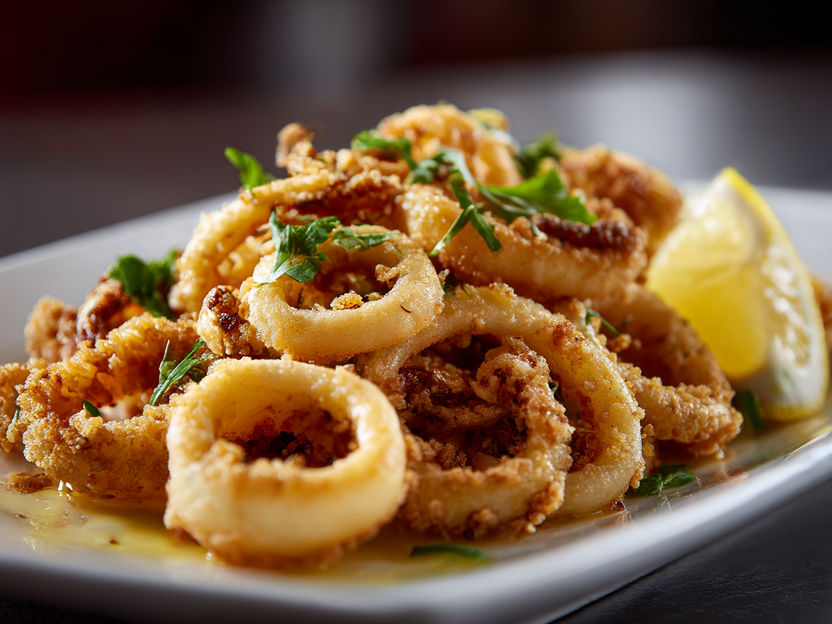
symbolic picture
computer generated pciture
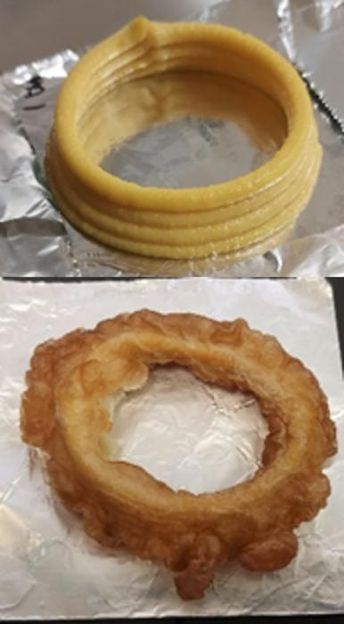
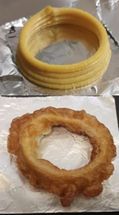
After this 3D-printed calamari mimic (top image) is battered and deep-fried (bottom image), its look and texture is like squid rings cooked the same way.
Adapted from ACS Food Science & Technology 2025, DOI: 10.1021/acsfoodscitech.4c00852
Previously, Poornima Vijayan, Dejian Huang and colleagues presented air-fried vegan calamari rings made from a 3D-printed paste of microalgae and mung bean proteins at ACS Fall 2023, a meeting of the American Chemical Society. When the researchers air-fried the calamari mimic (demonstrated in this short video), it had an acceptable taste, but they noted that the texture wasn’t ideal. So, now they’ve optimized the recipe and printing parameters, improving the plant-based product’s texture so that it’s more like real calamari when battered and deep-fried — the way most calamari is prepared.
The researchers tested multiple versions of their printable paste recipe, varying the amounts of mung bean protein isolate, powdered light-yellow microalgae, gellan gum (thickener) and canola oil (fat). A food-grade 3D printer deposited the pastes into layered rings about 1.8 inches wide (4.5 centimeters). Unlike the original research, this time the researchers froze the rings overnight and then battered and quickly deep-fried them.
In lab tests, the researchers analyzed properties related to the cooked samples’ chewiness, including hardness, springiness and cohesiveness. The deep-fried product with the textural properties closest to real calamari contained 1.5% gellan gum, 2% canola oil and 10% powdered microalgae. From microscope images, the researchers saw that small voids in the structure of these plant-based samples modified their softness, so they resembled the real seafood counterpart. Additionally, an analysis of the protein content in the optimal recipe found that the plant-based version could have more protein (19%) than the reported protein composition of squid (14%).
“This research showcases the potential of 3D printing to transform sustainable plant proteins like mung bean and microalgae into seafood analogs with comparable texture,” says Vijayan, the study’s lead author. “Our next steps involve understanding consumer acceptance and scaling formulation for broader applications.”
The authors acknowledge funding from the National University of Singapore and the Commonwealth Research Scholarship. This research is supported by the National Research Foundation, Prime Minister’s Office, Singapore under its Campus for Research Excellence and Technological Enterprise (CREATE) programme. CREATE is an international collaboratory housing research centres set up by top universities. At CREATE, researchers from diverse disciplines and backgrounds work closely together to perform cutting-edge research in strategic areas of interest, for translation into practical applications leading to positive economic and societal outcomes for Singapore. The interdisciplinary research centres at CREATE focus on four areas of interdisciplinary thematic areas of research, namely human systems, energy systems, environmental systems and urban systems. More information on the CREATE programme can be obtained from www.create.edu.sg.
Original publication
Other news from the department business & finance